
I am grateful to have received the 2025 Molonglo Plains ArtsNational Student Conservator of the Year Award. This recognition feels like the cherry on top of what has been an excellent year of postgraduate study at the University of Canberra, and it has helped confirm that I’m on the right path.
I first discovered heritage materials conservation whilst completing two consecutive internships at the National Museum of New Zealand Te Papa Tongarewa – first within the Natural History department, and then in Pacific Cultures. I was drawn in by the way the field was a blend of my favourite subjects – art, science and history. Additionally, I was intrigued by the conservation labs. Workbenches were lit by glowing magnifying lamps, shelves were neatly filled with colourful pigments, shiny tools, solvents, and safety equipment, and objects as small as a coin and as large as a grand piano were being examined and worked upon. It was there that I saw how conservation requires patience, precision, careful decision making and respect in order to stabilise, preserve, and care for heritage materials.
As someone who also loves the finer details, thorough documentation and hands-on craftsmanship, I knew I wanted to learn more. I crossed the Tasman Sea and enrolled at UC, where I was able to explore conservation in depth, learning about ideal environmental conditions, the cultural significance of patina, and the structure, integrity, aesthetics and stability of objects that we value.
There are three objects that I enjoyed examining, studying, treating and creating custom storage for. The first was a soft, culturally patterned Fijian masi kesa (bark cloth). To improve the aesthetics, I trialled and refined the preparation of gellan gum, based on Anne F Maheux’s 2015 paper, and used it to gently solubilise, lift and reduce staining while being mindful of the sensitive nature of the organic plant fibres.
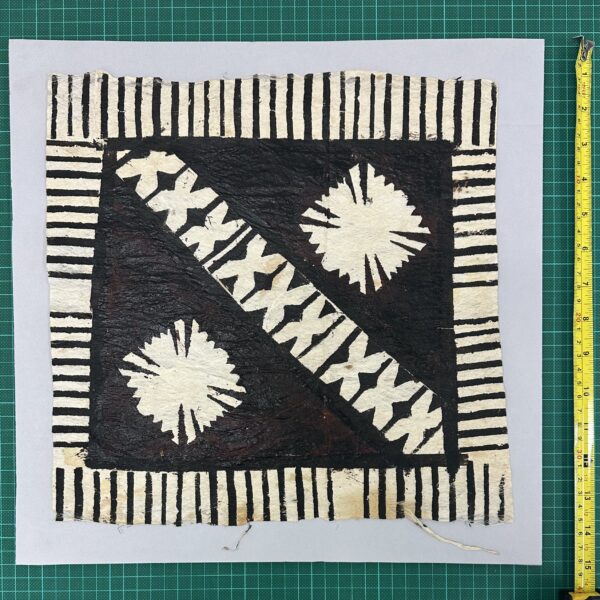
Fijian masi kesa after treatment. Image credit: Melanie Ioane-Warren, 2025.
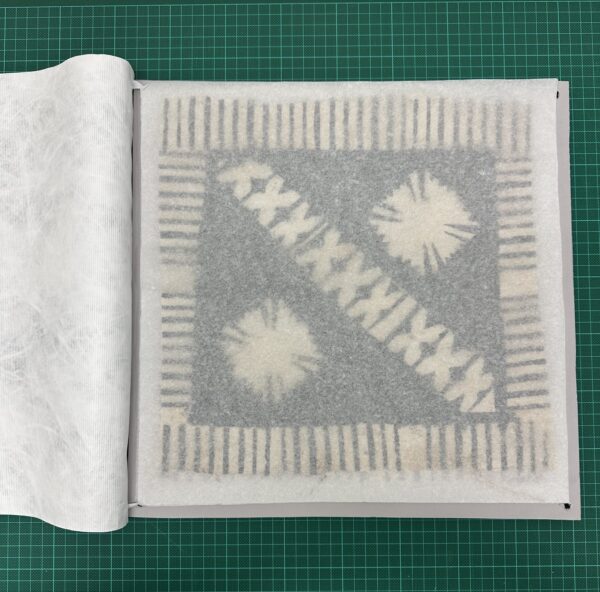
Fijian masi kesa within custom-made storage. Image credit: Melanie Ioane-Warren, 2025
The second project involved a delicate, floral-shaped, finely hand-woven placemat with areas of loss. I created a custom dyed thread to closely match the colour of the original fibres. This thread was then used to attach a supportive backing and to infill areas of loss using couching stitches. The treatment was successful in adding structural support and only being visible upon close inspection.
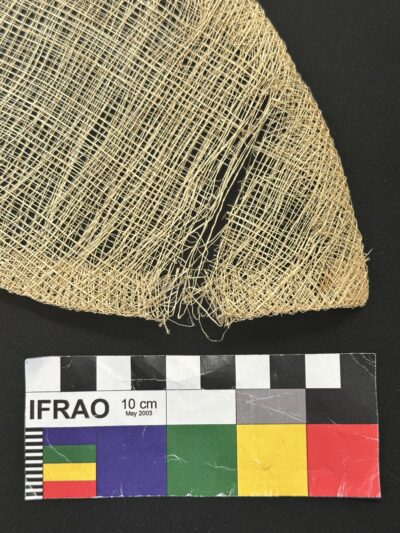
Broken plant fibres in the hand-woven placemat. Image credit: Melanie Ioane-Warren, 2025.
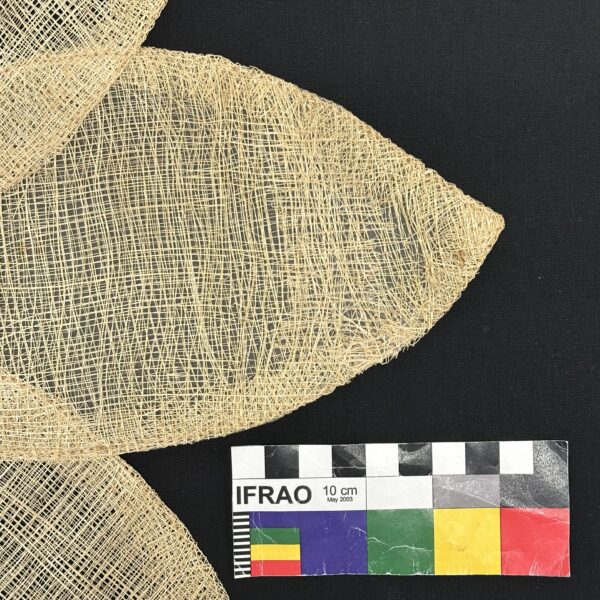
Hand-woven placemat after treatment. Image credit: Melanie Ioane-Warren, 2025.
The third project focused on a unique, terracotta and fire-hued Fijian saqa niwai (water vessel). I performed a series of treatments to improve both its readability and aesthetics. These included reattaching the handle and creating missing decorative elements, which required careful infilling, colour matching and painting to ensure the additions blended seamlessly with the original material. Overall, I was pleased with how the treatments enhanced the clarity and stability, with all additions remaining reversible.
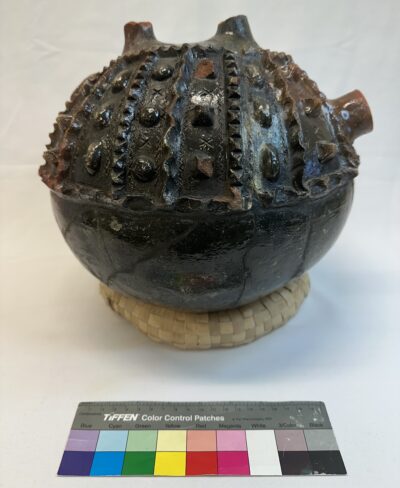
Fijian saqa niwai before treatment. Image credit: Melanie Ioane-Warren, 2025.
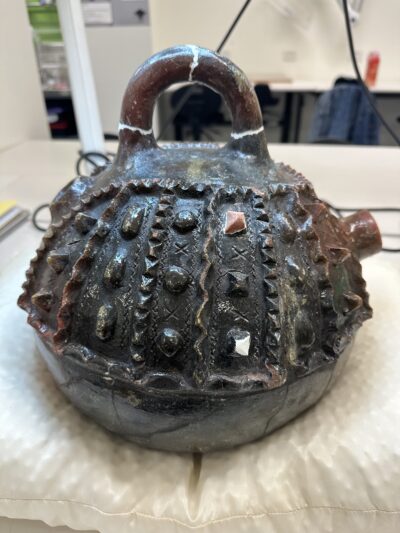
Fijian saqa niwai during treatment – handle and recreated decorative elements are attached. Image credit: Melanie Ioane-Warren, 2025.
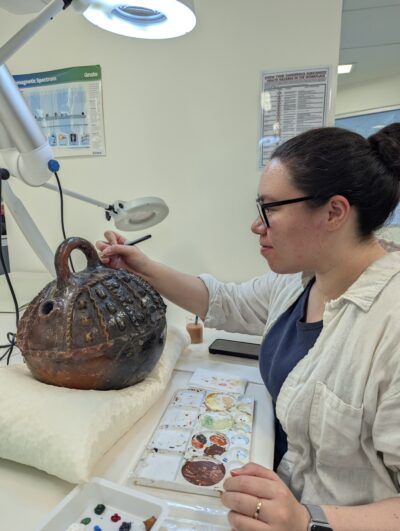
Melanie in the UC conservation lab carefully colour matching and inpainting fills. Image credit: Hakim Abdul Rahim, 2025.
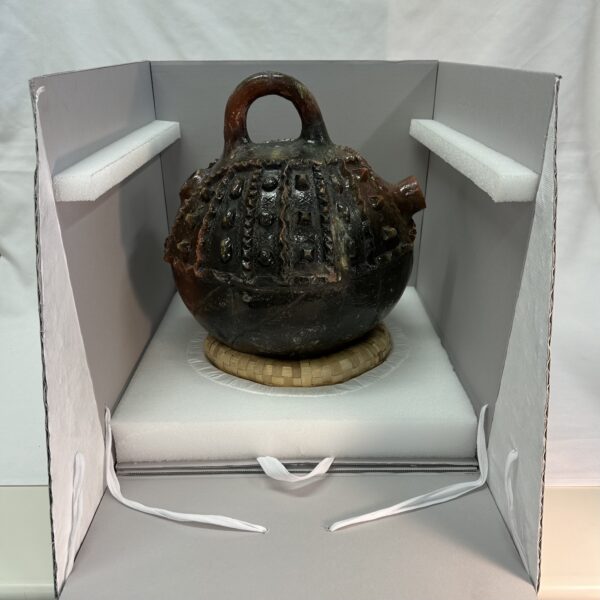
Fijian saqa niwai after treatment and placed in custom storage box. Image credit: Melanie Ioane-Warren, 2025.
I am very grateful to Ian Batterham, Alison Wain, Hakim Abdul Rahim, Natalie Ison and Michelle Newton-Edwards for their guidance and support throughout the academic year.
With graduation taking place at the end of March, I am looking forward to wrapping up this chapter and moving into the next. I am hopeful for a future of continued learning and the opportunity to build a career in conservation, with interest in objects, textiles and custom storage making.