A four-day deep-dive into the challenges and innovations in conserving kinetic art, hosted by UCL, GCI and Tate. 20–23 May 2025
Kasi Albert; Conservator, Objects, National Gallery of Victoria
The way things work
is by admitting
or opening away.
…
Wheel, kinetic flow,
rising and falling water,
ingots, levers and keys,
…
—excerpts from The way things work by Jorie Graham.
Movement is challenging because it inevitably results in change, decay and entropy. The friction of parts, the weakening of materials, the obsolescence of technology all bring diminishing action and eventual randomness in a system. Preservation is often tasked with arresting change, freezing time or even returning order to disorder, through immobilisation or static environments. Kinetic art is made to move (and sometimes shake), so approaches to conservation are necessarily plastic and inventive.
Presented over four and a half days, the recent Movers and Shakers: Strategies for the Conservation of Kinetic Art workshop brought together a distinguished group of specialists to present expertise, experience and historical context to a variety of objects, contemporary art and time-based media conservators from around the world. Hosted by University College London at their new UCL East Marshgate campus and supported by the Tate and the Getty Conservation Institute, the workshop was a unique opportunity for professionals working in a discipline that is not always covered in traditional conservation training.
A global cohort of participants was joined by second year students from the newly established UCL Conservation of Contemporary Art and Media MSc. Key instructors included Reinhard Bek (specialist in conservation of contemporary art), Deborah Cane (manager of the Tate’s Sculpture and Installation Art conservation team), Pip Laurenson (Professor of conservation at UCL) and Bill Castelo (freelance kinetic art restorer), along with many other knowledgeable contributors.
The benefit of the in-person event was highlighted by the integration of hands-on practical learning throughout the curriculum. After a theoretical session on the first day covering the basics of electrical safety and a case study examining the conservation of an older analogue kinetic sculpture, we worked in UCL’s innovation lab to build our own motorised mini kinetic sculptures, inspired by Jean Tinguely’s 1964 Constante Indeterminee. We used these sculptures in later sessions to practice documentation processes, trial system and switch assembly, and understand timers.
Other key components of kinetic works were covered in lectures and applied sessions. Loosely inspired by Visceral Canker, a 1990 work by Donald Rodney, we experimented with liquid pumps to fill and empty suspended ‘blood’ bags with dyed water, playing with direction and speed. Electronic microcontrollers were also demonstrated in a tutorial where we assembled our own breadboard LED array and programmed its flashing with an Arduino.
The integral roles of artists and their intentions were a continuous theme throughout the workshop. In an evening session, a number of local kinetic artists were invited to speak to the group about their own practice and experiences of ‘keeping it going’. Tate Modern’s exhibition Electric Dreams: Art and Technology Before the Internet was a key touchpoint throughout the workshop, as we heard from its curator, conservators and technicians and finally visited it on the last day. Not only was it exciting to see so many analogue and historic kinetic works functioning in one space, but it was also instructive to hear about processes, collaboration and (of course) complications.
The workshop was an incredible opportunity to build on my own experience, to connect with colleagues, and to reflect on the challenges, innovations and connections (pun intended) involved in the conservation of kinetic art.
The way things work
is by solution,
resistance lessened or
increased and taken
advantage of.
…
The way things work
is that eventually
something catches.
—excerpts from The way things work by Jorie Graham.
Sofia Lo Bianco; Conservator, Objects, Art Gallery of NSW
Conserving kinetic art means working with systems that often fail, wear out or behave unpredictably. It involves navigating the artist’s intent, the interplay of kinetic and energetic forces, and the nuances of overlapping electrical and mechanical systems—which are often prone to failure, degradation or obsolescence. These systems don’t always align. Artistic intent, operability, component behaviour and long-term conservation priorities often pull in different directions. Sometimes the systems themselves are unstable by design—customised, modified or assembled in ways that run counter to how the components were originally meant to function.
For conservators, meaningful intervention often starts with the artist’s intent—but understanding the electrical, mechanical or incidental structures that underpin a work is just as critical, even when those structures were never built to last.
The workshop approached these challenges by combining foundational instruction in mechanical, electrical and electronic systems with hands-on sessions focused on testing, troubleshooting and real-world case studies. It didn’t follow a single thread so much as a tangle—of systems, disciplines, practical constraints and conceptual rabbit holes.
The practical sessions were especially valuable in developing a more methodical approach to troubleshooting: isolating variables, testing inputs and outputs, and distinguishing between mechanical, electrical and more ambiguous kinds of faults. They offered a framework for understanding how electrical and mechanical behaviours interact—and how small adjustments can affect both the intended functioning of a kinetic work and its long-term wear.
Knowing what to test, what to rule out and when to escalate makes collaboration with external specialists far more effective and helps us act as better translators of the artist’s intent. It also allows us to better define the conditions under which a work can operate safely and meaningfully.
The workshop also provided tools for navigating key questions that directly affect the longevity of kinetic works—questions that rarely have simple answers. Should a work run continuously? Should it rely on a timer? Should it run for limited intervals? Should it be displayed inoperable, static? These decisions carry significant material consequences. Some components wear out faster when cycled on and off; others degrade with heat or due to obsolescence benefit from reduced run time. There’s no universal rule—each system behaves differently under load and is vulnerable to different stresses. The workshop gave us ways to ask these questions more precisely and offered clearer reference points—from data sheets and component specs to wiring diagrams and real-world examples of how similar systems have fared over time.
I especially enjoyed the insights shared by Reinhard Bek, whose extensive experience with kinetic works across the northern hemisphere, from his time at Museum Tinguely to his time in private practice, included close and intimate knowledge of the workings of many incredible artists such as Rebecca Horn.
The Electric Dreams exhibition was another highlight. It was special to see works I’ve long admired—especially pieces by Heinz Mack and Otto Piene from the ZERO movement. I also found myself drawn to early geometric plotter works from Grupo de Arte y Cibernetica, and enjoyed learning about movements like New Tendencies, GRAV, and Arte Programmata.
Umberto Eco’s concept of the ‘open work’, which he applied to the 1962 exhibition catalogue for Arte Programmata, offered a conceptual through-line for the workshop. Eco described open works as existing within a ‘field of relations’, where meaning emerges through the works’ conditions and the viewers’ interpretation. This resonates with the conservation challenges of interpretation we face when caring for contemporary art. The open work counters conservation’s more rigid impulses, resisting the need to fix meaning or preserve a singular state. Instead, it invites us to consider the parameters in which a work can remain active, meaningful and materially sound, while accepting that variability and impermanence may be central to its nature.
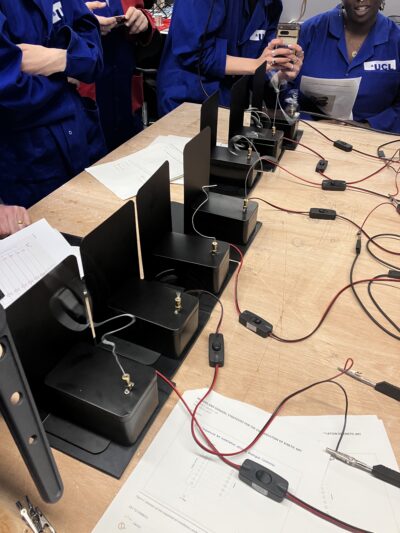
Connected kinetic sculptures
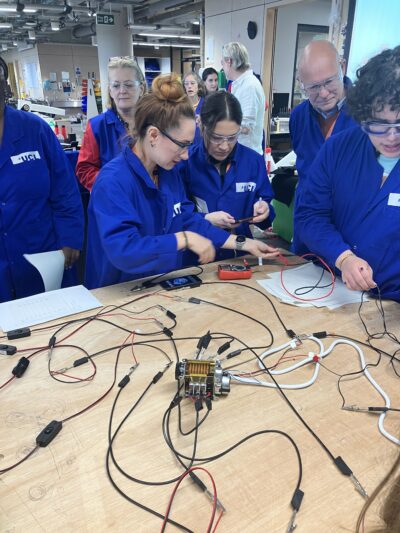
Kinetic sculptures connected to a timer
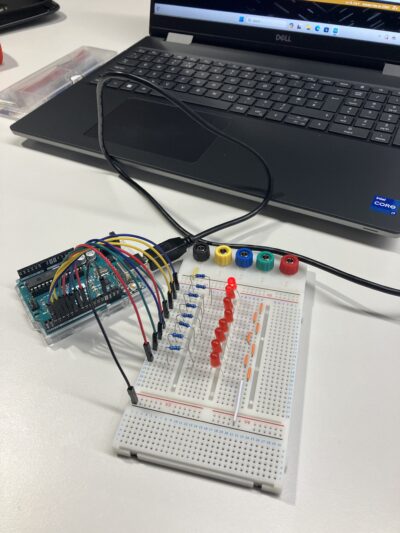
LED array with Arduino microcontroller
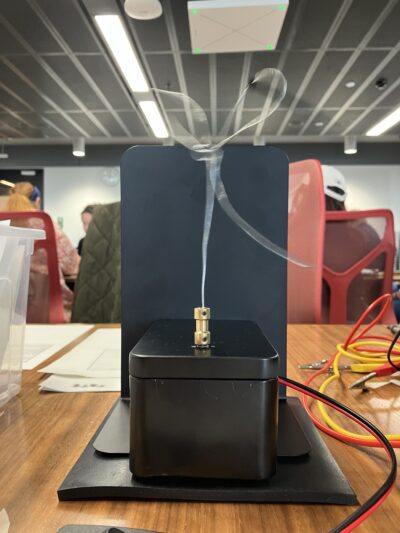
Tinguely-inspired sculpture in motion