Celebrating National NAIDOC week in July and coinciding with a generous gift from the Archie Roach Foundation, 2026, Senior Conservator Bronwyn Cosgrove recently installed a display including one of Archie Roach’s guitars and four of his iconic vests worn over many years of performances. These items are currently on display in the Velik Foyer on Level 5, Hamer Hall.
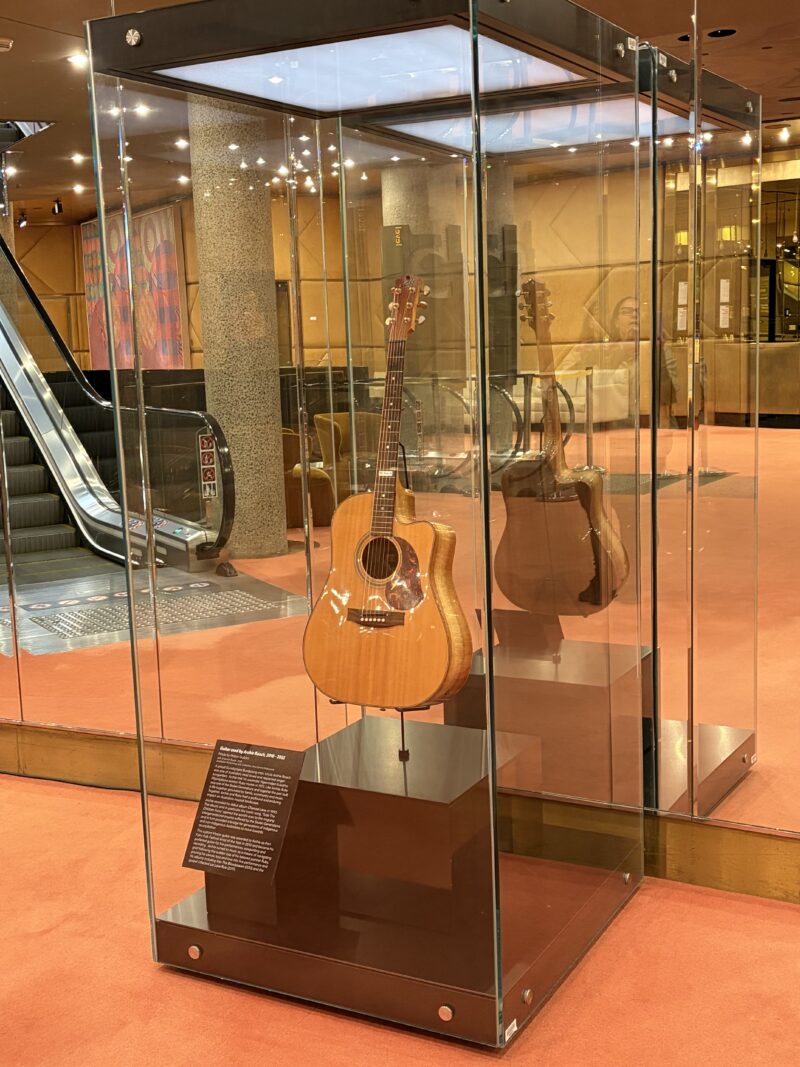
Archie Roach display for NAIDOC week 2026, Hamer Hall, Arts Centre Melbourne. Images by Carmela Lonetti, July 2026
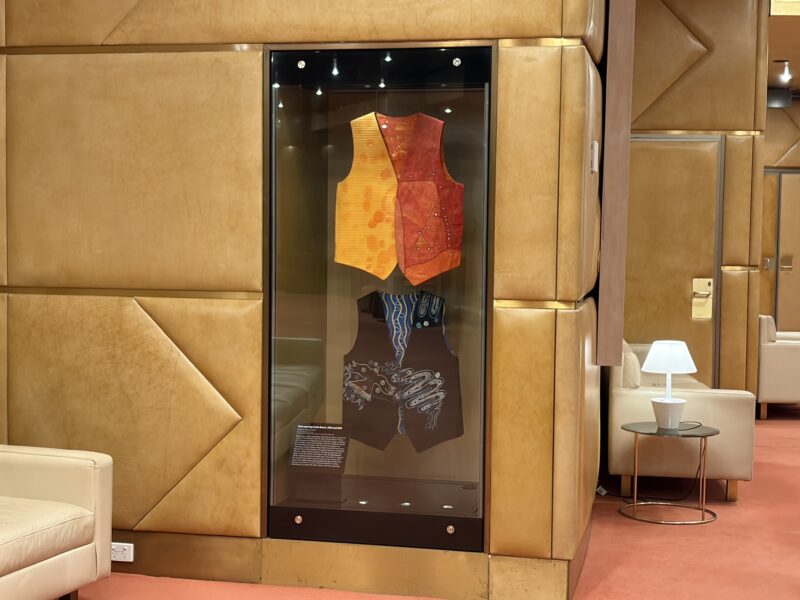
Archie Roach display for NAIDOC week 2026, Hamer Hall, Arts Centre Melbourne. Images by Carmela Lonetti, July 2026
Preparation for the Australian Museum Performing Arts (AMPA)’s second exhibition ‘Encore!’ continues apace with the opening scheduled in mid-September 2026. The exhibition celebrates 50 decades of collecting for the Australian Performing Arts Collection and will feature significant collection items spanning the history of the performing arts in Australia. The team has been preparing several performance costumes and ephemera for display.
The conservation team has been working to bring larger-scale objects used in theatre and musical performances to life for the exhibition. Two objects have required collaboration with specialised stage electricians to rewire electrical components for activation and safe museum display, including a stage prop designed by Baz Luhrmann and used by Opera Australia in its 1990 production of ‘La Bohème’. Including former stage props and items in the exhibition has afforded the opportunity to collaborate with our inhouse production and staging team, developing new relationships and sharing skills and knowledge.
Another project that the conservation team has been involved with is the Arts Access workshops. These workshops are part of the Alter State festival which is Arts Centre Melbourne’s disability-led arts initiative that engages with artists and performers. https://www.artscentremelbourne.com.au/festival-and-series/alter-state/about. The program enables disabled visual artists to spend time with pre-selected collection objects within the Collections space for the purpose of research and inspiration for their art practices.
Bronwyn has recently undertaken recruitment for our Barbara Van Ernst graduate conservator role. The successful applicant will commence with the team soon and assist with ‘Encore!’ exhibition preparation and installation.
Textiles
Old Melbourne Gaol’s lashing triangle
Principal Textiles Conservator, Christina Ritschel, has been working to preserve the Old Melbourne Gaol’s historic lashing triangle. This object has a macabre presence in our Burwood laboratory, knowing its history as a tool to inflict punishment on the gaol’s prisoners.
The upholstered fabric initially underwent a freeze treatment to eradicate moths before it was cleaned and assessed. The original green wool cover is severely fragmented, so the next stage will see it stabilised with specially dyed natural wool felt. Finally, the timber and metal structure will be cleaned and treated before being coated in protective wax to prevent further deterioration over time.
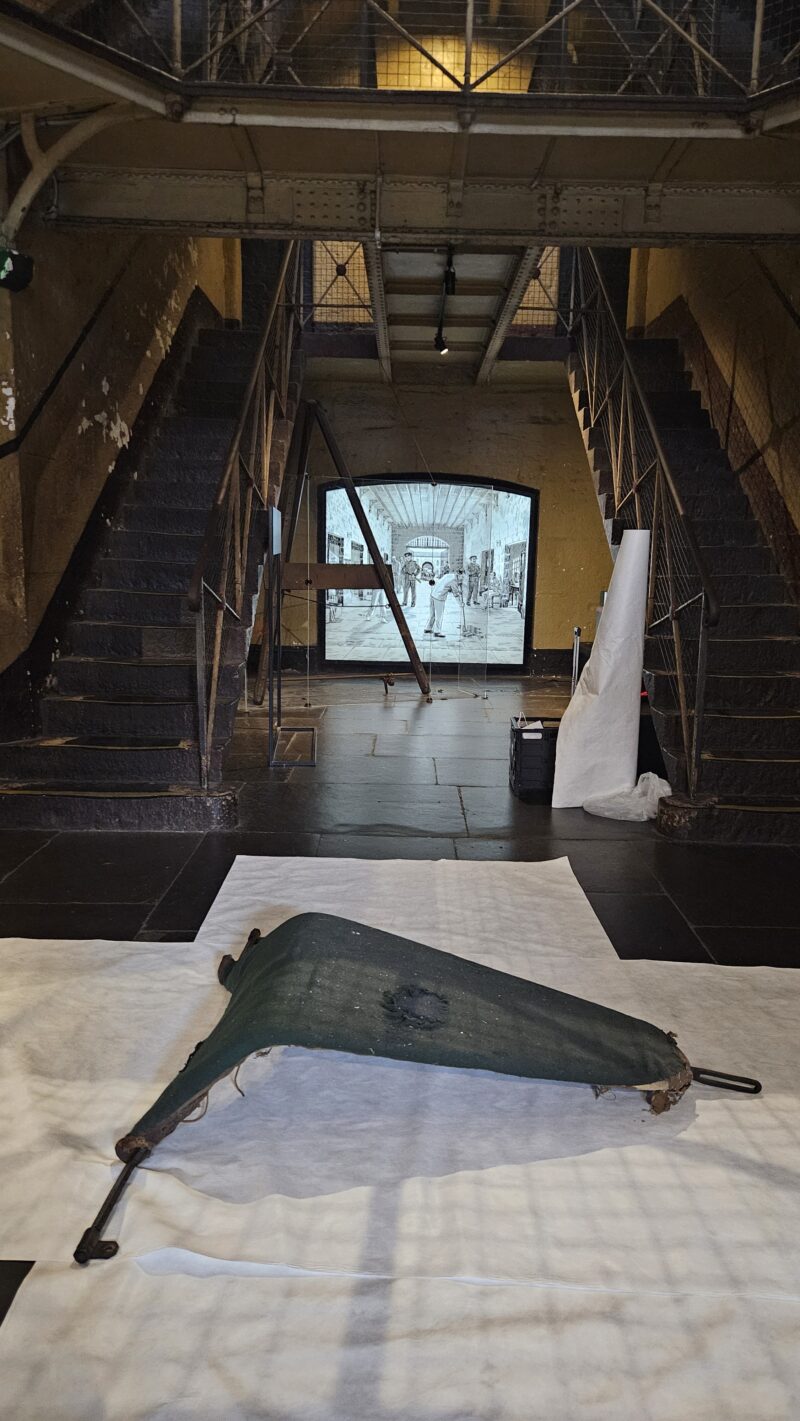
Lashing triangle deinstalled at Old Melbourne Gaol, before treatment.
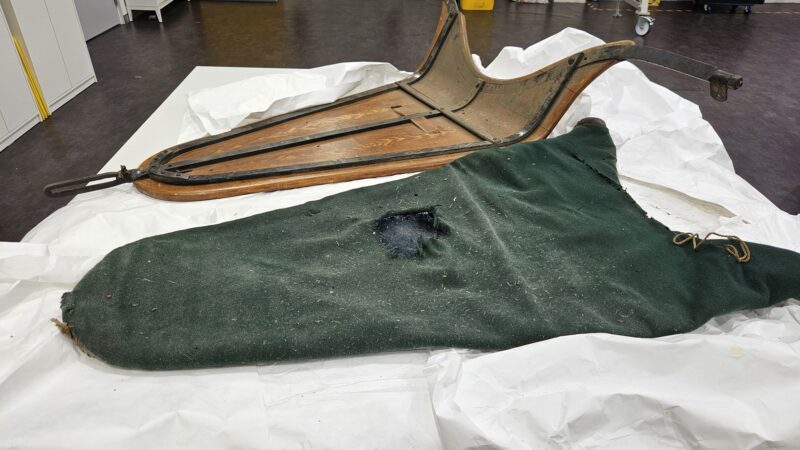
Textile released form wooden interior, before treatment.
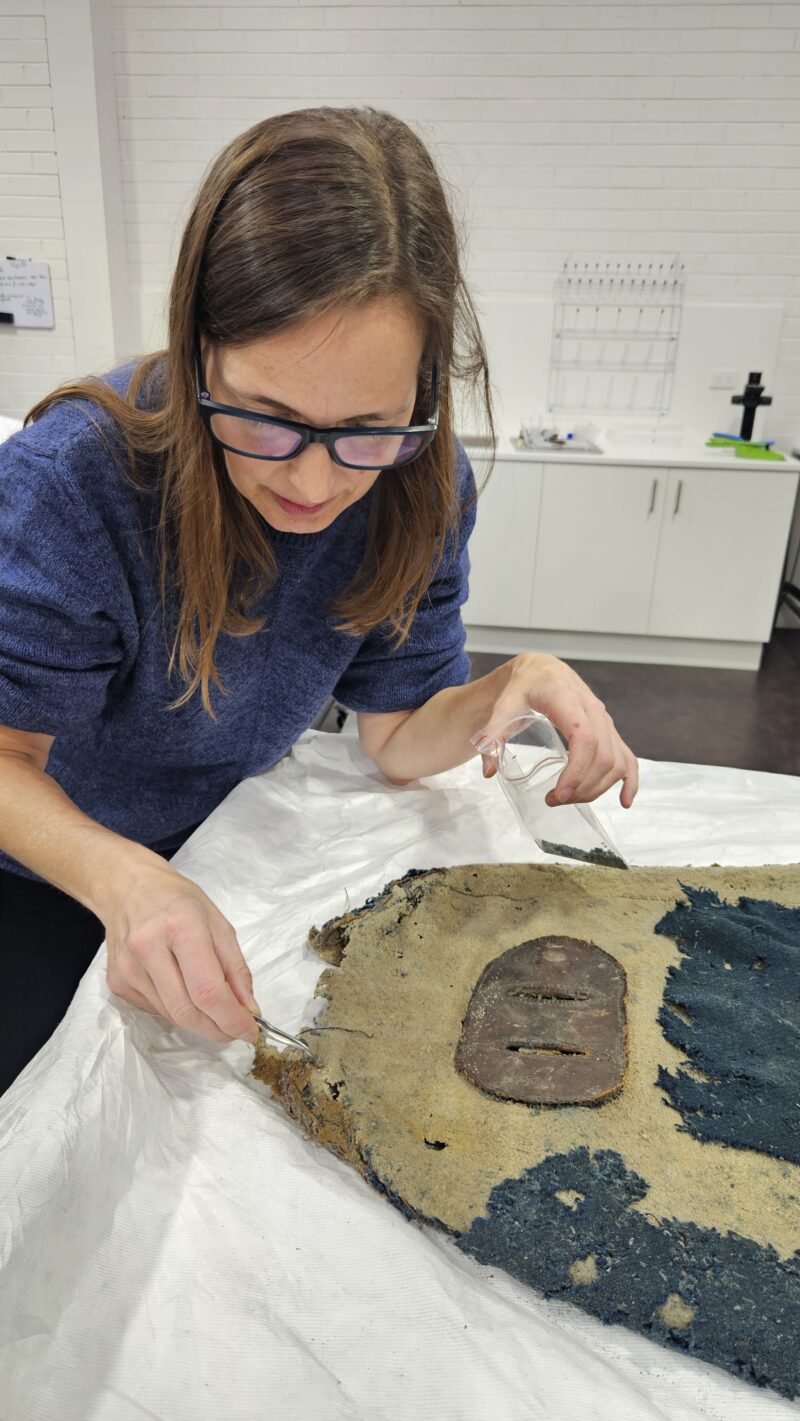
Christina Ritschel, Principal Conservator & Head of Textiles, during treatment.
Historic house tiles
The whole Melbourne team pulled together once again at a historic house in Melbourne where c. 40 square metres of tiles needed to be lifted for later reinstatement after cleaning.
The tiles were documented before being lifted from their bedding and sorted into storage boxes for transport back to our Burwood laboratory.
At the ICS lab, the tiles were cleaned to remove residual mortar, then sorted back into their boxes ready for reinstatement later in the year. This mammoth task required many hands and occupied half the lab space while it was underway.
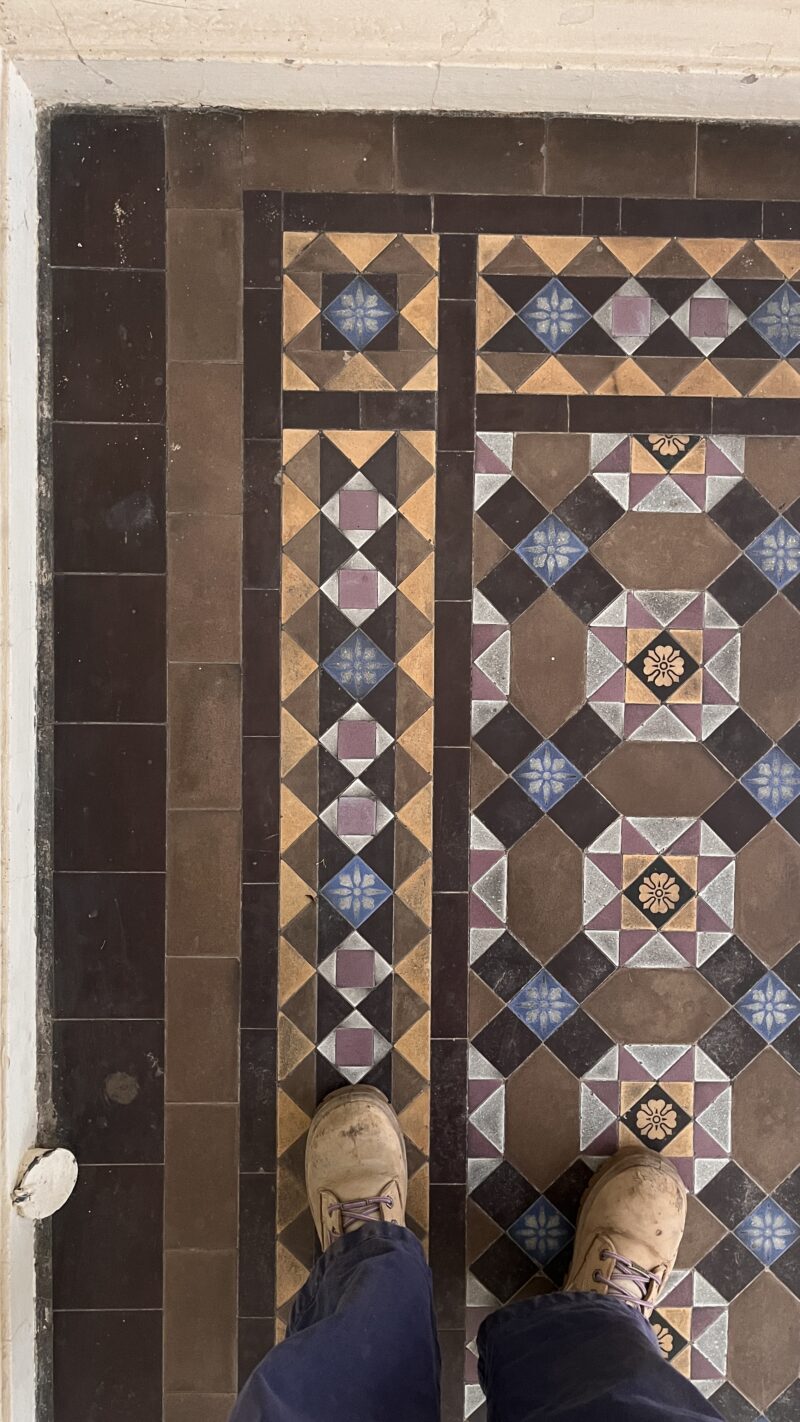
Tiles in situ, before treatment.
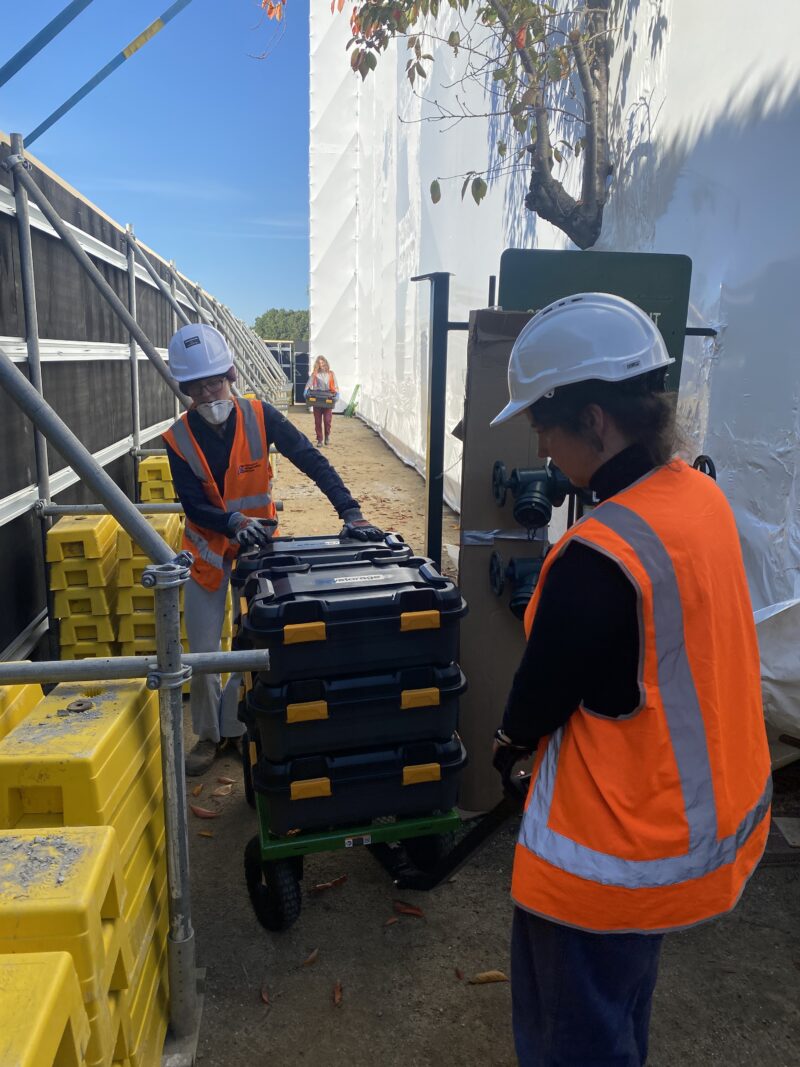
Tiles after lifting, packed for transport.
Fine Arts
Fairfield Hall wallpaper
At another historic house in Melbourne, our Fine Arts conservators were called out to restore a historic wallpaper mural depicting countryside scenes. The house, built in c. 1890 and designed by architect George Robbins, is a significant example of a suburban ‘boom period’ mansion and is currently undergoing restoration.
Unfortunately, the wallpaper had been damaged during changes to the window treatments, so the team was required to reproduce the missing sections in situ.
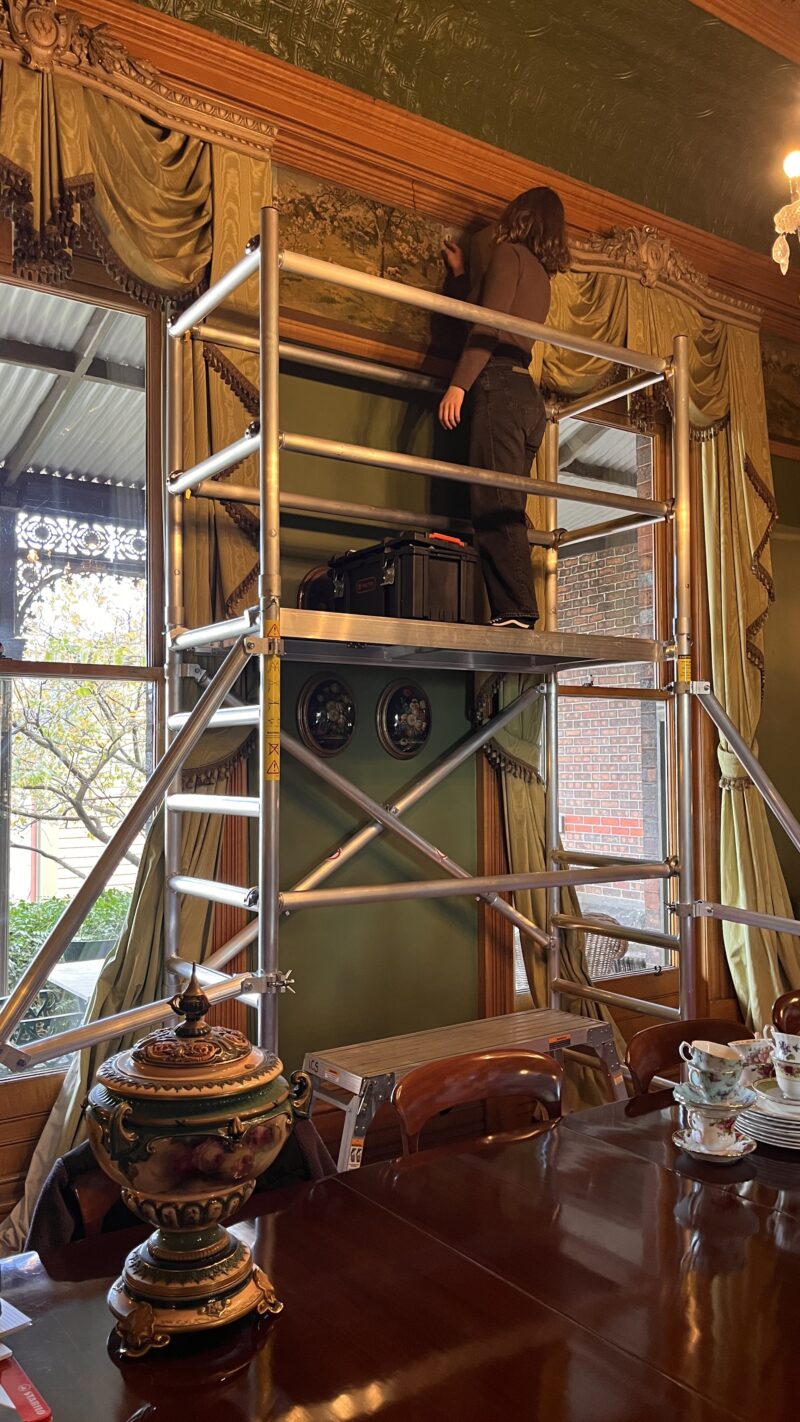
Lily Monk, Painting Conservator, with wallpaper during treatment.
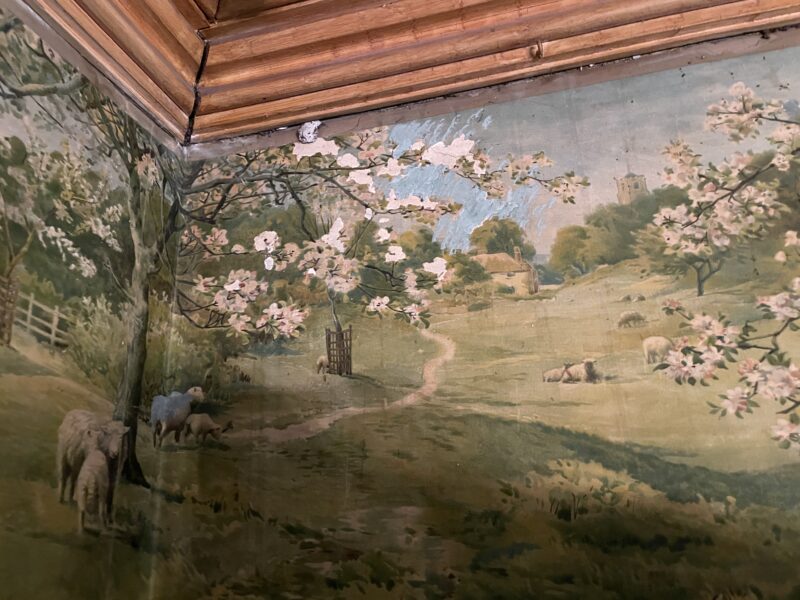
Wallpaper, before treatment.
Exhibitions
In April, we saw the retirement of the founder of the Exhibitions Conservation Section, Catherine Earley. Catherine developed the concept for Exhibitions Conservation at the NGV in the early 1990s and leaves a legacy of tireless advocacy and innovation for this specialty. She is already very much missed!
Shortly after Catherine’s departure, Janelle and Camielle began the installation of the Melbourne Winter Masterpieces show, ‘Cartier’. This show has almost 400 pieces of jewellery, and 150 pieces of archival material. They worked closely with a large number of couriers from Cartier, as well as institutional lenders the V&A, British Museum, NGA and Powerhouse. It was incredible to be so close to these objects and learn from experts from the Cartier team. Following this, Camielle is preparing for the installation of ‘Margaret Preston’ in August – with over 60 inward lenders this show is a large undertaking. As we write, Janelle is heading to Denver, Colorado, with Objects Conservator Kasi Albert to deinstall First Nations touring show ‘The Stars We Do Not See’. Its next venue is in Portland.
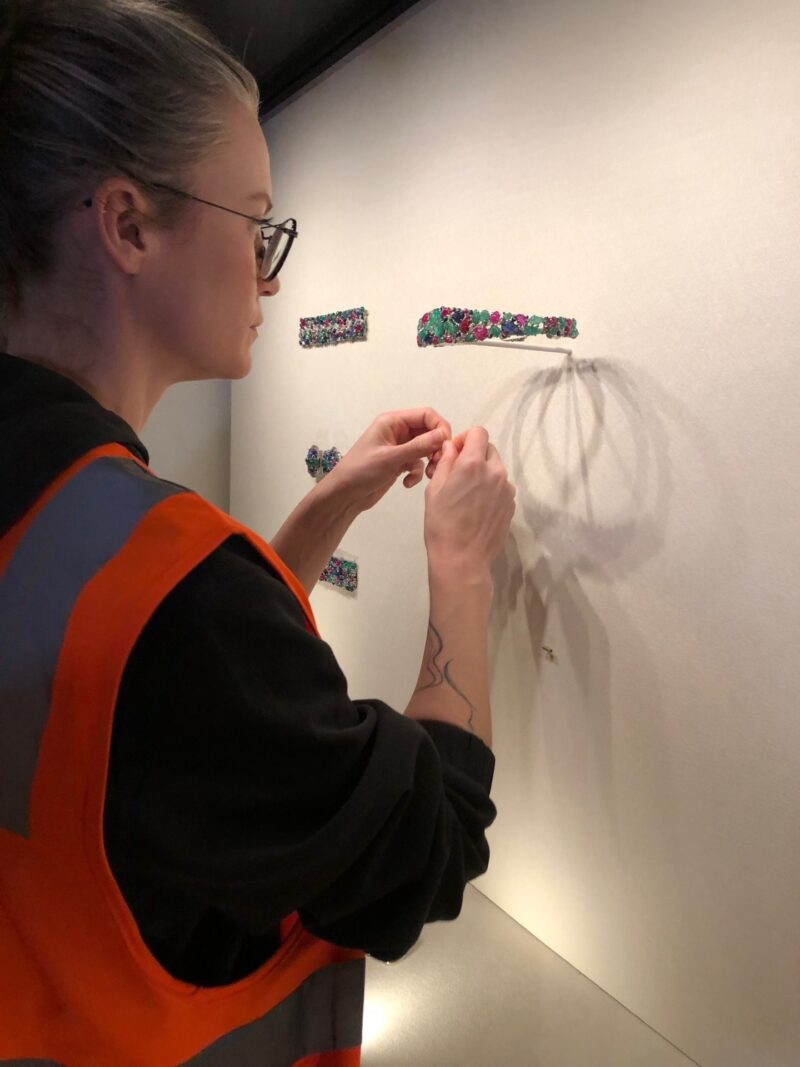
Camielle installing the Cartier exhibition.
First Nations
A major focus for 2026 for Conservator of Indigenous Art, Genevieve Sullivan, was the preparation and installation of ‘Future Country: Country Road + NGV First Nations Commissions’, an exhibition featuring eight new commissioned works by emerging Australian First Nations artists. This show was a great opportunity to undertake artists’ interviews and a major collaborative installation, including Jahkarli Feliecitas Romais’ ‘Channels’, a 9m x 6m photographic print installed from six separate panels across the wall and floor for the public to interact with, prepared with Conservator of Paper, Louise Wilson.
April also included the second installation of ‘The Stars We Do Not See’, a major touring exhibition of Australian First Nations art across the US. Genevieve and Manager, Conservation, MaryJo Lelyveld, travelled to Denver Art Museum to undertake condition reporting and assist with installation of the show.
Frames and Furniture
Over the last few months Emma Northwood has joined the team as a conservation assistant, working with NGV Frame Maker Jason King on the major reframing project for Henrietta Rae’s ‘Apollo and Daphne’ (1895). This striking aedicular frame is based on high resolution photographs of a frame on a painting by Rae’s artist husband Ernest Norman and features delicate frieze ornaments. Jason and Emma have also made a cassetta style reproduction frame for ‘The fish bowl’ by Margaret Preston (1910) for the upcoming Preston retrospective exhibition, based on a frame from c. 1909.
Suzi Shaw has been receiving new acquisitions for the exhibition ‘Plant Life’ at NGV Australia, which includes furniture made with hemp fibres and mycelium amongst other sustainable materials represented. The longevity and susceptibility to change of such artworks will be interesting to monitor.
Holly has recently recreated a missing metallic plastic strip from the original strip frame for Herbert Bayer’s ‘Chromatic intersection (warm reversed-warm, 12C)’, 1969, by gilding a shaped strip of mountboard and securing it in place with a Japanese paper barrier layer adhered to the timber frame. She has also been overseeing the installation and deinstallation of ‘Travellers’ from Judith Wright’s ‘A journey’ (2011–2012), for the ‘MOTHER’ exhibition. This powerful work is composed of old found objects including mannequins and masked bamboo figures in various forms of transport such as a wheelchair, toy car, wheelbarrow, canoe and bathtub, and provides interesting conservation challenges.
Objects
At the start of the year, the Objects team worked on the deinstallation of all works in the NGV sculpture garden to prepare for building works on the new NGV Contemporary. In March, the Objects team welcomed our new decorative arts conservation fellow, Imogen Colton, who will be with the department for three years. Imogen’s early work has focused on adhering and infilling fragmented South Asian ceramics in the collection. In April, Di Whittle and Kasi Albert hosted and attended the workshop Treatment Strategies for Outdoor Painted Sculpture in collaboration with the Getty Conservation Institute. The team has been kept busy with the installation of recent exhibitions ‘MOTHER’ and ‘Cartier: Melbourne Winter Masterpieces’, as well as permanent collection changeovers at both NGV International and NGV Australia. They are currently occupied with preparations for the upcoming Triennial, including the imminent deinstallation of Yayoi Kusama’s ‘Dancing Pumpkin’ (2020) from Federation Court.
Paintings
The past few months have seen the completion of Carl Villis’ major restoration of Salvator Rosa’s ‘Romantic Landscape with Mercury and Argus’, Emma Soyer’s ‘Girl with a basket of flowers’ and numerous other smaller treatments by the Paintings Conservation team in preparation for loans (John Perceval to Heide, Sidney Nolan to AGNSW) and NGV exhibitions (Margaret Preston).
In July, our team hosted Klara Kific and Iona McNab, students from the University of Melbourne’s master’s conservation program for a three-week internship. Iona and Klara had the opportunity to carry out extensive technical examinations and preparatory treatments of eleven of Sidney Nolan’s Wimmera group of paintings from 1942–44, working alongside each member of the NGV Paintings Conservation team.
Paper and Photography
The Paper and Photographs Conservation team has returned to treatment and research projects during a brief break between major exhibitions.
Ruth Shervington has carried out stain reduction on three Picasso prints and is in the midst of repairing one. Ruth is also liaising with a New Zealand photographer on the construction of a large multi-part artwork going into the next Triennial, likewise the securing of objects for another large-scale artwork by an American artist for the same exhibition.
Bonnie Hearn is undertaking treatment of the ‘Wasmuth Portfolio’, a two-volume first edition set of lithographs by American architect Frank Lloyd Wright, printed in 1910. Comprising over 100 lithographs, these are a deluxe presentation set of architectural and interior design prints detailing various buildings made throughout the USA, including buildings that never came to fruition. The set is made from a variety of papers such as laminated mulberry paper, transparent paper and thin tissue, requiring a mix of dry-cleaning, repair, humidifying and flattening.
Ruth and Bonnie recently presented their research and findings on the study of the NGV’s earliest illuminated manuscript, the ‘Gospel Book of Theophanes’, for two bookish events: Melbourne Art Book Fair and Melbourne Rare Book Week. The manuscript is a deluxe Byzantine rendition of the Four Gospels, written in miniscule Greek and produced in Constantinople (ca. 1125–1150). Ruth and Bonnie’s research focuses on how the manuscript was made, exploring artisan materials and techniques.
Marion Jones research project – Copland Foundation Project
Recent exhibitions at the National Gallery of Australia and the Art Gallery of South Australia[1] have highlighted the discrepancy in female artist representation in our national collections.
Marion Jones (1892–1977) was born in Bendigo to a well-respected family of solicitors. She attended the National Gallery School where she excelled in painting and was awarded the prestigious National Gallery travelling scholarship in 1917. This provided a generous stipend to travel to Europe for two years and a requirement was that three works were to be sent back to the National Gallery of Victoria. Jones was only one of nine women to be awarded the scholarship between 1908 and 1932[2].
Grimwade Conservation Service / GCS (part of the Cripps Institute) is currently undertaking a defined treatment and research project on a suite of seven paintings from the Bendigo Art Gallery Collection by this important Victorian female artist who is not well documented in art historical records. The Copland Foundation funded project aims to ensure her work is preserved into the future, spotlighting regional collections and stories.
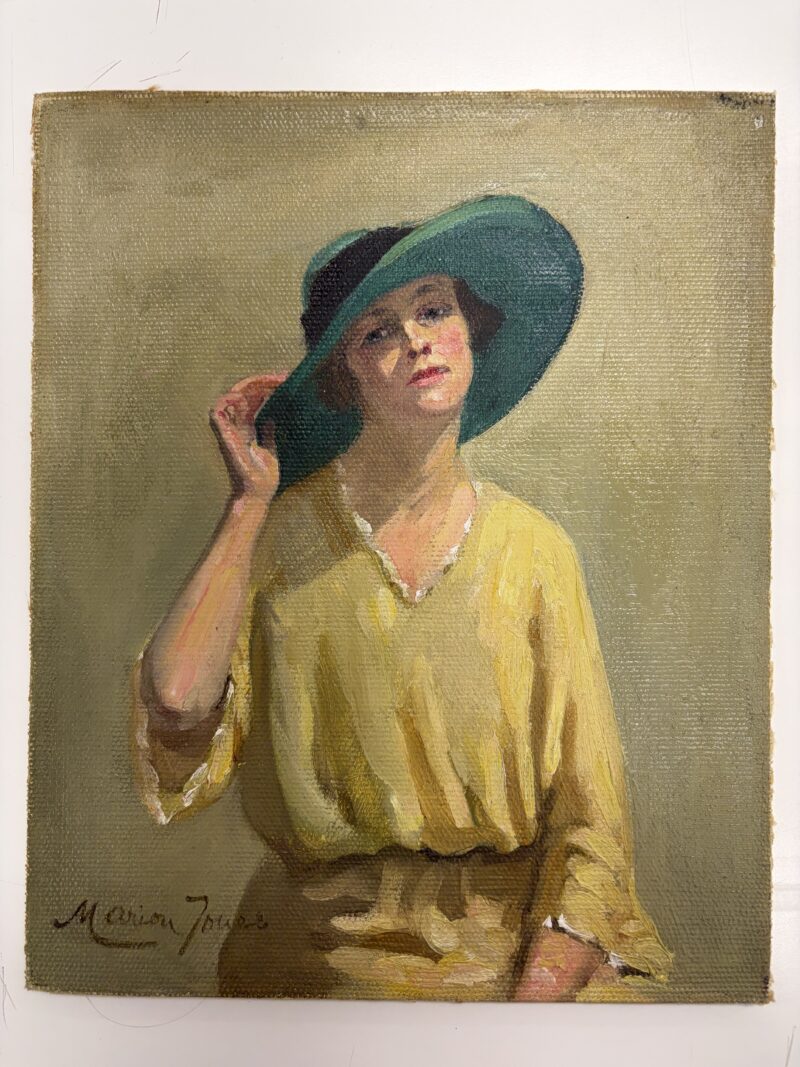
Marion Jones ‘Self Portrait’, ca 1930. Collection of Bendigo Art Gallery.
The project maintains and expands our longstanding collaborative relationship with the Bendigo Art Gallery collection, in a research and consultative capacity. In the last 20 years, our Conservation experts have researched and treated over 130 significant works from the collection, contributing to the long-term preservation, access and exhibition success for this highly successful regional gallery.
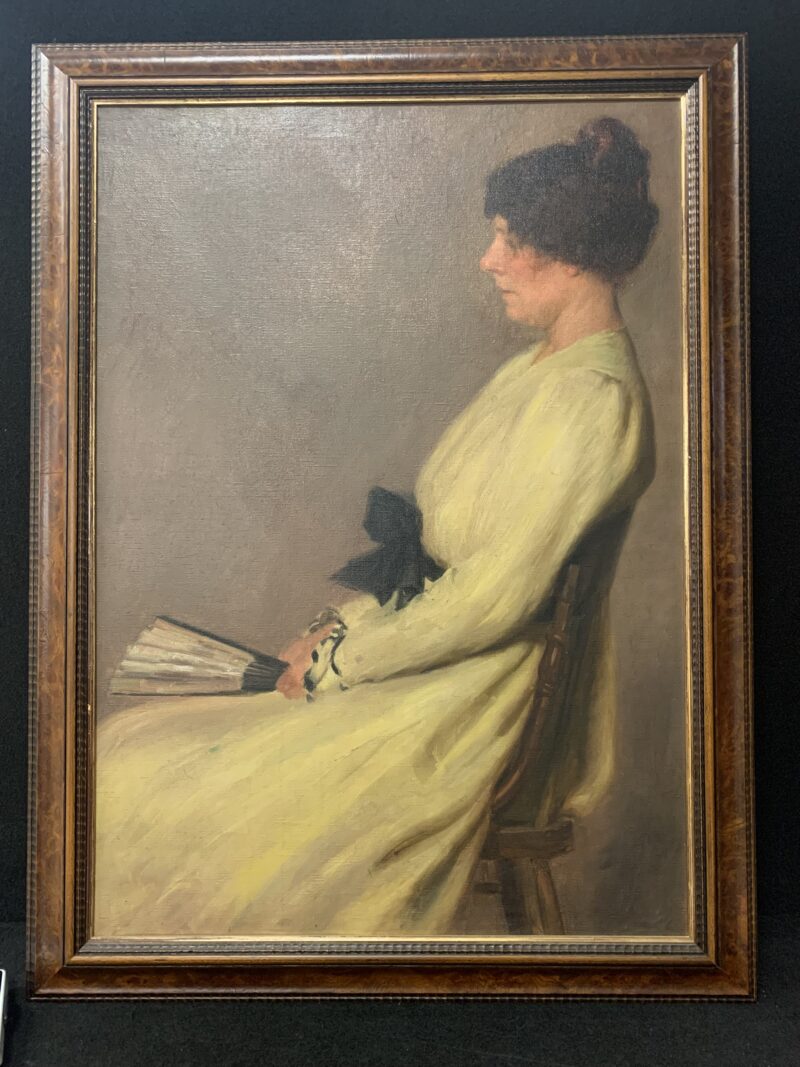
‘Untitled woman with a fan’, Marion Jones Collection of Bendigo Art Gallery.
To date, two out of seven of the works have completed treatments, with five paintings still undergoing intensive research into the materials and techniques using analytical equipment in-house and through University avenues.
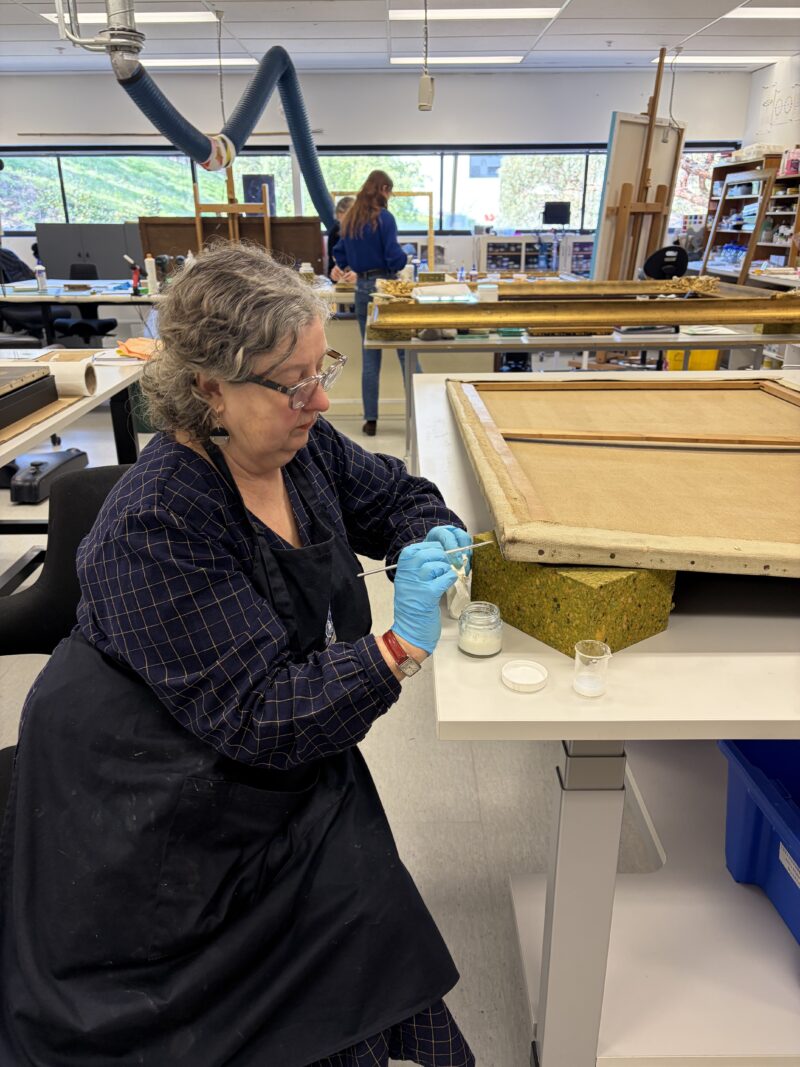
Consolidation treatment.
This project enables our Conservation researchers to undertake expanded documentation on Marion Jones and to analyse the data for any information that can be obtained about artist material preference and art suppliers of the early 20th century in both Bendigo and Melbourne. Microscopic and analytical analyses have revealed pigment and canvas preferences, previous interventions and some historical provenance information.
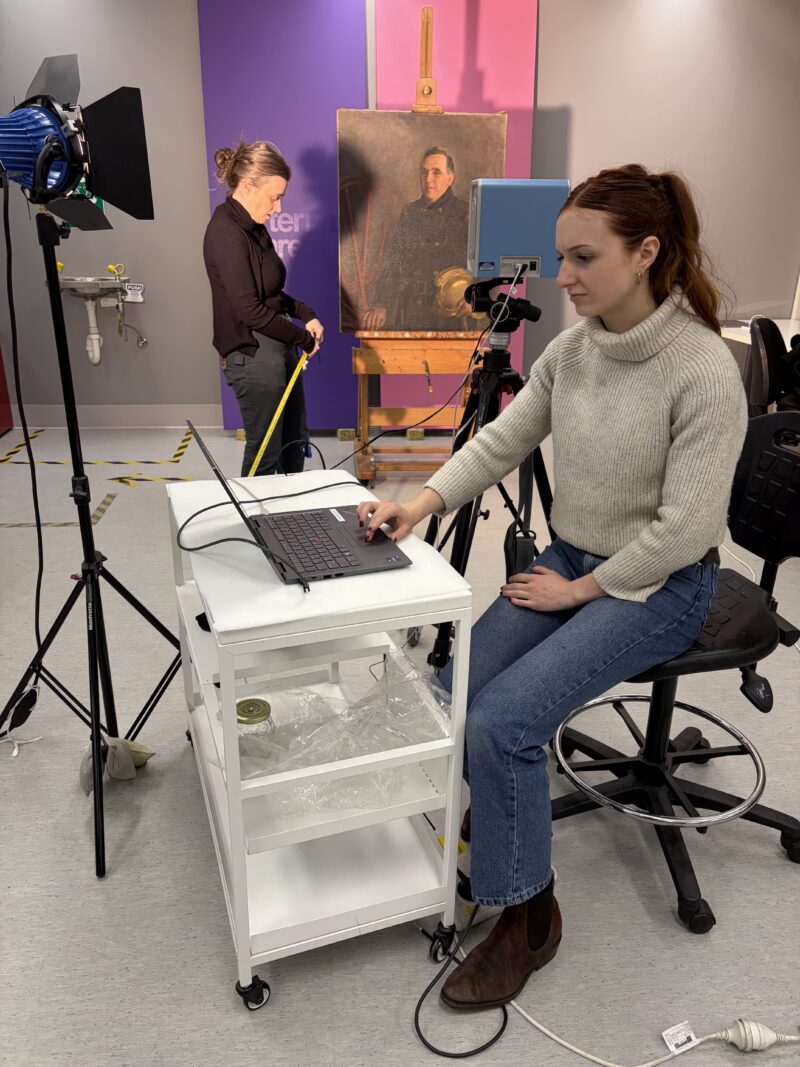
Infrared analysis.
Some interventive treatments have been undertaken but also preventive conservation rehousing measures to preserve the works into the future. Additionally, a large-scale frame restoration project is underway, designing and rebuilding lost corner elements to a substantial early 20th-century original frame from one of the portraits.
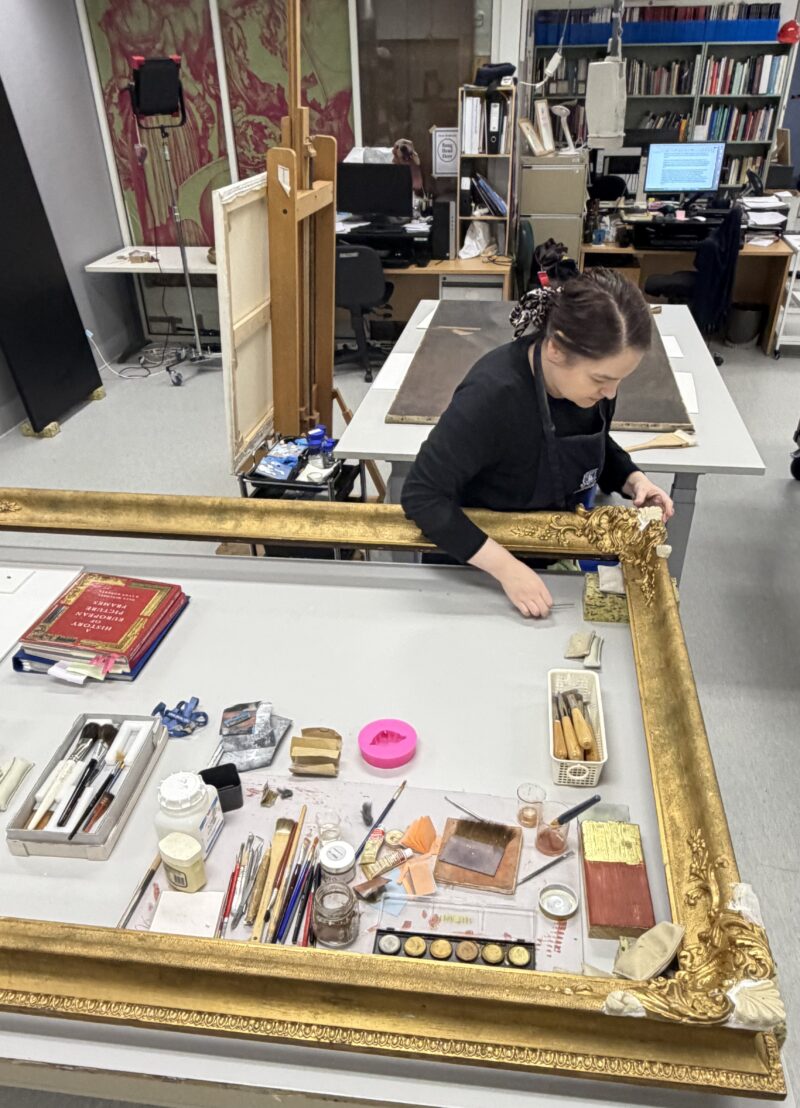
Frame conservation during treatment.
The oeuvre of Marion Jones is a research specialisation of Cushla Hill, Team Leader Paintings Laboratory, Grimwade Conservation Services. She has studied her work in collections throughout Australia and also her juvenilia works held by the University of Melbourne (previously Victorian College of the Arts Historic Collection). These National Gallery School student works were previously part of a project-based learning unit for the master’s program in Conservation at the University of Melbourne.
The Paintings Conservation team at the Grimwade is very grateful for the support of the Copland Foundation and the Bendigo Art Gallery in enabling this project and supporting our research interests.
[1] ‘Know My Name: Australian Women Artists 1900 to Now’, NGA, 14 Nov 2020 – 9 May 2021 (part one) 12 Jun 2021 – 26 Jun 2022 (part two) ‘Dangerously Modern: Australian Women Artists in Europe 1890–1940,’ AGSA, 24 May – 7 Sep 2025
[2] Dwyer, Jillian (2016). ‘The ‘work’ of art: The National Gallery of Victoria Travelling Scholarship, 1887–1932′. Monash University. Thesis. https://doi.org/10.4225/03/5844bf211767a
Archaeology Week 2026 presentation
GCS Objects Conservator Marica Mucic recently participated in a panel discussion hosted by the PMI Victorian History Library, exploring the archaeology and conservation of unique 19th-century Melbourne artefacts. Alongside former GCS Objects Team Leader Dr Holly Jones-Amin (Lecturer in Art History and Art Curatorship), Dr Vincent Clark Archaeology & Heritage’s Dr Michelle Negus Cleary (Technical Director), Ramona Angelico (Historical Artefact Specialist) and Jaimi Houston (Historical Artefact Assistant), the panel discussed the excavation, assessment and conservation of archaeological footwear recovered from the former West Melbourne Swamp and a rare timber barrel from Little Lonsdale Street, highlighting the importance of collaboration between archaeologists, conservators, clients and Heritage Victoria in safeguarding Melbourne’s material heritage.
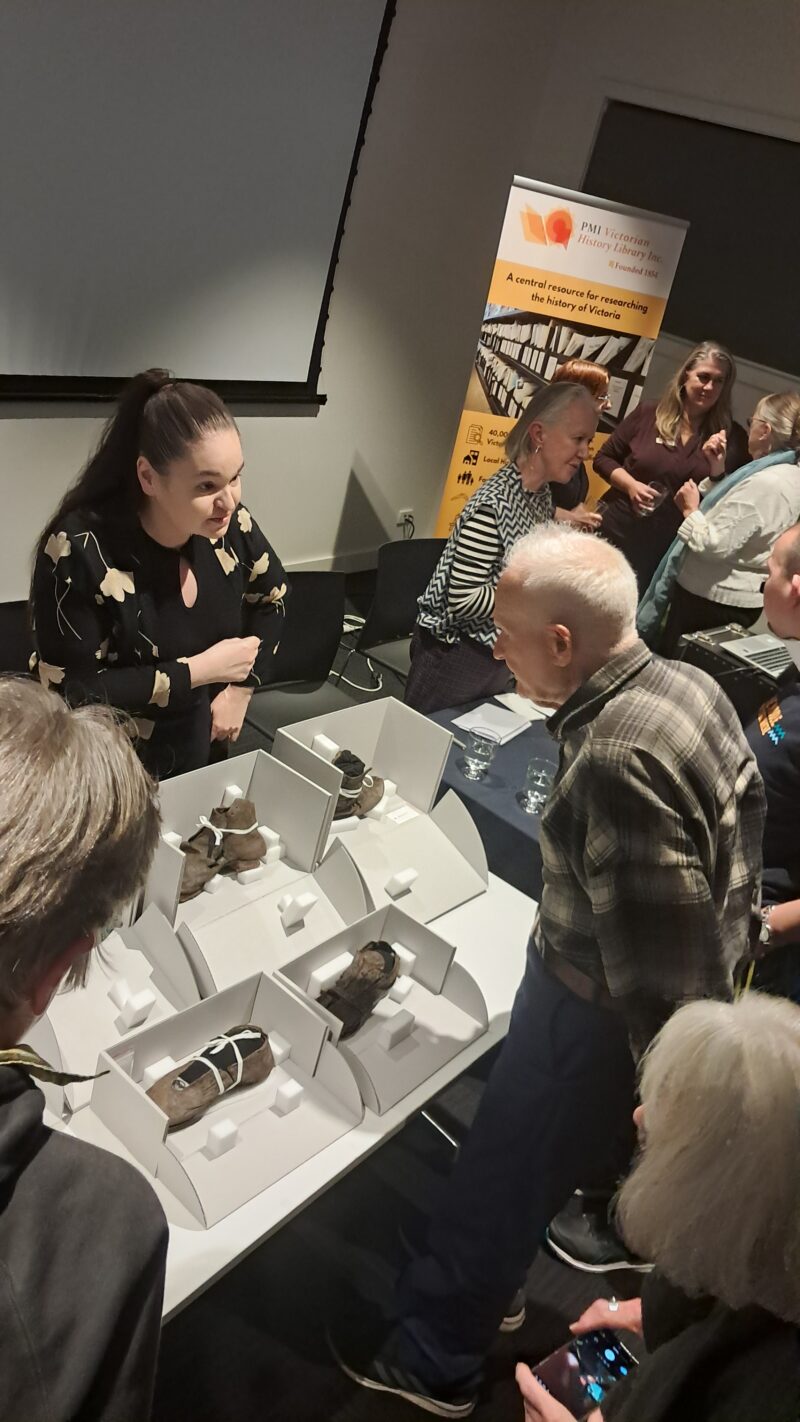
GCS Conservator Marica Mucic at Archaeology Week panel.
Conservation of historic dress
In the Paper/Textiles lab at GCS, Reyhane Mirabootalebi has undertaken the conservation of a significant historic dress held by the Sovereign Hill Museum in Ballarat. Funded by the Copland Foundation Grant (2025), this conservation project aimed to preserve a day dress dating to the 1850s and worn by Eliza Perrin, a Ballarat woman who migrated to Australia from England several months after her husband, John Perrin, departed for the goldfields. The dress is particularly significant as it is accompanied by a photograph (ca 1850s) depicting Eliza (with her three children) wearing the dress. The dress arrived in very poor condition, having suffered from age-related deterioration, environmental exposure and insect damage. The conservation treatment encompassed cleaning, stabilisation and extensive repair work. Given its materials, construction methods and form, the dress represents a rare and valuable research resource that will illuminate the daily lives and material culture of working women during this period.
Conservation Dialogues: Frameworks for Artist and Stakeholder Interviews in Conservation
From 11 to 15 May, Cripps Institute’s Dr Eliza O’Donnell and Dr Sabine Cotte ran an intensive master’s subject centred on artist and stakeholder interviews in contemporary conservation. The subject included the ethical, theoretical and practical challenges conducting interviews may pose, the practice of the interview itself, and the documentation and interpretation of results as essential tools for evidence-based conservation research and practice.
The benefits of artist and stakeholder interviews for conservation have been recognised by leading scholars in this field and organisations such as Voices in Contemporary Art (VoCA). Artist interviews in conservation provide critical, firsthand information on materials, techniques and artist intent, and guide conservation decision-making, future research and curatorial strategies for display and collection care. Transcripts and recordings form essential components of an artwork’s documentation, providing future conservators and collection managers with authoritative guidance when the artist is no longer available to inform treatment decisions or share knowledge of their intent.
For this intensive five-day course, we collaborated with collector Konfir Kabo, Founder of Project Eleven Foundation, and the Project Eleven collection manager, Mara Sison. Project Eleven is a dynamic, ever-evolving private collection of contemporary Indonesian and Australian works, currently stored in Ballarat, regional Victoria, with a view to becoming an open-access museum in the future.
Five artists based in Melbourne and represented in the Project Eleven collection agreed to be interviewed by groups of two to three students, including Sally Smart, Scotty So, Jeremy Blincoe, Zico Albaiquni and Patriot Mukmin. During fieldwork in the Project Eleven collection in Ballarat, students aimed to scope the anticipated material behaviour of their case-study works and plan future conservation strategies that would respect the artist’s original intent and vision of their own legacy. The course was structured around the iterative process of planning, executing and analysing an artist interview. The subject began by examining the history of artist interviews, ethical principles in oral history and useful frameworks, with guest lectures from Rachel Davis (GCS) and Robyn Ho (Care Of Studios) sharing their practice of interviews and the context for doing them. Fieldwork in the Ballarat-based collection allowed students to examine closely the artworks that would form the base of their interview, research the artist’s practice and exchange with the collector and collection manager.
The preparation of the interviews also involved structuring the dialogue, carefully developing targeted questions and always keeping in mind the need for open dialogue, the respect of artists’ privacy and intellectual property, and generally framing the purpose of the interview in conservation and future care terms. Technical aspects such as video and sound recording, transcribing and sharing dialogue were also examined.
After each group of students conducted their respective interviews, the last day was dedicated to transcribing, analysing the data collected and reflections about the process, including auto ethnography, to acknowledge the importance of context, people and relationships in the quality of the exchange and the data interpretation. We were lucky to be able to share these reflections with Dr Sanneke Stigter, a leading scholar in this field who delivered a lecture and reflection session over Zoom from Amsterdam on our last day of the subject.
While short, this five-day intensive course provided the students with theoretical background, practical tools and real field experience that will improve their practice of conducting interviews with contemporary artists and collection care stakeholders.
From risk to resilience: sharing expertise to support Taiwanese heritage recovery
Following the devastating floods caused by Typhoon Krathon, researchers from the Robert Cripps Institute for Cultural Conservation travelled to Taiwan to help museum professionals strengthen disaster preparedness and conservation skills, supporting the long-term recovery of cultural heritage.
In the aftermath of Typhoon Krathon, which caused significant flooding and damage across Taiwan in October 2024, heritage professionals are working not only to restore affected collections but also to strengthen resilience against future disasters.
As part of the recovery effort, Dr Jonathan Kemp and PhD candidate Hohi Ikeda from the Cripps Institute travelled to Taiwan in June 2026 to deliver a series of specialist workshops at the Juming Museum, helping museum professionals, conservators and students build practical skills in disaster preparedness and stone conservation. Read more here: https://arts.unimelb.edu.au/crippsinstitute/news/from-risk-to-resilience-sharing-expertise-to-support-taiwanese-heritage-recovery