
National Gallery of Australia
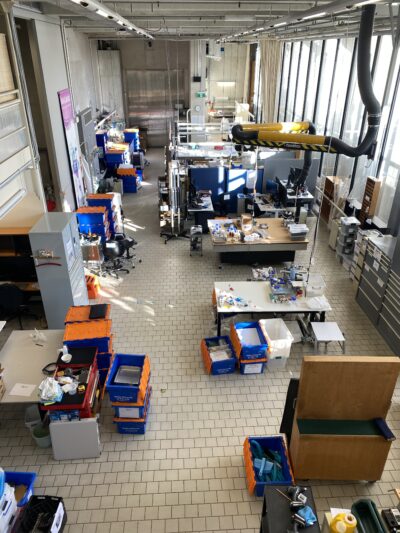
The year 2025 has been one of many changes for the Conservation Department at the National Gallery of Australia. The largest and possibly most disruptive has been the complete decanting of the conservation lab space. They may say moving house is one of the most stressful things one undertakes; moving the lab took things to a different level as staff were still required to meet business-as-usual commitments. It was an amazing effort by everyone and demonstrated the exceptional teamwork required to make big things happen in a small amount of time. The decant was to enable a work health and safety upgrade, which will provide the team with new fume cupboards, sinks, lighting, and fire and alarm systems. The objects, paintings, and textiles sections will also be moved to make better use of the space.
It was a trip down memory lane for some and for others a time to cleanse. A total of 18,000 litres of portable equipment and supplies were packed, and over 12 cubic metres of materials went for recycling. It does feel a little strange without a department to work within as the team are hot desking throughout the Gallery and working in pop-up work areas for the four weeks assigned to the contractors for the work to be completed. We look forward to spending the pre-Christmas and early new year reorganising, sorting and positioning furniture so we can be fully functional in a new and improved workspace.
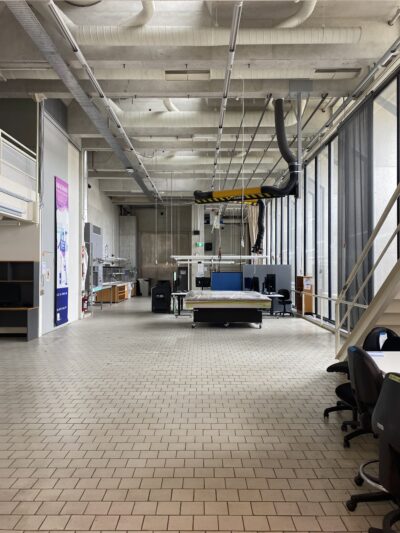
Lab during and after pack-up.
Objects and Time-Based Media
It’s been a busy lead-up to the end of the year for Objects and Time-Based Media (TBM). After the Rain, The 5th National Indigenous Triennial has involved the whole team in preparing and installing some fantastic large-scale installation works from 500 painted flying foxes to mortuary tables and an entire glasshouse.
TBM conservator Paul Coleman has been working out a process for radio frequency (RF) digitisation of laser disc-based artworks and finalising digitisation of remaining magnetic media in the collection, alongside installing several TBM-based works for upcoming exhibitions.
Courtney Crane participated in the Bronze Patination Workshop for conservators held at the Getty Centre in Los Angeles. The workshop was designed to provide conservators with the practical skills and knowledge needed to better understand chemical patinas and their application.
The Objects team has welcomed David Liu as our new Conservation Technician, Annabelle Williams and Isabelle Legg as Contract Conservators and Sarah McHugh has returned to the Gallery as our Senior Conservator. Thank you to Kim Goldsmith for doing a great job as Acting Senior for most of this year.
Paintings
Paintings Conservation has had a number of staff changes in 2025 with Dr Alexandra Gent starting as Senior Conservator, Paintings, in February. Alex made the move back to Australia after many years working in the UK, most recently at the National Portrait Gallery in London. Janet Hearne was welcomed back to the Paintings team in July, working alongside Jocelyn Evans. Lachlan Tumeth also joined us as Frames Technician in April, with Greg Howard continuing to work with us on a freelance basis.
It has been a busy time in Paintings Conservation in the lead-up to the lab closure. The team has undertaken treatments of a number of early Arthur Boyd paintings in preparation for loan to Bundanon through the NGA’s outreach program ‘Sharing the National Collection’. This also included fitting several works into newly commissioned frames. Support for the loans program has continued alongside the ongoing schedule of exhibition changeovers at the Gallery and new acquisitions. Some highlights of the year include the treatment of Man with Horse by Edvard Munch, and the stretching of the painting Sweers Island by the Bentnick Island Women’s Collaborative. All of this has kept Paintings Conservation on their toes right up until the closure of the lab, a much anticipated and exiting time for us all and a chance to review equipment and processes. An RH Engineering customised electric easel and a new custom woodworking bench are exciting new additions to the lab equipment.
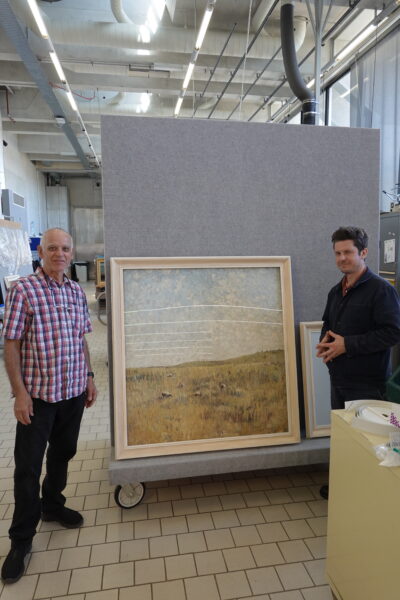
Greg Howard and Lachlan Tumeth with one of the newly framed Arthur Boyd paintings. [Arthur Boyd, Sheep grazing, 1938, National Gallery of Australia, Kamberri/Canberra, gift of Arthur Boyd, 1975. Reproduced with permission of Bundanon Trust]
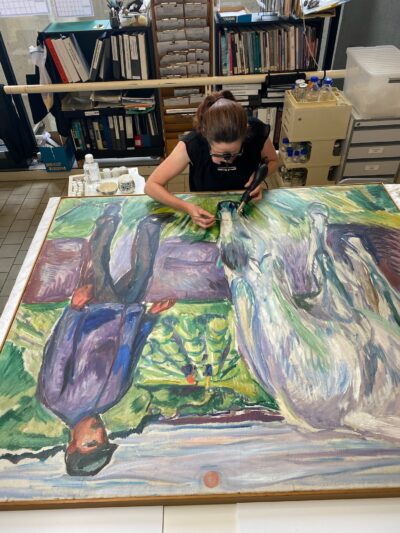
Jocelyn Evans undertaking treatment of Man with Horse by Edvard Munch. [Mann med hest/Mann mit Pferd (Man with horse)], 1918, National Gallery of Australia, Kamberri/Canberra, gift of Geoff Ainsworth AM 2024]
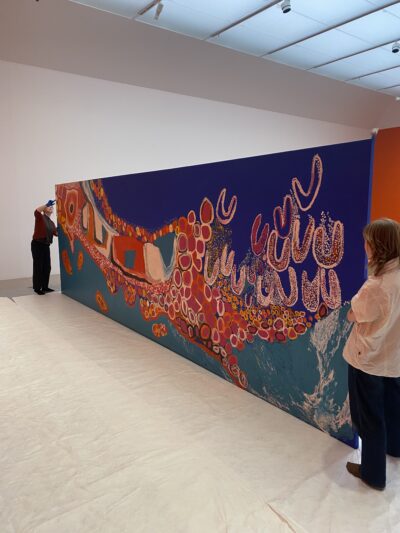
Janet examining the Bentnick Island Women’s Collaborative Painting Sweers Island after re-stretching [Mirdidingkingathi Juwarnda Sally Gabori (co-creator), Birmuyingathi Maali Netta Loogatha (co-creator), Warthadangathi Bijarrba Ethel Thomas (co-creator), Thunduyingathi Bijarrb May Moodoonuthi (co-creator), Kuruwarriyingathi Bijarrb Paula Paul (co-creator), Wirrngajingathi Bijarrb Kurdalalngk Dawn Naranatjil (co-creator), Rayarriwarrtharrbayingathi Mingungurra Amy Loogatha (co-creator), Sweers Island, 2008, National Gallery of Australia, Kamberri/Canberra, purchased 2025, © the artists / Copyright Agency 2025]
Paper
The Paper Conservation team has had a very hectic exhibition year with works on paper in all shapes and sizes and media being prepared for display. We have focused on several large-cale paper projects including the mounting of 360 chromogenic photographs for our New Asian Art display and the conservation and mounting of a 9-metre-long Papua New Guinean scroll. During our Conservation lab upgrade, we have been lucky enough to incorporate a visit to our AGNSW colleagues and we have also embarked on the re-layering of a large karibari board, under the expert guidance of James Ward.
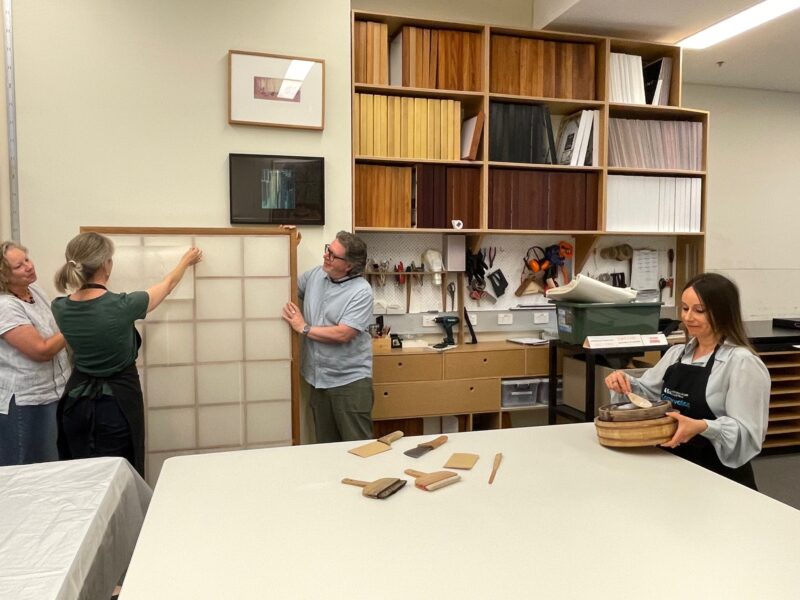
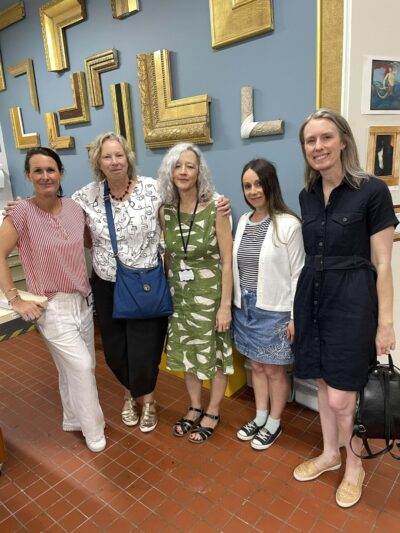
The Paper Conservation team working on the preparation of a karibari board at AGNSW.
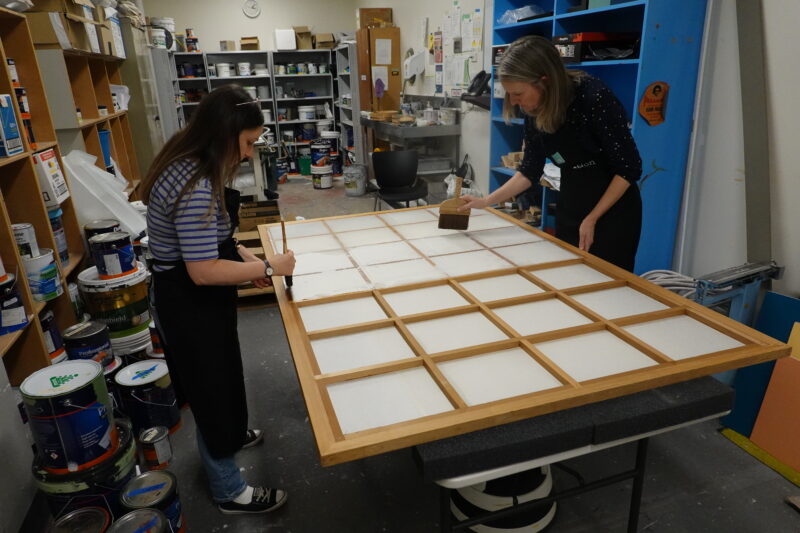
The NGA Paper Conservation team during their visit to AGNSW.
Textiles
After 40 years at the Gallery, Micheline Ford retired from the NGA at the beginning of July. She is enjoying spending time in the garden with her grandchildren. Textile Technician Tiffany Abbott went on maternity leave in July and the team welcomed Olivia Barnett to take over the position. Carmela Mollica is now leading the team as the Senior for the section and continues to oversee the care of Skywhale and Skywhalepapa as they travel across Australia. In September, Michelle Hunter travelled to Banff, Canada, to deliver a paper at the North American Textile Conservation Conference on the intentional removal of alterations found within Ballets Russes costumes in the collection.
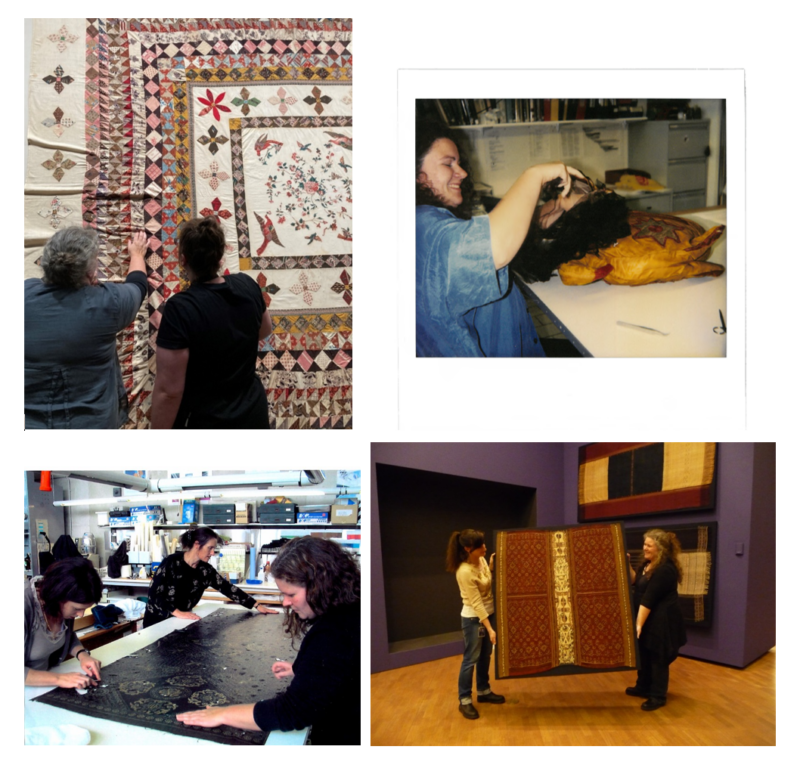
Some highlights from Micheline’s 40 years at NGA.
Endangered Heritage
Opportunities from Endangered Heritage
Training: Integrated Mould Management
Endangered Heritage has developed a proven portable mould remediation device (chemical free) that sterilises surfaces to prevent mould on heritage items. After 25 years of empirical research, we are offering training in Integrated Mould Management, giving organisations control of mould treatment designed to minimise human risk and prevent deterioration of artefacts.
Victoria and Andrew were the subject-matter experts for mould remediation for UK heritage in 2019 and 2025’s heritage guidance notes, distributed to all heritage-listed properties and palaces across the UK. The training they are now offering covers the cultural (yes, there are cultural ethics and bio ethics to some treatments) and science-based issues around different mould treatment methods, historical and current, the chemical bi-products and the follow-through treatment options for museum professionals, to ensure effective mould treatment is in the hands of custodians.
Participants will review past treatment methods and learn the different strategies recommended for different materials – for example, proteins, cellulose paint and mixed matrix materials. Training will cover post-disaster mould prevention, and show why there is no need to worry about treatment when you can prevent mould starting in the first place.
Victoria and Andrew are both members of the Australian Institute of Occupational Hygienists (AIOH) and have specialised their practice in the OH&S hazards in collections. After losing her sister-in-law to mould inhalation over 25 years ago, Victoria has been researching mould remediation for our sector and the construction industry and, with the patent pending, is now ready to share the cutting edge of mould management with comprehensive case studies and hands-on training.
The portable mould remediation device should be in every disaster kit but for safety reasons can only be used by a trained operator so is only available for sale to people who have completed the training.
The cost of the training is variable. As we wish to make it accessible to disadvantaged countries and communities, cost will be determined by World Trade Organisation (WTO) country ranking. Visit the following site https://integratedmouldmanagement.com/ for more information.
Conservator on Retainer
In 2023, Endangered Heritage launched Conservator on Retainer, a support program for museums providing up-skilling and conservation advice, particularly for rural and regional locations. The program is aimed at also supporting and mentoring emerging conservators or those responsible for collections not specifically in their wheelhouse. This innovative program is already well-subscribed and growing, both here and overseas, and was a finalist in the ACT heritage awards.
We invite senior conservators to reach out to support the program for paid speaking opportunities to advance the skills in our sector and raise appreciation and awareness of the work we do and the importance of it for our shared national story.
ICS International Conservation Services, New South Wales
Events
AICCM National Conference
ICS was proud to both sponsor and take part in November’s AICCM National Conference in Brisbane. It was an outstanding conference both in terms of content and organisation, for which ICS congratulates the local conference organisers.
Through our First Nations speaker sponsorship, we supported the attendance of Jillian Munday, an award-winning photographer, writer, emerging filmmaker and occasional artist. Jillian delivered a compelling talk, ‘A Conservation of a Colonial Perpetrator Statue Facedown’, tracing the contentious story of the Statue of William Crowther in Hobart and its complex legacy.
Her presentation formed part of the session ‘What Comes Around’, where Julian Bickersteth AO, ICS CEO, presented Keir Bayley’s paper on conservator perspective in his talk ‘The Statue of William Crowther: A Complicated History’, where Keir reflected on the challenging task of reassembling the sculpture and navigating the history it represents.
A dynamic panel discussion on ‘Conservation and Activism’ followed, featuring Jillian, Julian, and Caroline Martin. Their conversation sparked stimulating debate and important reflections on how conservators engage with culturally and historically sensitive objects – an exchange that promises to shape future practice by informing the current review of the AICCM Code of Ethics and Practice.
Julian chaired the final day’s lightning talks and also participated in a second panel, ‘OL PORO WOK BUNG WAINTAIM LO CONSERVATION: Friends Working Together in Conservation’, alongside Evare Gari (Motu), Carolyn McLennan, Associate Professor Alison Wain, Detlev Lueth and Professor Robyn Sloggett. Together, they explored the deep and ongoing collaboration between Australian conservators and Papua New Guinea since independence.
In addition, Dr Shrief Eissa, ICS Senior Objects Conservator, contributed a video poster titled ‘Multi-faith collaboration at the Great Synagogue Sydney’. Co-authored with Julian, the presentation shared the story of the Synagogue’s restoration and the symbolic harmony reflected in its long-standing partnerships across faiths.
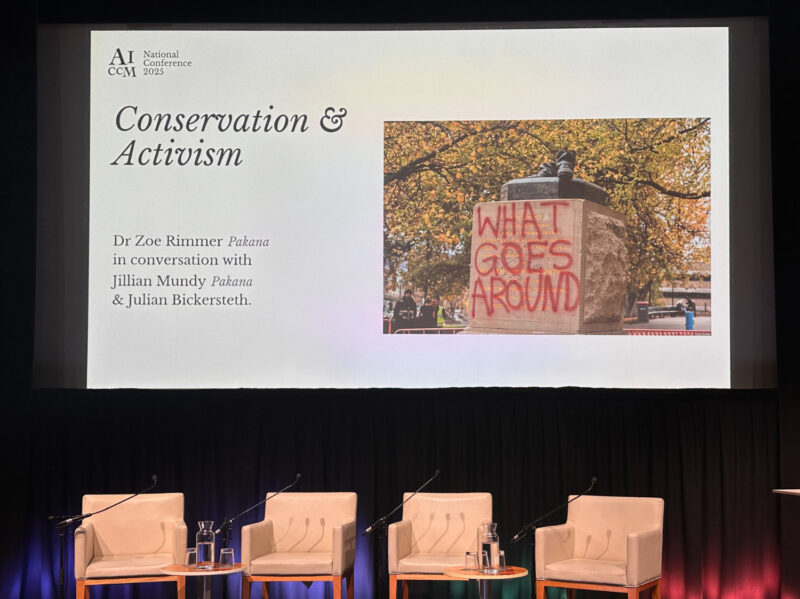
The stage is set for the panel discussion.
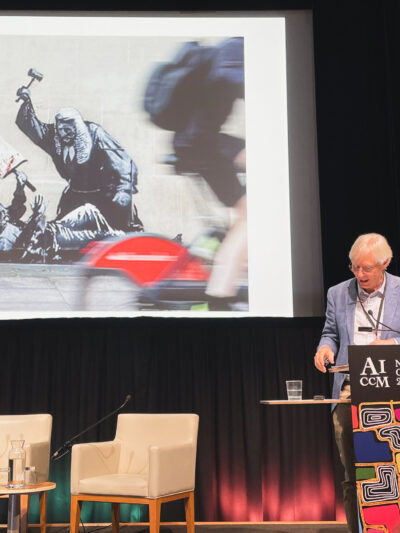
Julian Bickersteth AO, during his presentation.
Awards
AICCM Awards 2025
The ICS Melbourne Team proudly accepted the Outstanding Conservation Project of the Year Award 2025.
The winning project – the conservation of the Victorian Trades Hall honour boards and tablets – was led by Eden Christian, ICS Senior Conservator and Team Leader, Fine Arts. Through meticulous work, the team removed multiple layers of overpaint to reveal the original painted and gilded honour boards and commemorative panels hidden beneath, restoring these important historic artworks to their former presence.
For a closer look at the project: https://bit.ly/49t0RUr
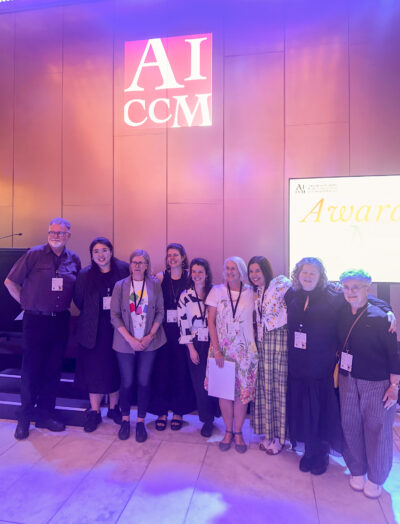
Eden Christian and other award winners.
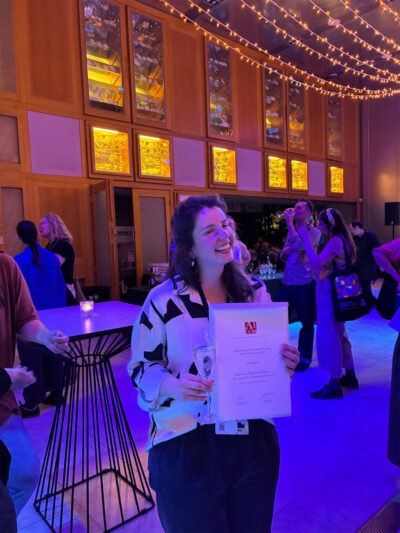
Eden Christian proudly displays the AICCM award.
Paintings
Matteo Volonté, Head of Paintings, and his team of painting conservators—Francesca Elia, Suati Rojas, Monica Renn, Jenny Dawson and Annabelle Silk—together with paper conservators Rebecca Clendinen and Caroline Whitely, have been hard at work preparing several significant collections for upcoming exhibitions.
Recent projects include conservation work for Mosman Art Gallery ahead of its exhibition Between the Heads – Views from Middle Harbour, and for Manly Art Gallery & Museum in preparation for Maestri – Influences from Italy to Austria.
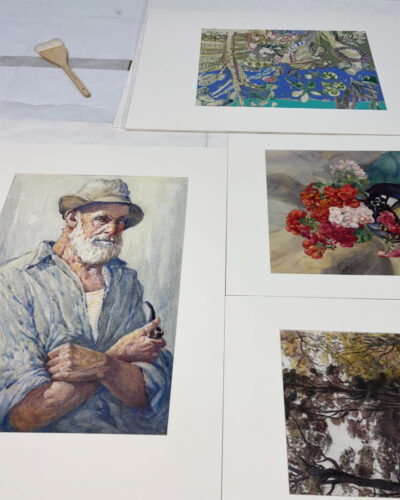
Artworks for the Manly Art Gallery & Museum exhibition ready for reframing.
NERAM Adopt an Artwork
For the past decade, ICS has partnered with the New England Regional Art Museum (NERAM) in Armidale to carry out paintings conservation treatments for its Adopt an Artwork initiative. We are now undertaking treatments for Phase 10 of the program, continuing our long-running support in preserving this important regional collection.
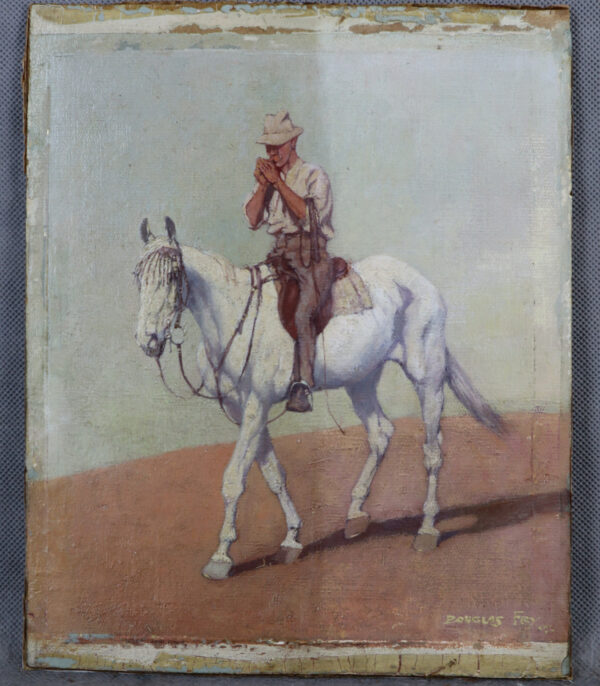
Painting by D Fry – The Boundary Rider, during treatment.
Tear repairs
Monica Renn, Paintings Conservator, has been undertaking a major tear repair using an RH Trecker – a tensioning aid originally developed by Professor Winfried Heiber and later refined by Laura Hartman.
Using this method, Monica has been able to gradually and successfully close a significant gaping tear, and we look forward to seeing the impressive final outcome.
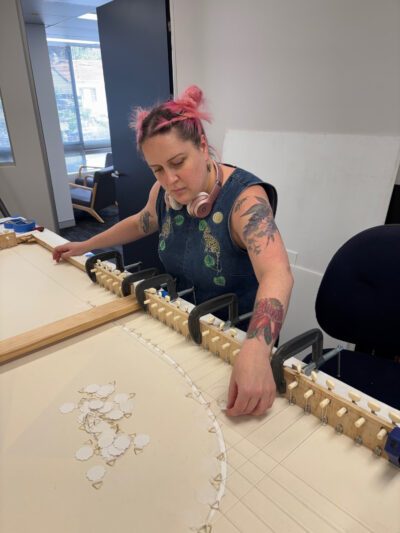
Monica Renn performing a tear repair with an RH Trecker.
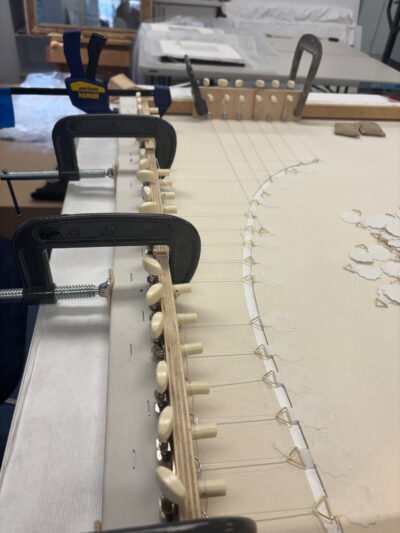
A close-up of the RH Trecker.
Paper
The Paper Team is delighted to welcome Jennifer Walker as our new Senior Paper Conservator.
Recently, Suati Rojas, Senior Paper and Paintings Conservator, and Rebecca Clendinen, Paper Conservator, returned to the White Rabbit Contemporary Chinese Art Collection where they treated 35 individual photographs, each framed in a custom cardboard system designed by the artist. Over time, the acidic nature of the cardboard caused noticeable staining on the photographs.
To stabilise and protect the works, our conservators replaced the affected photographs and introduced a protective barrier layer on the reverse to prevent further acid migration. The cardboard frames were then carefully sealed using wheat starch paste and toned Japanese tissue, ensuring the artist’s original construction was preserved while improving long-term stability.
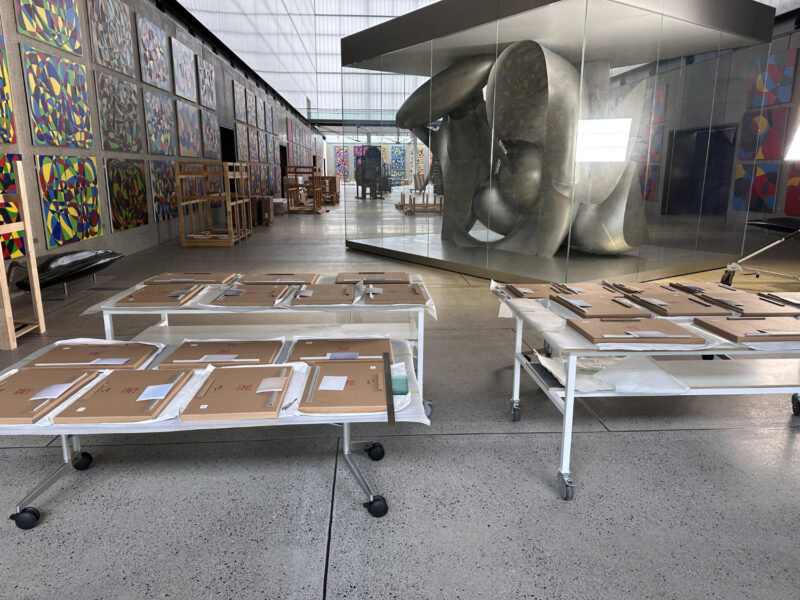
The artworks receiving treatment in the gallery.
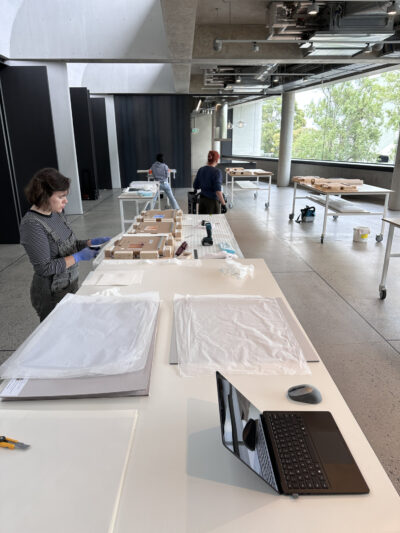
Rebecca Clendinen during treatment.
Textiles
Christina Ritschel, Principal Conservator & Head of Textiles, has been hard at work treating several significant tapestries.
Most recently, she completed conservation on the National Trust Mortlake Tapestry from Redford Park. The failing backing cloths and Velcro were removed, fragile silk sections were stabilised, and areas of loss were carefully compensated. The tapestry was then given a new full backing supported with spaced cotton straps to evenly distribute its weight when hanging, together with a new Velcro hanging system along the top.
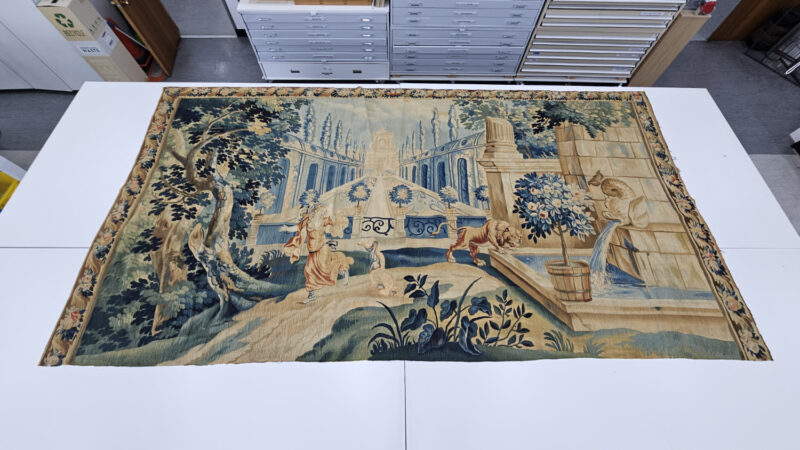
Retford Park Tapestry after vacuuming.
Christina and Annabelle Silk, Conservation Technician, surface cleaned the impressive Mona Hessing Tapestry at the Sydney Masonic Centre.
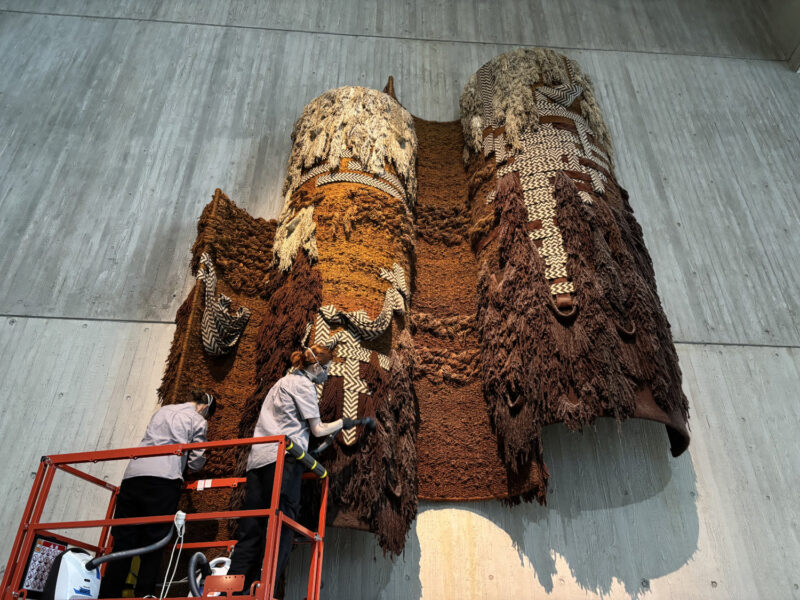
Christina Ritschel and Annabelle Silk cleaning the Mona Hessing Tapestry.
Christina and Keir Bayley, Principal Metals Conservator (on loan from the OOBH team), surface cleaned the BNP Paribas Tapestry – Terra Australis, by John Coburn in the Elizabeth Street lobby after hours.
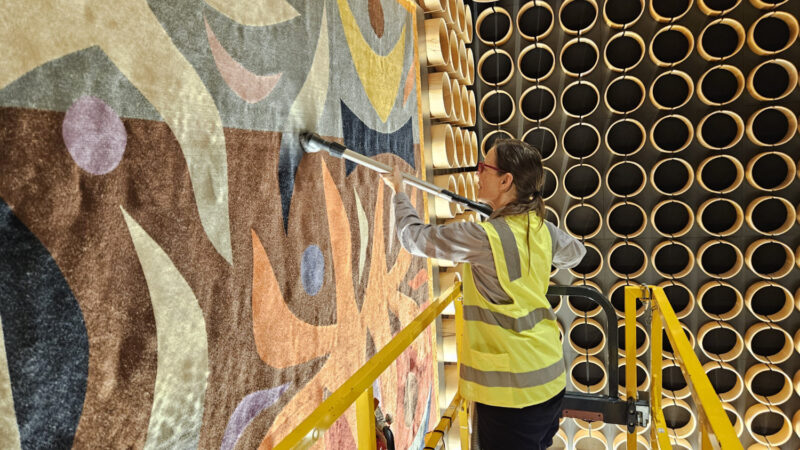
Christina Ritschel cleaning the Terra Australis tapestry.
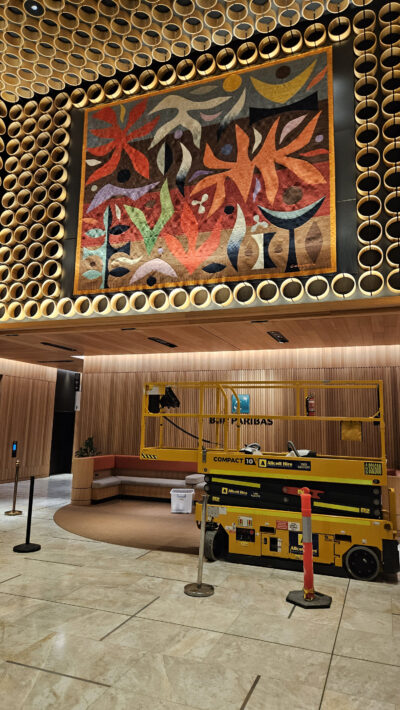
Terra Australis tapestry by John Coburn after treatment.
Christina, Annabelle, and Lisa Sharp, Conservation Technician, surface cleaned the 12-panel Hunter Tapestry by Mary Beeston in the Great Hall of Newcastle University while Keir adjusted the metal backing boards to accommodate the dimensional change that has occurred over time to the tapestry panels.
Finally, Christina assisted Katie Smith, State Manager Vic, during the installation of two tapestries hung in an oval from a free-hanging armature at the newly constructed Footscray Hospital.
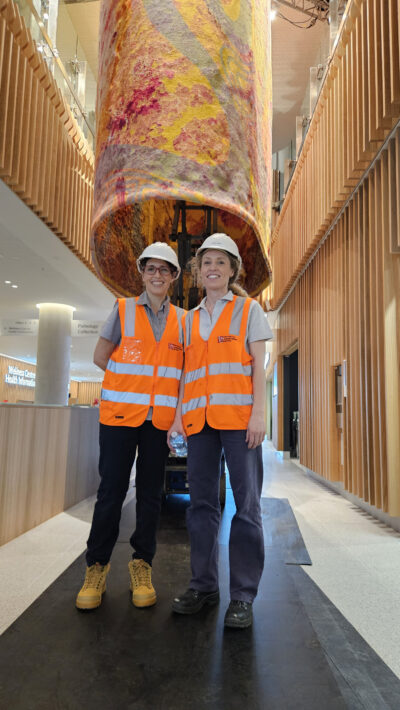
Christina Ritschel and Katie Smith after the tapestry hang completion.
Aside from tapestry treatments, Lisa completed mould remediation on a collection of water damaged fans, which are now being assessed for further treatment. And Annabelle is finalising the last treatments and Velcro applications to the Possum, Quoll, Platypus and Unknown fur blankets in preparation for conservation framing.
Objects, Outdoor & Built Heritage
The Objects, Outdoor & Built Heritage team recently gave a big welcome to Emma Ward, Objects Conservator, and Kacey Green, Objects Conservator. We were also delighted to welcome two interns: Matilda Smith from the University of Sydney, and Luna Daffnay from the University of Antwerp, Belgium.
Joy statue
Keir Bayley, Principal Metals Conservator, recently completed the conservation of Joy – widely regarded as the world’s first statue of a sex worker. The original artwork, constructed from a cement mixture with white paint over a painted steel armature, is housed at Macquarie University in Sydney.
Keir was then commissioned by the City of Sydney to project-manage the creation and installation of a bronze replica of Joy. Working closely with the original artist and the foundry, he oversaw the entire process from casting to placement.
The new bronze Joy has now been installed at the corner of Yurong and Stanley Streets in Darlinghurst, returning the sculpture to the site where it originally stood from 1995 to 1997 before its removal amid controversy.
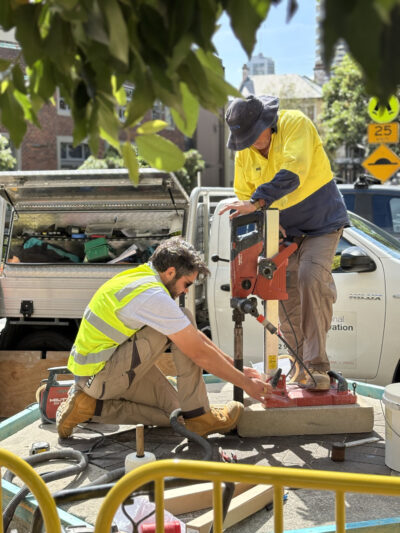
Installing Joy.
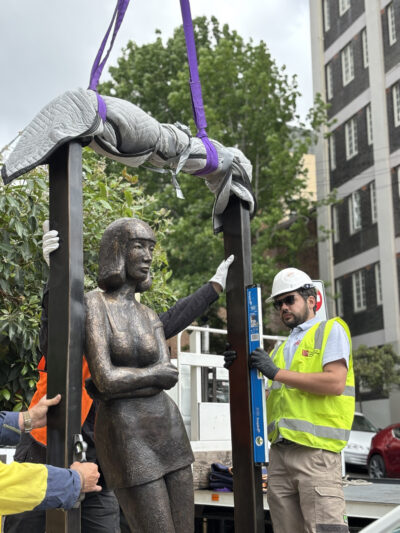
Keir Bayley installing Joy.
Anzac Memorial oil clean-up
Jenny Snowdon, Senior Built Heritage Specialist, and Emma Ward, Objects Conservator, were called in to address a serious incident at the Anzac Memorial in Hyde Park.
In September and October, the site was maliciously targeted with oil on two separate occasions. Thanks to their swift and expert intervention, the granite, stone and bronze surfaces were cleaned effectively, preventing what could have been permanent damage and staining to this important heritage landmark.
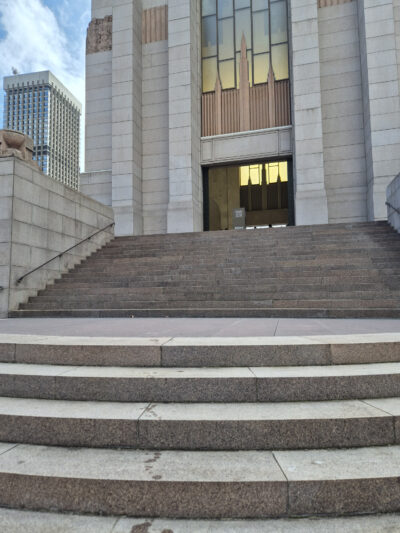
The Anzac Memorial with oil stains on the steps.
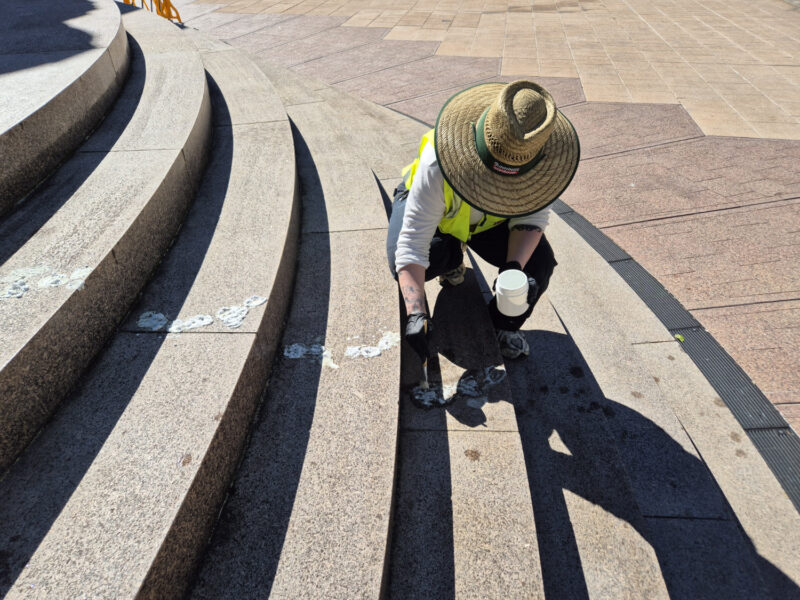
Emma Ward cleaning the Anzac Memorial steps.
Journey to Blacktown by Jun Caingat
Alis Jitarescu, Principal, Decorative Arts & Murals, along with Elric Ringstad, Senior Conservation Framer, and Ned Carr, Conservation Technician and Framer, recently conserved the 8 ft × 8 ft acrylic mural Journey to Blacktown by Jun Caingat, displayed at the Blacktown Bus/Rail Interchange.
The mural was carefully removed from the site and underwent an overall surface clean. A new custom frame was fabricated to support the artwork, and a protective polycarbonate sheet was added to safeguard it against future wear, ensuring its continued preservation for the public.
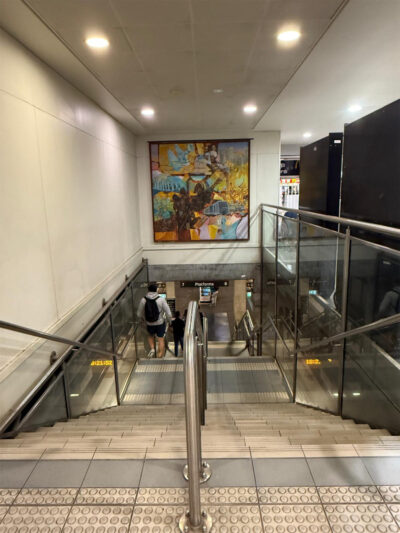
Journey to Blacktown in situ before treatment.
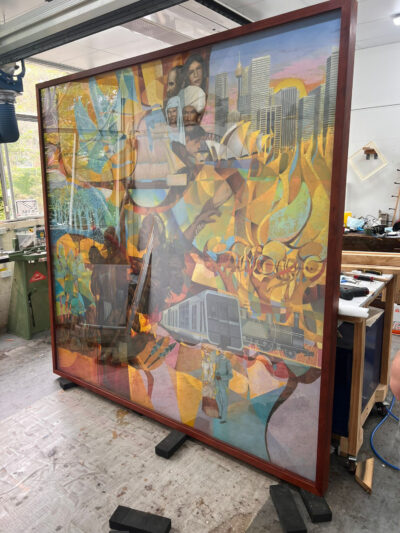
Journey to Blacktown after cleaning and framing.
Museums of History NSW
At Museums of History NSW (MHNSW), we have undergone several changes in staffing in recent times. Sadly (for us) Registrar Alex Shapley has taken up an exciting opportunity at the National Portrait Gallery; Belinda Christie has moved to the First Nations Community Access to Archives Project digitisation lead role; and Sascha Gloor’s time with us as Coordinator, Collection Barcoding, has come to an end. We’d like to thank Sascha, Belinda and Alex for their support and contribution; we will miss them greatly.
At the Western Sydney Records Centre (WSRC) we welcome conservator Kimberley Chung to the team – welcome Kimberley!
Projects
WSRC 50th anniversary
The team at the WSRC has been busy preparing for the 50th anniversary of the records centre, the home of the State Archives collection, and held an open day on 22 November to celebrate. Visitors were able to go on behind-the-scenes tours, see collections up close, listen to expert talks, and enjoy family-friendly activities such as letterset printing and mosaic art. The conservation lab was open for visitors, and we had many curious members of the public pop in for a chat with the conservation team whilst we worked.
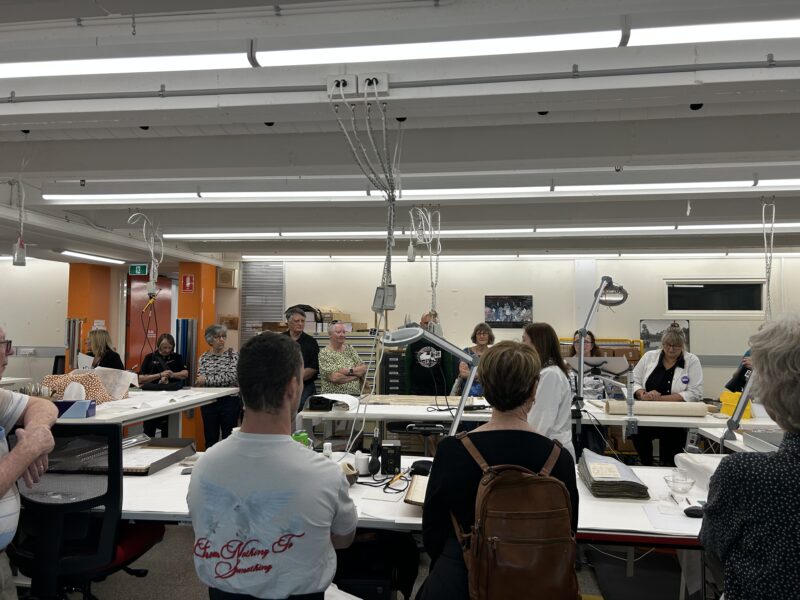
Clara Cesarone, Paula Thorby and Jacinta Sanders at the WSRC 50th Anniversary Open Day. Image credit: Lang Ngo for MHNSW.
MV Cape Don site visit and ship models
Conservator Tristan Congreve recently undertook a site inspection of the Cape Don ship model RNCG-4344-16-[A3580 3] which is on loan to the Sea Heritage Foundation on board the MV Cape Don, a former research vessel and lighthouse tender, in Waverton, Sydney. The site inspection was also useful as we have other ship model cases at the WSRC, which we would like to open to clean and remediate the lead disease. The Sea Heritage volunteers returned the favour by visiting the WSRC in late November to view the polar engine model which is on the Cape Don ship!
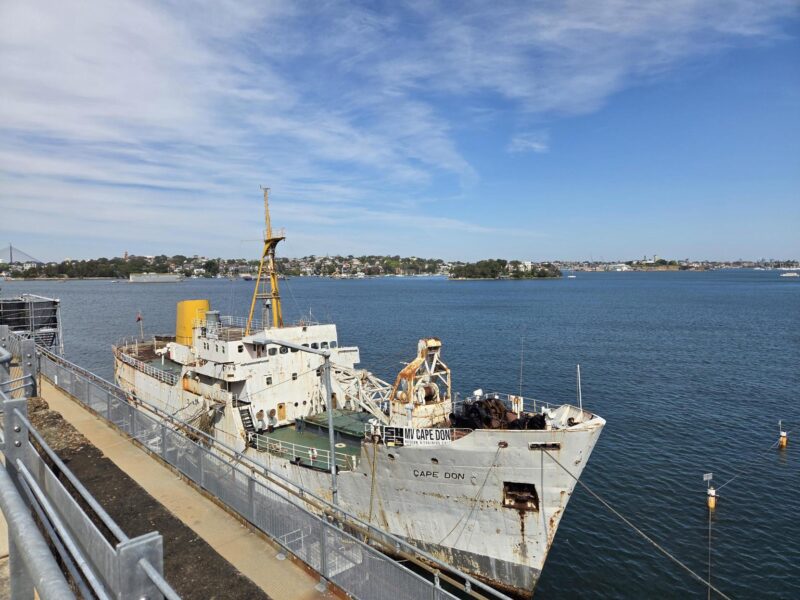
The MV Cape Don. Image credit: Tristan Congreve for MHNSW.
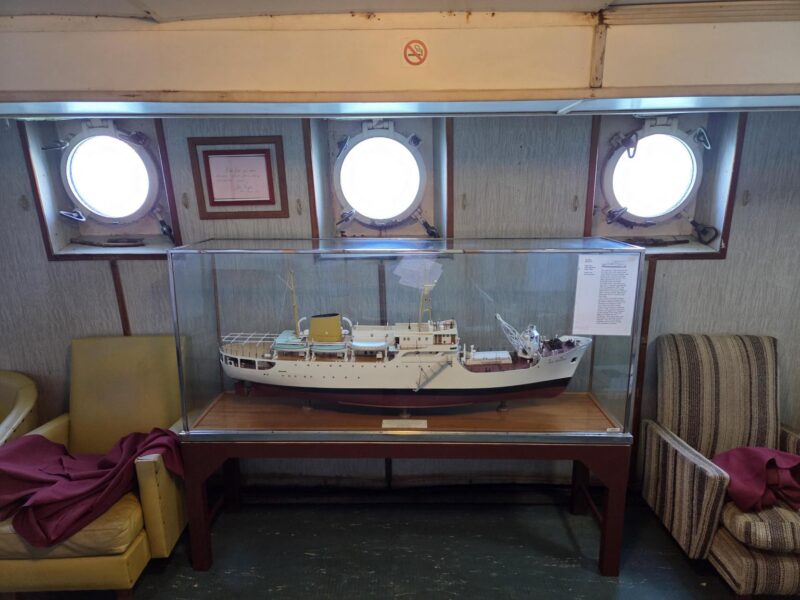
Cape Don ship model. Image credit: Tristan Congreve for MHNSW.
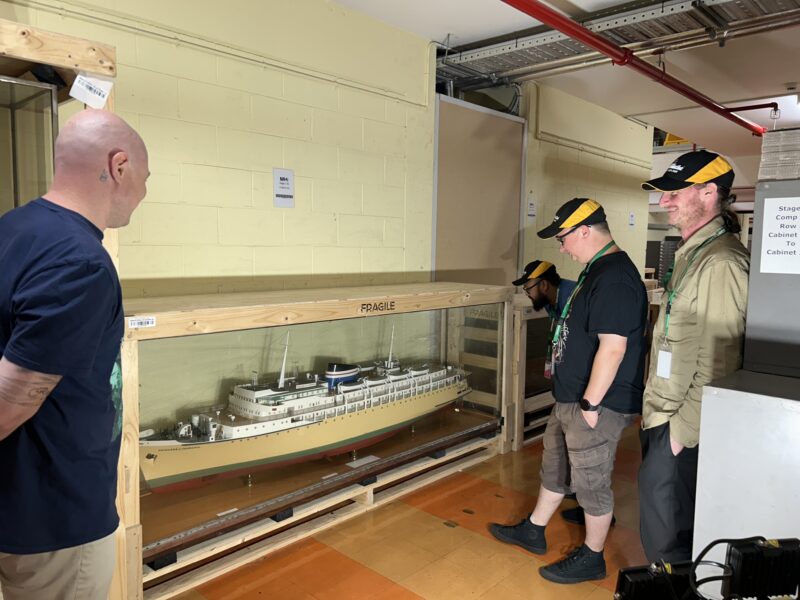
The Sea Heritage crew visiting the WSRC in November, viewing the Spirit of Tasmania ship model. Image credit: Lang Ngo for MHNSW.
Assistant Conservator Pinkal Pandya has been working with us on a project to preserve and prepare records from Parliament NSW. Pinkal completed this project on 14 November.
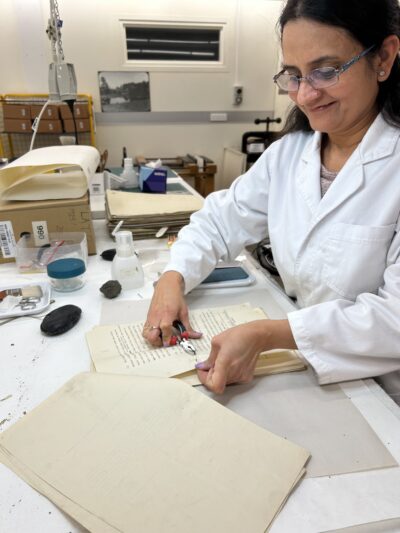
Pinkal removing the last pin from the PHNSW records. Image credit: Lang Ngo for MHNSW.
Assistant Conservator Paula Thorby and Conservators Clara Cesarone and Jacinta Sanders have been treating correspondence from early immigration records for a digitisation partnership program. Jacinta has also been preparing letters from bushranger Andrew Scott (better known as Captain Moonlite), which will go on loan to the State Library of Victoria for an exhibition next year. Captain Moonlite has been the subject of some media attention in recent years and these letters written by Scott when awaiting execution in 1880 detail his love and relationship with fellow gang member Jim Nesbitt (then deceased) to Jim’s mother.
Exhibitions
The team deinstalled the exhibition Seeing Sydney Knowing Country from the Museum of Sydney in early November to make way for the upcoming exhibition Unearthed at the Museum of Sydney, which opens on 5 December 2025. Sarah-Jane Rennie, John Fisher, Phoebe Clarke, Alex Shapley, Annabel McWhinnie, Julieanne Rabier, Carlin De Montfort, Paula Thorby and Catherine Thomson have all worked on this exhibition which looks at the excavation of the site of the first Government House in Sydney between 1983 and 1991.
Together with the expert support-making skills of Kevin Bray, the team prepared a fascinating selection of objects excavated from the site, from remains of the first printing press in Australia to wine bottles transformed into tools by First Nations toolmakers, and elaborately decorated crockery hidden in a privy. The exhibition explores the tangible and intangible histories embodied in the finds and sheds light on the people who lived and worked at the house, and those whose lives were impacted by decisions made within its walls.
Events and building work
Sarah-Jane, Carlin and David White have been preparing the Overseers Cottage at Rouse Hill Estate for building work. This has involved lead remediation, which has complicated the task of protecting the collection.
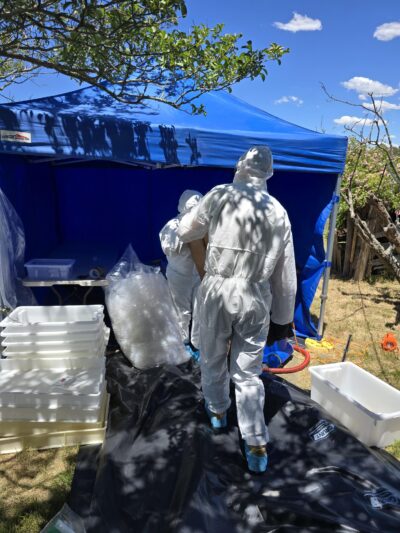
Sarah-Jane and Carlin removing lead-contaminated collections. Image credit: Catherine Thomson for MHNSW.
The team has also prepared collections for various events, including the launch of the 2025–26 Annual Giving Appeal, which this year focuses on the renewal of the Justice and Police Museum, and December’s Collection Series ‘Faces in Shadow’: Silhouettes from Our Collections.
O’Sullivan Conservation
In recent months, our team has been busy engaging in professional development and global knowledge exchange.
Emily attended the Big Stuff 2025 conference in Western Australia. The theme focused on the conservation of large and industrial heritage objects, with sessions on practical challenges and innovative solutions. The conference included field trips to heritage sites, offering an opportunity to see large-scale conservation projects up close.
Eoin participated in Metal 2025, the International Conference on Metals Conservation, in Cardiff, UK, in September 2025 (organised by ICOM-CC Metals Working Group). While at the conference he explored advances in metals conservation, corrosion prevention and sustainability.
Hannah represented O’Sullivan Conservation at STONE 2025 in Paris in September 2025 (organised by ICOMOS). The conference focused on stone heritage preservation, climate impacts and innovative treatment methods. Field visits to iconic Parisian monuments provided invaluable insights into current global best practice.
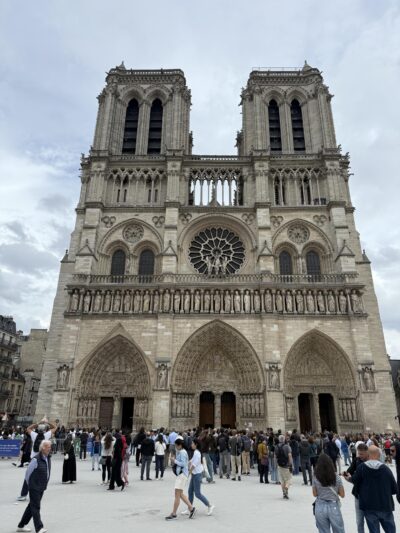
Notre Dame, Paris.
The highlight of the year, however, was reconnecting with colleagues at the AICCM National Conference 2025, held in Brisbane in November. The conference theme was More than Materials: Collaborative Approaches in Cultural Heritage Conservation. Hannah delivered a presentation on Uncle Jimmy Clements, and Eoin contributed as part of a panel discussion around the broader project with Australian Museum.
O’Sullivan Conservation was delighted to support the event as a sponsor, including sponsoring a First Nations speaker and providing sustainable items for the conference bag. The AICCM conference remains a cornerstone of our professional calendar, and we eagerly anticipate the next conference in 2027.
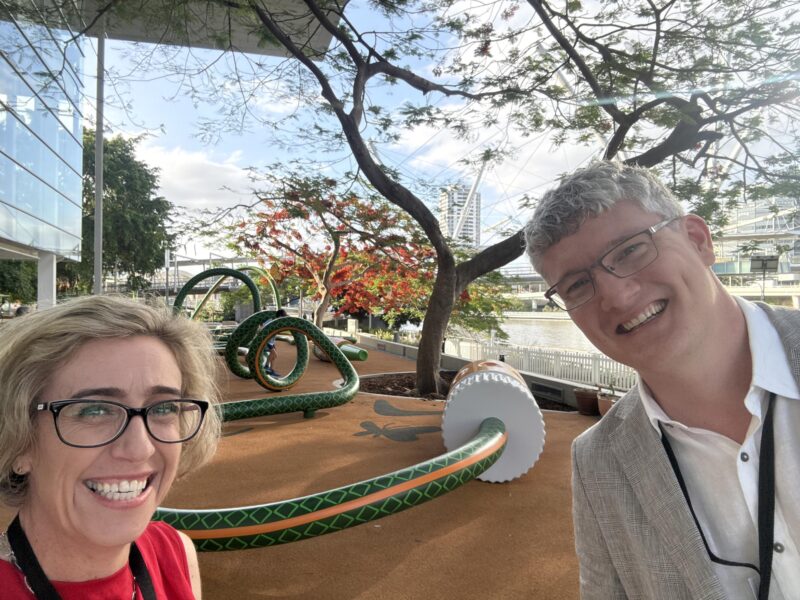
Hannah and Eoin at the AICCM National Conference with The Big Hose by Tony Albert (Girramay/Yidinyji/Kuku Yalanji peoples) and Nell (Sydney), 2025.
Staff news
During the second half of 2025, we were thrilled to welcome Madeleine Tripp and Stacey Hibberd to our conservation team.
Stacey joins us with a strong background in metals conservation, previously working in the UK. She holds a Postgraduate Diploma in Metalwork Conservation, along with a foundation in jewellery, silversmithing and blacksmithing.
Madeleine also brings extensive experience in international archaeological, museological and conservation settings, having worked in Australia and overseas. She has a number of qualifications in conservation and archaeology including a Master’s of Cultural Materials Conservation.
We are delighted to have Madeleine and Stacey on board and look forward to showcasing their contributions in future issues.
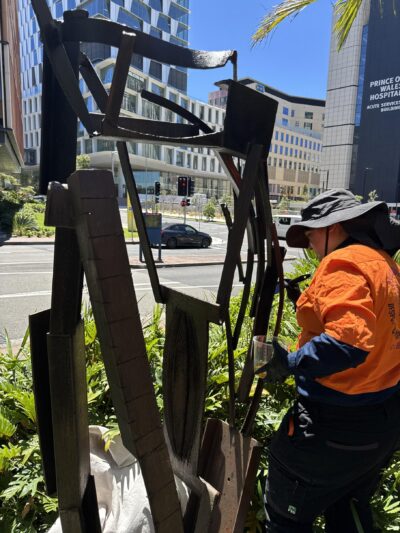
Stacey onsite undertaking a conservation treatment.
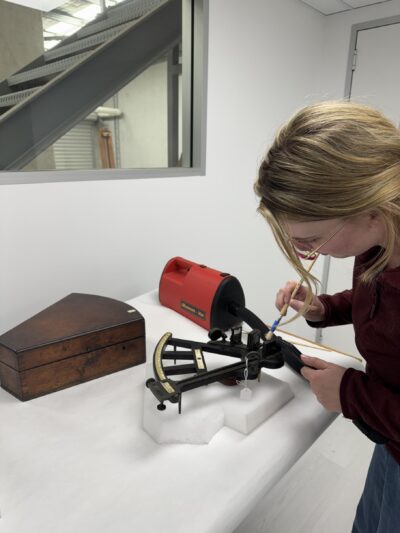
Madeline working in the studio.
Treatment projects
Our team has been busy delivering conservation across a diverse range of projects. Recently, we have undertaken conservation treatments and cleans to numerous monuments and sculptures in preparation for Remembrance Day, ensuring these important memorials are in excellent condition for commemorative events.
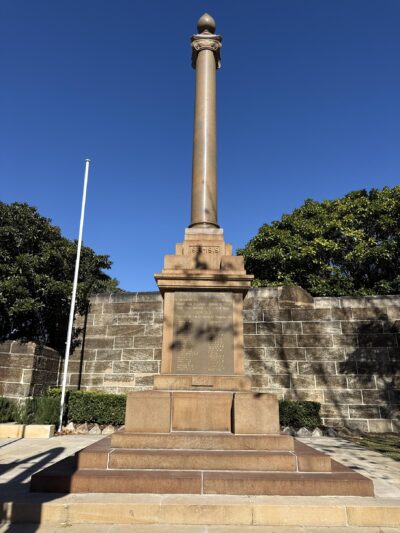
Paddington War Memorial, Unknown, 1922, after conservation treatment and repointing.
O’Sullivan Conservation was contracted to undertake conservation maintenance of the Shakespeare Memorial by Sir Edgar Bertram Mackennal, 1926, in Sydney.
The treatment included a full conservation clean of the memorial’s stone, as well as repointing of the mortar joints. This project forms part of our extensive portfolio of works conserving statues and memorials, ensuring these significant cultural landmarks are preserved for future generations.
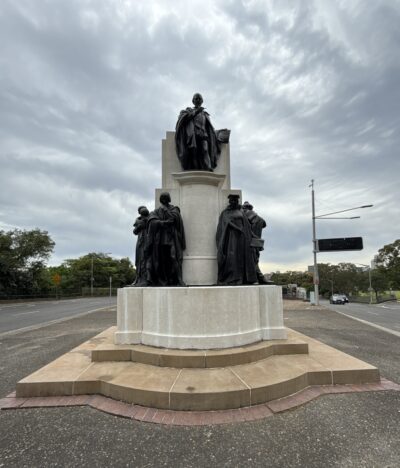
Shakespeare Memorial, Sir Edgar Bertram Mackennal, 1926, during conservation treatment.
We have been out and about over the last few months undertaking condition assessments of the public arts collection for the Inner West Council. This is a wide and varied collection including mosaics, murals and installations.
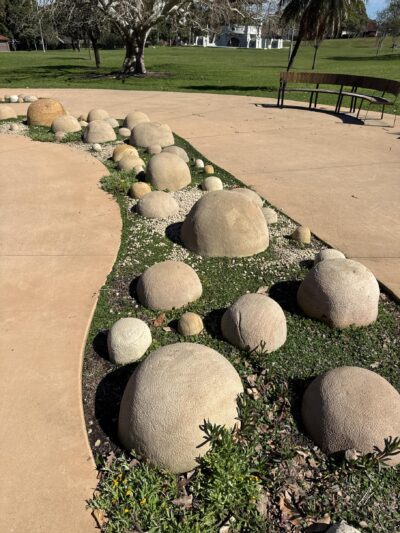
Breathe by Nicole Monks and Maddison Gibbs, 2024.
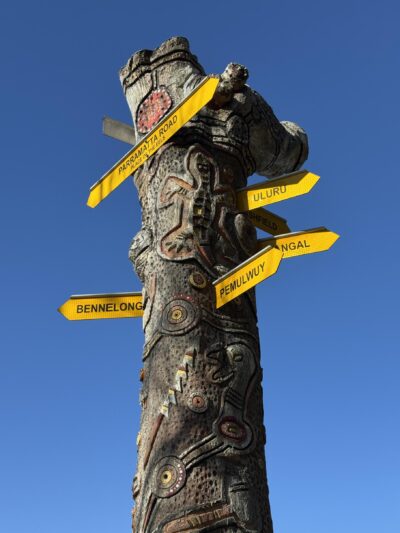
Totem Pole by Danny Eastwood, James Eastwood, date unknown.
State Library of New South Wales
The Collection Care team at the State Library of New South Wales has been through a period of change with several new staff joining us, bringing the team to full strength after more than 12 months.
Kate Hughes returned to the Library as a Senior Conservator in January and Phoebe Clarke returned to the Library as an Assistant Conservator in May. Jessica Gray-Hart joined the team as a Conservator on a fixed-term contract in July and Abigail Hundley joined us as a Senior Conservator in the same month. And, lastly, Sophie Potterat D’Abrigeon joined us as an Assistant Conservator following the vacancy created by Nicholas Beckett’s appointment as Conservator following a comparative selection process.
Phoebe Clarke, Assistant Conservator, recently rehoused the manuscript collection of Dorothea Mackellar’s ‘Core of My Heart’ – a poem later retitled ‘My Country’ and known to most Australians for the first line of its second stanza: ‘I love a sunburnt country …’
The collection was found wanting of rehousing when State Librarian Dr Caroline Butler-Bowden requested to take an item to a Sydney Morning Herald photoshoot celebrating the all-female leadership of Sydney’s cultural institutions.
The collection consists of Mackellar’s only known manuscript of the iconic poem in a notebook labelled ‘Verses 1907–1908’, alongside a first edition of her 1911 poetry collection, The Closed Door and Other Verses. Ephemera relating to the first publication of ‘Core of My Heart’ in British newspaper The Spectator (5 September 1908) was also found to be in poor condition, interleaved inside the poetry book.
Under the supervision of Senior Conservator Kate Hughes, Phoebe humidified and repaired the newsprint material from The Spectator and created a unified archival enclosure for the three items to live permanently in the State Library’s strongroom.
The Mackellar collection https://collection.sl.nsw.gov.au/record/nQR2Vgd1 is one of the State Library’s most iconic items. In February 2017, the manuscript was officially included on the UNESCO Australian Memory of the World register, which honours documentary heritage of significance for Australia and the world, and advocates for its preservation. It was the first Australian literary work to be added to the register.
This rehousing ensures a long-term storage solution befitting a national treasure.
Conservators Kiki Lawler-Dormer and Dominique Moussou planned and led the relocation of two oversized trades unions banners between two storage areas five floors apart. The two painted silk and canvas banners, measuring 3.5m and 4.1m long, do not fit into the lifts that access the storage floors and each weigh about 20–30kg. As a result, each had to be manoeuvred through the several sets of fire escape stairs with a team of up to 9 Collection Care handlers. They also both worked on the current major exhibition, Paper Universe, creating intricate and bespoke mounts for over 100 artists’ books. The exhibition runs until 3 May 2026.
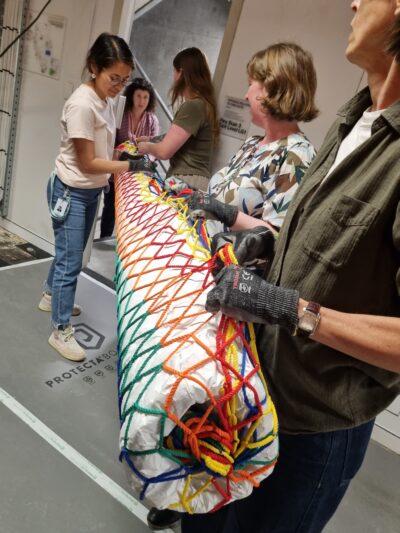
Manoeuvring one of the banners through fire doors and stairs.
Senior Conservator Felicity Corkill worked with the digitisation team and led Collection Care colleagues on the photogrammetry and digitisation of the Macquarie collectors’ chest https://collection.sl.nsw.gov.au/record/16AJ2jon. The chest itself was extensively documented for both processes, and the fragile preserved bird and insect specimens were photographed to a level not previously possible to enable fine details to be viewable online. Felicity has also engaged external conservation specialists to undertake an extensive survey of the condition of the chest, as well as that of the Dixson collectors’ chest, and initiate further research into the construction and provenance of both.
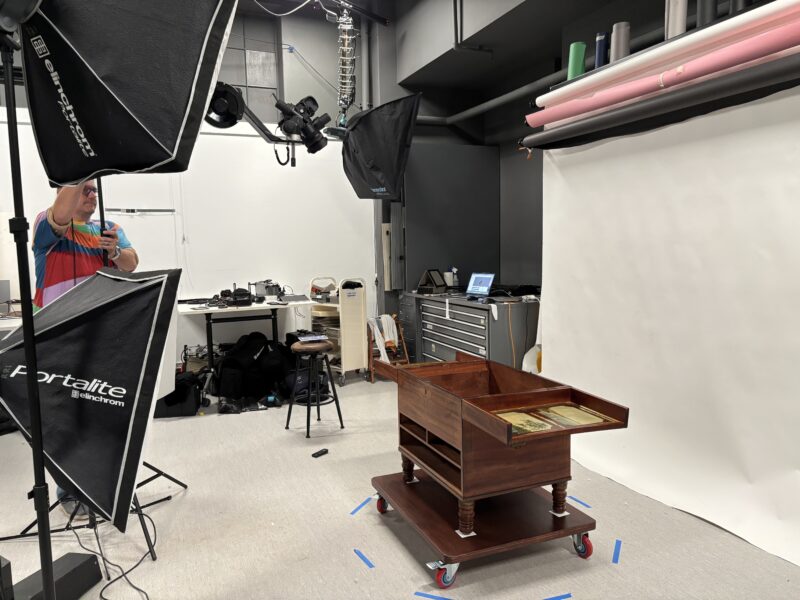
Macquarie collectors’ chest undergoing photogrammetry.
Conservator Nicholas Beckett undertook a lengthy project to treat a series of John Gould’s The Birds of Australia in original publisher’s bindings. This significant collection item and multi-volume set required considerable surface cleaning, sensitive binding repairs and careful rehousing.
Museum and Art Gallery of the Northern Territory (MAGNT)
Cyclone Season
‘You must be used to cyclones by now’, is a comment Darwin locals often hear. The truth is—we never get used to them. What we do is prepare thoroughly, hope for the best, and stay ready for the unexpected.
At MAGNT, our Cyclone Preparedness Plan is reviewed and updated each October, ahead of the Wet Season (officially November to April). This plan guides staff through preparation and recovery, outlining clear roles and responsibilities to ensure the Museum can respond quickly and effectively.
Working alongside this plan, our Collections and Conservation teams maintain a detailed Disaster Preparedness Manual. This manual identifies collection and loan materials requiring extra care, and sets out the staff, equipment, locations and actions needed at each stage of a cyclone—watch, warning and post-event.
Cyclones are notoriously unpredictable. A Category 1 system can intensify rapidly, as seen with Cyclone Fina. Initially rated Category 1, Fina passed Darwin as a Category 3 before strengthening to Category 4 on its path to Western Australia. While Darwin experienced relatively minor flooding and tree falls, MAGNT was well-prepared – and fortunate – to encounter just the outer edge of this unusually early-season cyclone.
When Darwin entered the Watch phase early in the week, the MAGNT Disaster Preparedness Committee regularly met to review and ready the emergency plan. By Friday 22 November, as the Warning phase was declared, Conservation and Collections staff had already commenced protective measures: loaned artworks were removed and covered, vulnerable pieces were relocated, dehumidifiers were installed in storage and gallery areas to counter rising humidity, and sandbags were placed at external and storage doors. MAGNT remained closed on 23 and 24 November while the cyclone passed. Backup generators supplied power throughout the weekend until electricity was restored on the morning of Monday 24 November. That afternoon, Collections and Conservation staff returned to prepare the gallery for reopening, reinstalling artworks and removing the dehumidifiers and sandbags. No damage was sustained by staff, collections or the building. On Tuesday 25 November, MAGNT reopened to the public. A review meeting to consider how we implement the MAGNT Disaster Preparedness Plan – and what we can improve – is soon to occur.
Preparation may not make cyclones less daunting, but preparedness is our best defence, ensuring we’re ready to protect staff and collections.
ICS International Conservation Services, Queensland
The Brisbane team is delighted to welcome Maite Le Mens as our new Senior Paintings Conservator. After seven years in private practice, Maite joins ICS full-time, bringing extensive experience and expertise to the team.
Liam Holmes, Paper Conservator, is excited that the paper lab is now fully operational, complete with new sinks and cabinetry, providing an ideal workspace for his treatments.
To support the newly established paintings lab, ICS has leased a second building next door to our main premises, expanding ICS’s capacity for ongoing and future projects.
Work has been busy, including conservation of privately owned and public sculpture. Metals specialist Keir Bayley from Sydney joins the Brisbane team as needed to assist with these projects.
With the disaster season starting early, Veronia Scorer and Jochen Letsch have been actively coordinating and conducting onsite visits, assessments and disaster response efforts, ensuring artworks and cultural assets are protected.
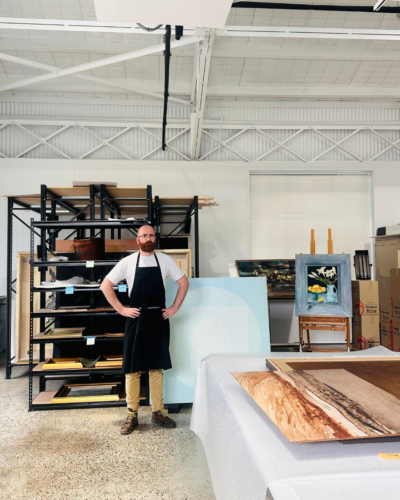
Liam Holmes, Paper Conservator in the Brisbane space.
Artlab
Paper, Books & Photography
September brought exhibition preparation to the Paper Lab for the celebration of Too Deadly: Ten Years of Tarnanthi at the Art Gallery of South Australia. Tarnanthi includes vibrant contemporary artworks by Aboriginal and Torres Strait Islander artists. Three large artworks in ink, paint and graphite on high grammage paper were prepared for framing on black backboards with internal Japanese paper hinging and TruVue Optimum Acrylic. Working closely on Iluwanti Ken’s incredible Walawulu ngunytju kukaku ananyi (Mother eagles going hunting), 122 x 152cm, for permanent conservation framing was a highlight. Four works were also hung in the Art Gallery using Japanese paper back pockets with magnets for the exhibition, which required high concentration and handling precision for these very large, pristine and pigmented works on paper.
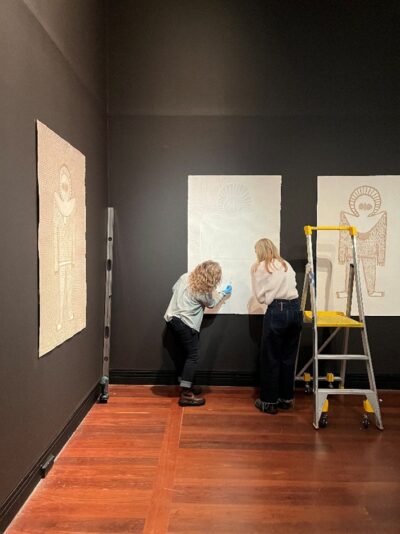
Principal Paper Conservator Aquila Evill and Bernadette Klavins, Artistic Programs, Tarnanthi, inspecting artist Angelina Karadada Boona’s Wandjina Emerging following installation. Image credit: Artlab Australia.
The Paper Lab was very proud to have two members representing Artlab at the AICCM National Conference. Yuhong conducted as session Chair on the last day of presentations, tying the session together beautifully, and Aquila delivered an insightful and polished talk with Artlab objects conservator Sophie Parker regarding the Yirrkala Bark Petition of the Buku-Larrnggay Mulka Arts Centre. Aquila and Sophie discussed themes considered throughout the conference including connections and respectful understanding while delivering high quality conservation and ongoing preservation strategies for this unique and significant item.
Projects
Projects has continued with the undertaking of commercial public art condition assessments and subsequent treatments for various memorials and outdoor statuary in the heart of Adelaide, throughout 2025. After conducting treatments of the Pugi brothers’ Canova’s Venus and of Robbie Burns, the Australasian Soldiers (Dardanelles) Memorial was next on the waiting list for some conservation preservation love, as well as some emergency graffiti removal ahead of Remembrance Day.
The Cripps Institute for Cultural Conservation, The University of Melbourne
Staffing news at Grimwade Conservation Services
After a 22-year career at the Grimwade Centre, we bid farewell to Holly Jones-Amin as she embarks on an exciting new journey. Holly will be taking on the role of Lecturer in Art History and Art Curatorship within the School of Culture and Communication in the Faculty of Arts, at the University of Melbourne.
Holly has contributed significantly to our commercial and academic teaching programs. Holly was the first objects conservator on staff, and established the commercial objects lab, expanding our client base and forming strong relationships with peers and clients alike. Some of the significant projects she has been involved in include the War Heritage Roadshow and the Loong Conservation Project at the Golden Dragon Museum in Bendigo. Holly has managed the growth of archaeological conservation through the Metro Tunnel project and subsequent engagements with partners across Melbourne. Her expertise extends beyond Melbourne, with projects in Gallipoli, Georgia, Papua New Guinea and the Himalayas.
Holly was also instrumental in developing the Master for Cultural Material Conservation course at the University of Melbourne. As an educator, teaching into the program over many years, Holly has been a great mentor to many conservators during her time at the University.
Alongside all this she has completed her PhD on the conservation of low-fired archaeological ceramics. Holly’s generous spirit and expertise will be greatly missed by the Grimwade Centre team. We look forward to seeing her future achievements in her new role and wish her the very best. Keep an eye out for her book on the archaeology, conservation, restoration and analysis of low-fired pottery in 2026.
Maddy Fraser and Rachel Davis, both graduates and emerging conservators from the Grimwade Centre’s Master of Cultural Materials Conservation program, have recently joined the Paintings Conservation team. Maddy Fraser joins us from FARCO in the UK and Rachel Davis from Te Papa Tongarewa, New Zealand.
Southern West Yiradyuri camp
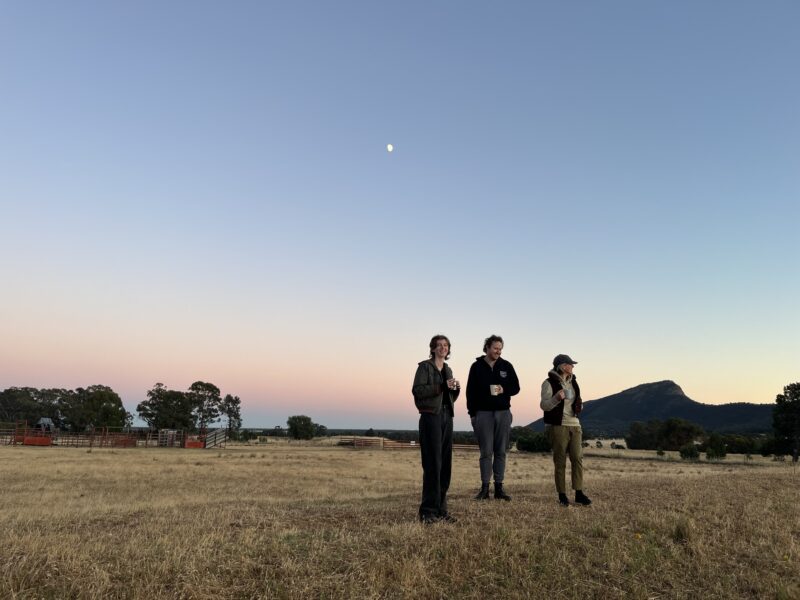
From 7 to 11 November, a group of 6 students and 2 staff members attended a With Country Camp organised in partnership with Will Carter, (Yiradyuri/Ngunnawal), Executive Advisor, Indigenous Strategy and Partnerships, University of Melbourne, and Southern West Yiradyuri Clans Land, Water and Sky Country Aboriginal Corporation.
The five-day journey explored the theme ‘Country, Knowledge, and Shared Futures’. Camping on Country near The Rock, NSW, and Kengal National Park, we were privileged to learn from Elders and Knowledge Holders about cultural practices, stories and landscapes, and how they shape identity, law and belonging.
We were welcomed and made safe on Country with a smoking ceremony where we were invited to understand Country as a teacher and our responsibility to care for it. We experienced sustainable cultural practice by making string from splicing fibres of the kurrajong tree and weaving it into a small dilly bag that symbolically holds the knowledge transmitted to us by skilled Knowledge Holders.
Visiting sites and understanding protocols of land and water helped us to slowly feel how Indigenous knowledge is embedded into the landscape and the environment, the philosophy of Yindyamarra that commands respect, going slowly and governs ways of being and keeping one accountable.
We were taught about the living ecosystem and the shared responsibility to protect and maintain it and participated in a plant identification survey for the Corporation’s future project of a native nursery, recording plants names (Indigenous and English) and status, and drawing their features.
Our hosts generously shared their knowledge and created a safe space where we had discussions on lived experience, ongoing impact of colonisation and trauma, legal challenges and shared futures.
We are very grateful to the Southern West Yiradyuri Clans Corporation for allowing us to live this experience; it has taught us respectful engagement with people and community, triggered deep reflection, and encouraged us to slow down and take time to appreciate and to apply Indigenous knowledge in professional and personal contexts.
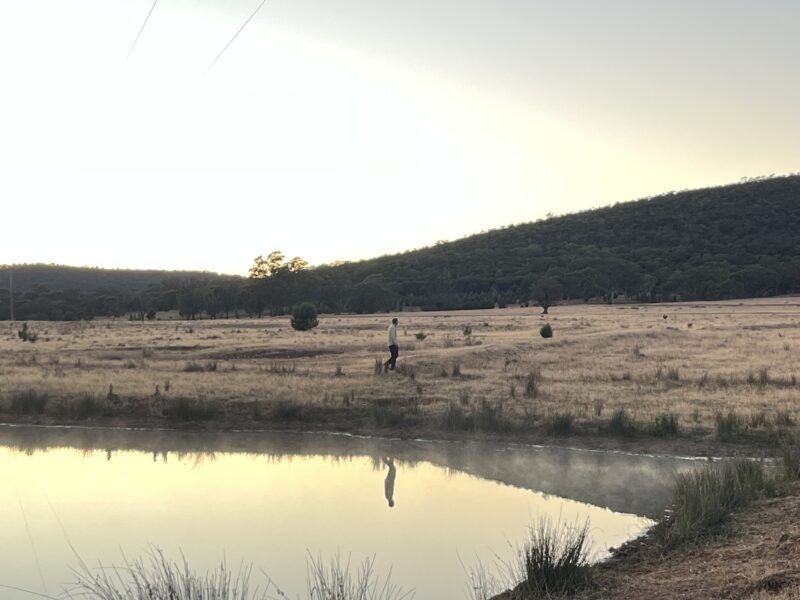
Students looking for special bird at sunrise along the dam, 2025.
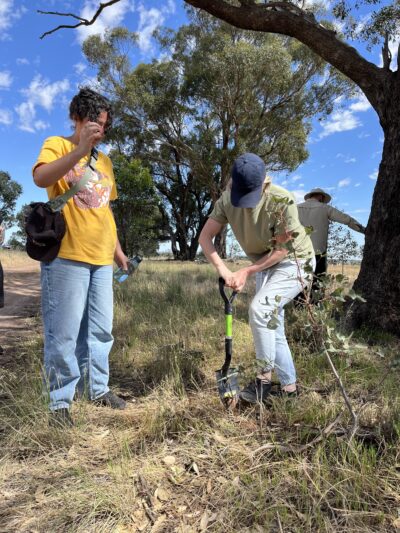
Finding the edible root of the kurrajong tree, 2025.
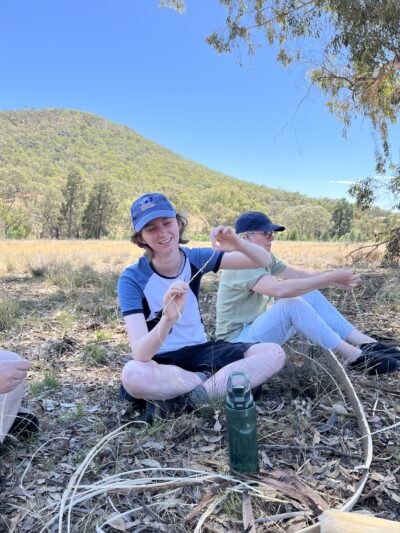
Making twine out of the spliced fibres of the kurrajong tree, 2025.
2025 ANKA AGM
The Arnhem Northern and Kimberley Artists (ANKA) Aboriginal Corporation AGM and annual conference was held in Darwin on 5–6 November. More than 100 attendees from art centres across the Kimberley, Arnhem Land, Tiwi Islands and Darwin-Katherine regions gathered in the capital city to discuss strategic priorities for the next year. ANKA is a key industry partner of the Grimwade Centre. As PhD candidates, we (Caleb Triscari and Cheralyn Lim) spent two weeks in Darwin assisting ANKA with the final preparations for the AGM and conference.
Over the fortnight, we helped the ANKA team with confirming travel and accommodation for attendees, organising the conference program, designing and printing lanyards, greeting attendees as they arrived in Darwin, and providing general support on the day of the event.
PhD students Cheralyn Lim & Caleb Triscari, ARC Laureate update
Our main undertaking in the first few months of our candidature has been laying the contextual and relational groundwork for our PhD projects. This included a trip to Darwin in November to assist project partner ANKA with its AGM and conference.
The ANKA conference was a great opportunity to introduce ourselves to the art centres’ managers, artists and arts workers with whom we will be collaborating over the next few years. It also gave us first-hand insight into the challenges that these stakeholders face around sustainable funding, staffing, conservation and the threats of climate change.
Inaugural public engagement events at the Cripps Institute for Cultural Conservation
This year saw the launch of public events for the Cripps Institute. UK paintings conservator Sarah Cove presented a public lecture titled Fakes and Fortunes! (or, have I found a Constable in my attic?) on 9 October 2025. Sarah founded the Constable Research Project in conjunction with the V&A Museum in 1986 to study John Constable’s materials and techniques from the technical and scientific point of view. In this lecture, she provided a behind-the-scenes look at how authentication decisions are made and described some of her extraordinary successes and crashing disappointments. Stories included a hugely publicised oil sketch seen on Breakfast TV, reputedly worth £250,000, and the chance discovery of a fabulous, almost abstract, rare oil study of the 1830s that had formerly belonged to an American GI.
A second lecture, Accelerator mass spectrometry techniques for cultural heritage studies and objects authentication, was presented by Dr Vlad Levchenko, Research Scientist at Australian Nuclear Science and Technology Organisation (ANTSO). The presentation explained the basic principles of radiocarbon dating and accelerator mass-spectrometry, as well as ANTSO’s capabilities in this field. Examples of various applications to cultural heritage objects undertaken at CAS ANSTO, spanning Egyptian artefacts to rock art and architecture, were also shown and discussed. Special attention was paid to dating modern objects.
Penny Byrne completes first stage of Benalla Ceramic Mural preservation
Grimwade Conservation Services specialist ceramics conservator Penny Byrne has recently completed the first stage of a large conservation project to preserve the iconic Benalla Ceramic Mural. Urgent works to repair a failing wall and delaminating tiles, plus remedial drainage works, were carried out by Penny and specialist heritage tiler Michael Hathaway. The response from locals has been overwhelmingly positive as the Mural holds a special place within the community, having been created over a 20-year period by local artists, engineers and architects.
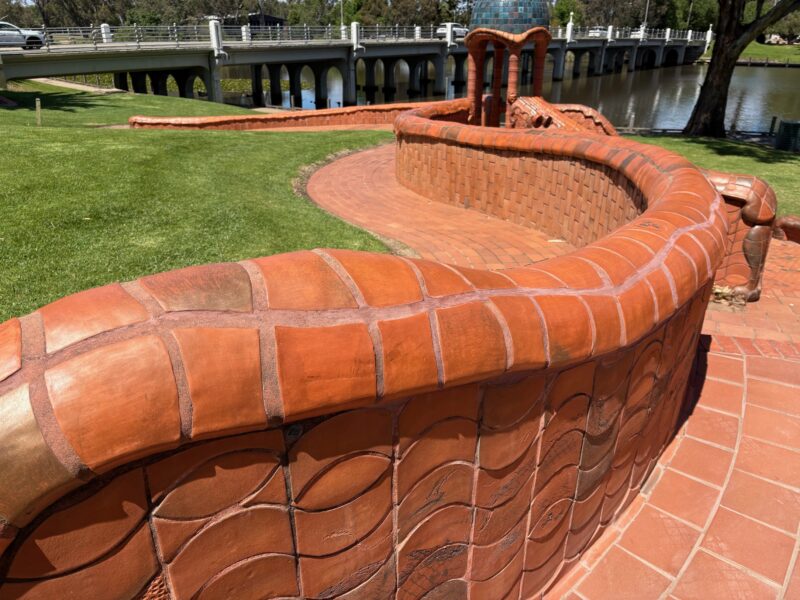
East braille wall after treatment, 2025.
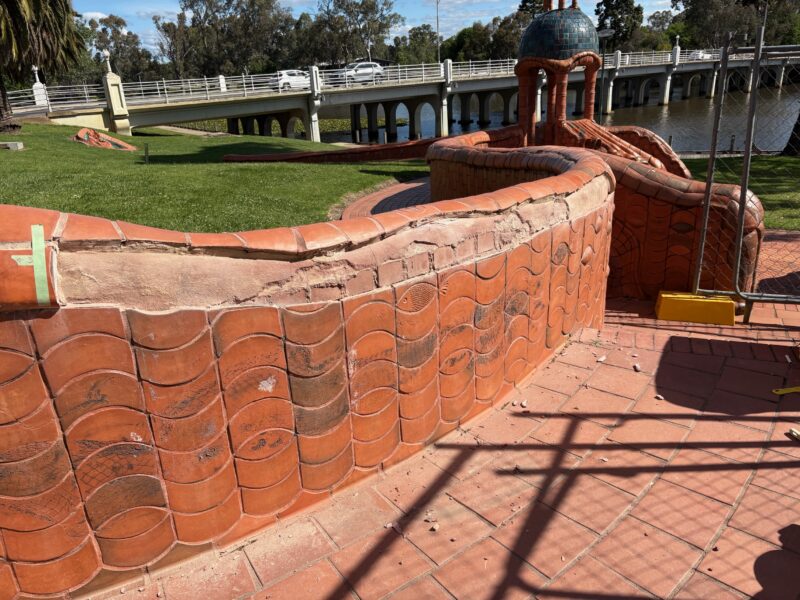
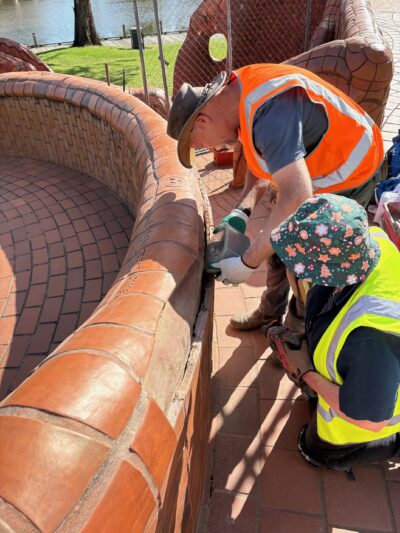
East braille wall before and during treatment, 2025.
Cutting-edge technology reveals hidden layers in Sidney Nolan’s iconic Kelly paintings
One of Australia’s most iconic artistic series, six of Sidney Nolan’s Ned Kelly paintings, was examined using advanced imaging technologies in a new collaborative project featuring Dr Paula Dredge, paintings conservator at the Robert Cripps Institute for Cultural Conservation. The project brought together the Canberra Museum and Gallery, Sydney Analytical at the University of Sydney, Celia Cramer Conservation, and Dr Dredge. The team used cutting-edge equipment, including an infrared reflectography camera and a portable X-ray fluorescence instrument, to probe beneath the visible paint layers. The team brought analysis out of the lab in the event Nolan Unmasked, undertaking XRF analysis at Canberra Museum and Art Gallery in sessions open to the public.
‘These works include some of Nolan’s most significant early Kelly paintings,’ Dr Dredge said. By visualising the hidden stages of their creation, we can uncover new insights into Nolan’s creativity and his process of making and meaning.
The investigation focused on paintings Nolan produced between 1945 and 1946 while working at the home of John and Sunday Reed, now Heide Museum of Modern Art. At the time, Nolan himself was an outlaw, having gone absent without leave from the Australian Army.
This is not the first time Dr Dredge’s research has revealed new dimensions to Nolan’s practice. In 2016, she collaborated with Heide curator Kendrah Morgan and Australian Synchrotron scientist Dr Daryl Howard to examine the 1945 painting Ned Kelly:‘Nobody knows anything about my case but myself’. X-ray fluorescence mapping revealed a fully painted head beneath the famous black helmet – possibly a self-portrait.
Dr Dredge’s longstanding scholarship on Nolan began with her PhD at the Grimwade Centre for Cultural Materials Conservation, University of Melbourne, undertaken between 2009 and 2013 with support from an Australian Research Council Industry Linkage Project grant.
Her research into Nolan’s use of house paint as an artist’s medium drew on materials left in his Sydney studio, as well as case studies from the Art Gallery of NSW and Heide.
In 2018, with support from the Gordon Darling Foundation and the Art Gallery of NSW, she undertook a research residency at the Sidney Nolan Trust in Wales.
The culmination of her doctoral and international research was the 2020 publication of Sidney Nolan: The Artist’s Materials, by the Getty Conservation Institute, which placed Nolan among a small group of 20th-century artists celebrated for their experimental approaches to materials.
Through harnessing state-of-the-art imaging instruments, Dr Dredge and her collaborators hope to shed new light on Nolan’s practice between 1945 and 1946. But, as she notes, the results may only deepen the intrigue.
This project was made possible through the support of the Robert Cripps Institute for Cultural Conservation, University of Melbourne; Sydney Analytical, a core research facility of the University of Sydney; Celia Cramer Conservation, the ACT Government; and the Commonwealth Government.
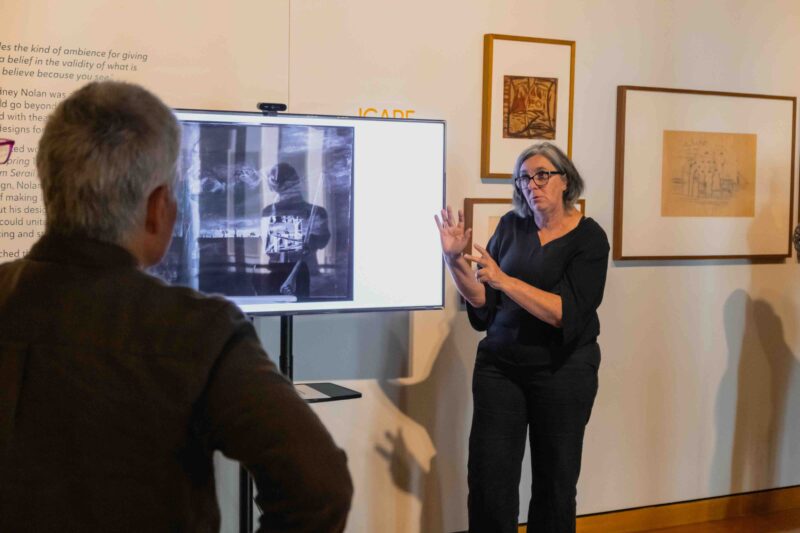
Dr Paula Dredge at Nolan Unmasked, 2025. Image: Dominic Northcott, Canberra Museum and Gallery, 2025
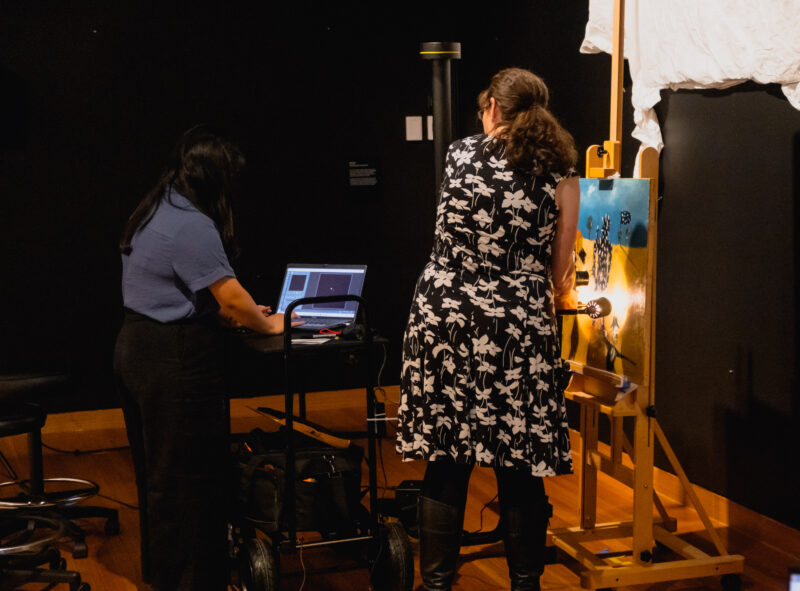
XRF analysis undertaken on one of Nolan’s painting as part of Nolan Unmasked at Canberra Museum and Gallery. Image: Dominic Northcott, Canberra Museum and Gallery, 2025
Special Issue for Journal of the Institute of Conservation
As Editor of Journal of the Institute of Conservation, the Cripps Institute’s Jonathan Kemp with Guest Editor Hélia Marçal steered an October special issue of 12 articles on the theme of ‘Conservation and Care’. Focused on the intersection of conservation and care ethics, its contributors explore fresh readings of care in conservation: who gives care, what care is for, caring-for and caring-with, in a diversity of responses – many Open Access – in the 170-page edited volume. We are especially honoured to have a cover image graciously agreed by senior Gija and Warmun artist Mabel Juli Wirroongoon – the painting Nyawawoordoony depicts a hill in Springvale Station country ‘where they been cover up my grandfather’. The volume is available here.
Dr Jonathan Kemp is invited speaker at Taiwan conference
In September, Dr Jonathan Kemp was an invited speaker at a two-day conference celebrating the 100th Anniversary of the National Palace Museum in Taipei, Taiwan. The Forum on Collections Registration and Conservation had session themes on Registration, Analysis, Objects and Paintings and was a chance to both celebrate the achievements of the National Palace Museum’s Conservation Department and meet with old and new colleagues from the Asia-Pacific region as well as from the US, France and the UK. One of those former colleagues was Yasuhiro Oka from Oka Bokkōdō in Tokyo, who discussed potential opportunities for exchanges between Melbourne and Tokyo.
After the conference, Jonathan travelled south to meet with colleagues at Cheng Shiu University’s Cultural Heritage Conservation Research Center, one of four MA conservation programs offered in Taiwan. Jonathan was invited to discuss capacity building in stone conservation in Taiwan in partnership with the Ju Ming Musuem in New Taipei, building on some work he and Grimwade PhD candidate Hohi Ikeda had done before they came to Australia. Travelling on to Japan, meetings were also held with Yoichiro Ozawa and Yukiko Watari of Tokyo Studio Co. Ltd, Japan’s largest art installation company, which is involved in contemporary art conservation.
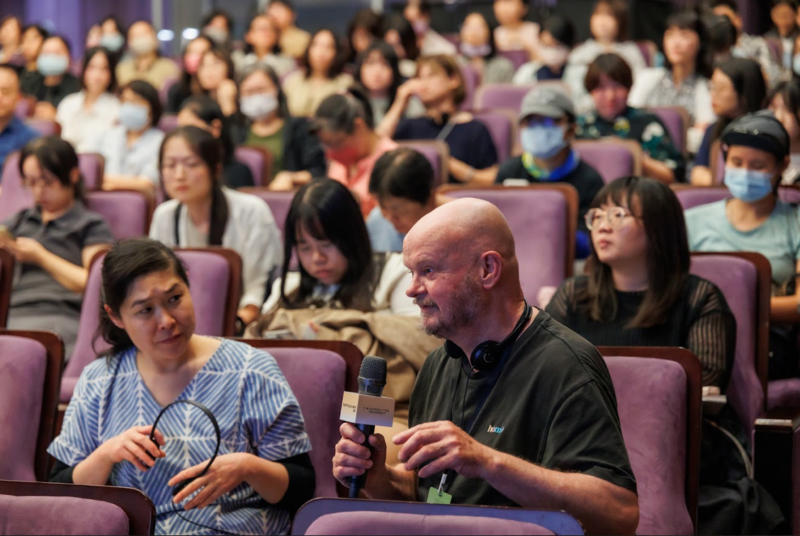
Dr Jonathan Kemp speaks at the 100th Anniversary of the National Palace Museum – Forum on Collections Registration and Conservation , Taipei, 2025.
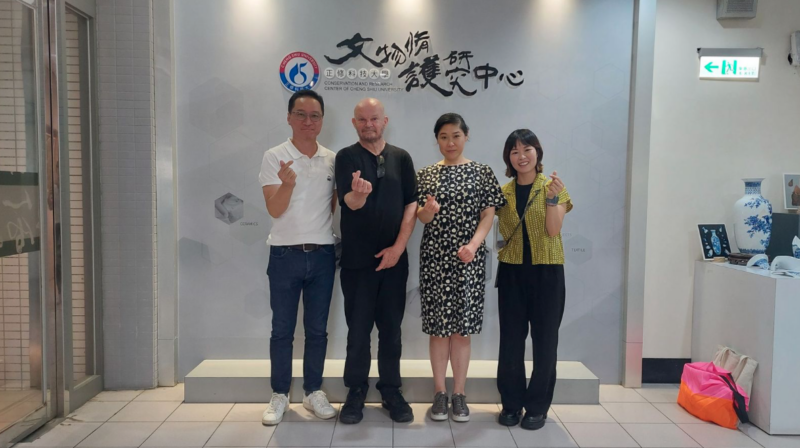
Dr Jonathan Kemp lab/studio visit and Conservation Roundtable, Cheng Shiu University Conservation & Research Centre, 2025.
ICS International Conservation Services, Melbourne
AICCM Awards 2025
The ICS Melbourne Team proudly accepted the Outstanding Conservation Project of the Year Award 2025.
The winning project – the conservation of the Victorian Trades Hall honour boards and tablets – was led by Eden Christian, Senior Conservator and Team Leader, Fine Arts. Through meticulous work, the team removed multiple layers of overpaint to reveal the original painted and gilded honour boards and commemorative panels hidden beneath, restoring these important historic artworks to their former presence.
For a closer look at the project: https://bit.ly/49t0RUr
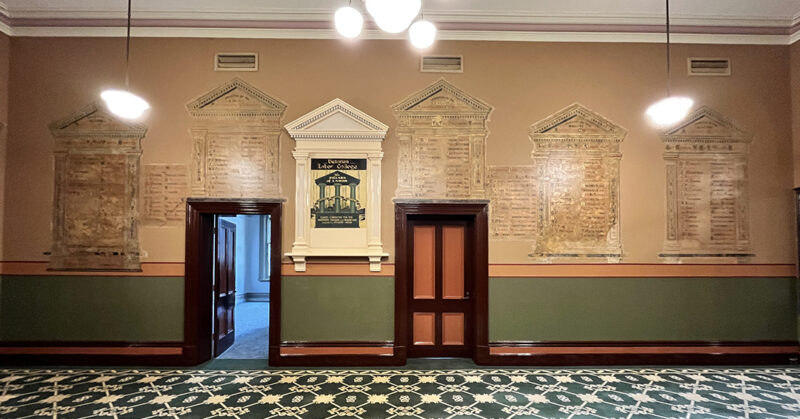
Victorian Trades Hall after treatment.
Cornwall painting collection
The Melbourne paintings team of Eden Christian, Lucy Moore, and Lily Monk recently conserved four family portraits dating from the 17th to 19th centuries, along with their gilt frames. Treatments included careful cleaning, varnish removal, overpaint correction and infilling. The finished works were met with great appreciation, highlighting the skill and meticulous care of the team.
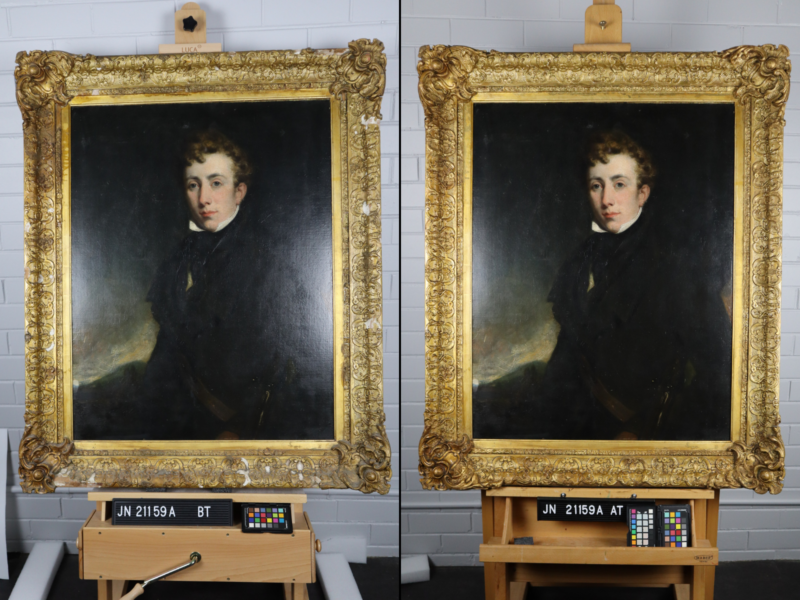
Portrait of John Downes, the frame before and after treatment.
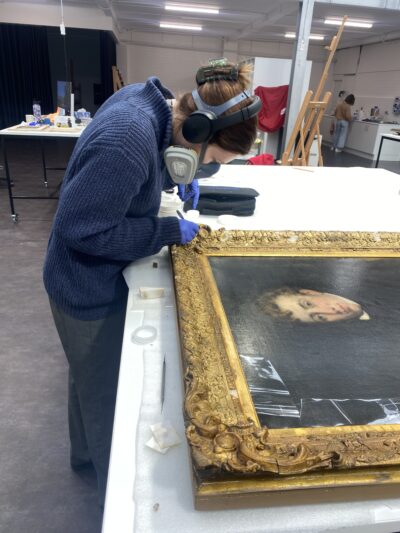
Lucy Moore, during treatment of the frame.
Beyond the Oceans of Existence
Zora Sanders, Senior Objects Conservator, recently reinstalled the bronze sculpture Beyond the Oceans of Existence in the newly reopened City Square, Melbourne, returning the artwork to public display and enhancing the revitalised civic space.
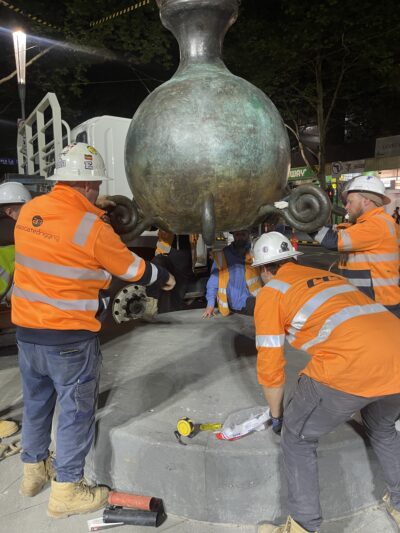
Reinstallation of the large bronze sculpture.
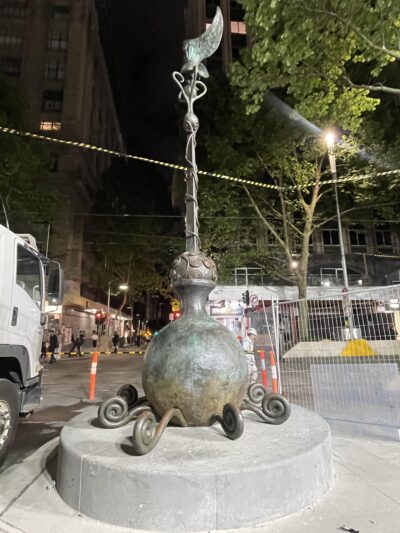
Beyond Oceans of Existence restored to City Square.
Government House
Eden Christian, Lily Monk and Lily Roberts, our intern from Grimwade, were invited to Government House, Melbourne, to conserve original wallpaper hidden beneath the current decorative scheme, addressing areas with holes and losses and helping to preserve this important historic fabric.
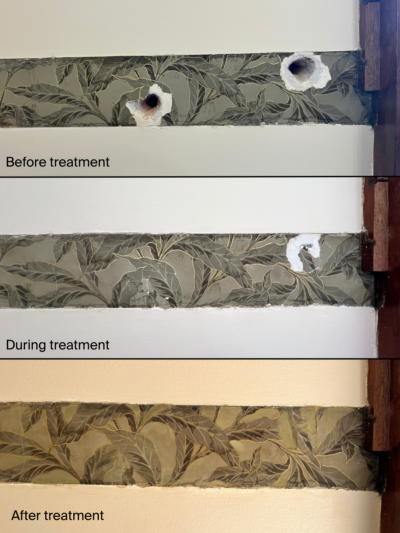
The wallpaper at various stages of treatment.
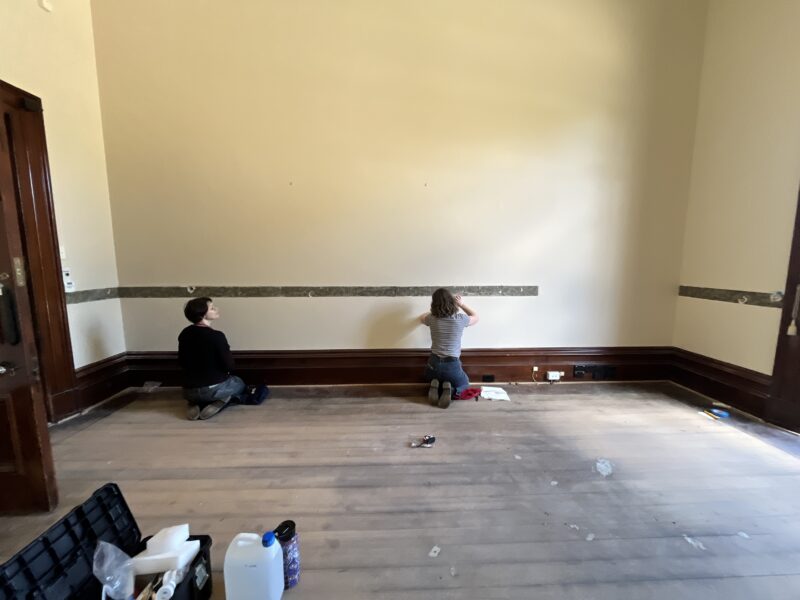
Lily Monk and intern Lily Roberts at Government House.
Tapestry installation at Footscray Hospital
Katie Smith, State Manager Vic, and Christina Ritschel, Principal Conservator & Head of Textiles, played a key role in the installation of the tapestry Welcome to Country – now you see me: seeing the invisible at the new Footscray Hospital. This three-dimensional work is one of the largest ever produced for a public hospital in Victoria and will greet patients, staff and visitors when the hospital opens in 2026.
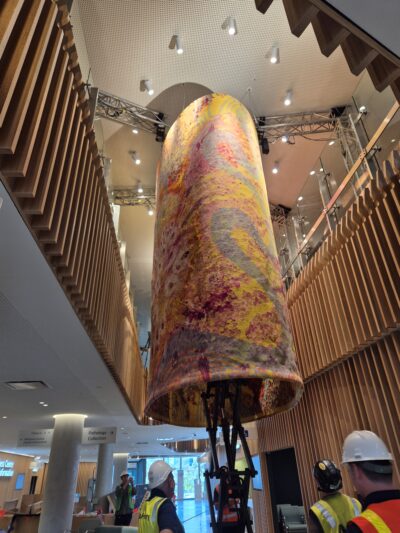
During the tapestry hang.
Paper Conservation training
Suati Rojas, Senior Paintings & Paper Conservator from Sydney, visited Melbourne to deliver tutorials on specialised paper conservation techniques. The team received hands-on guidance in humidification and flattening, washing to reduce stains, facings, linings and tear repairs.
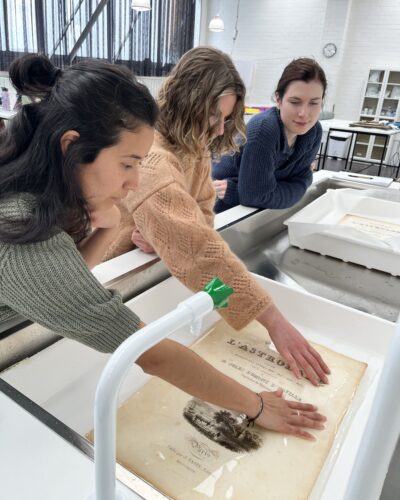
Suati Rojas with Lily Monk and Lucy Moore bathing a printed work.
National Gallery of Victoria (NGV)
First Nations Art
Genevieve Sullivan and Janelle Borig have recently returned from the National Gallery of Art in Washington DC after installing The Stars We Do Not See, the largest-ever touring exhibition of Australian First Nations art. Featuring a variety of artists and media, including Anwerlarr anganenty (Big Yam Dreaming) by Emily Kam Kngwarray and Reko Rennie’s neon OA WARRIOR I, it was a great opportunity to share these incredible works with overseas audiences and a massive effort from various teams to prepare everything this year.
Paintings
The past few months have seen steady progress on some of the ongoing major paintings conservation treatments reported in the previous newsletter: Raye Collins has continued varnish removal on Rene Magritte’s In praise of dialectics, Raymonda Rajkowski’s inpainting of Peter Upward’s large yellow circular canvas Io sono, and Carl Villis’s retouching of Salvator Rosa’s Romantic landscape with Mercury and Argus. Caitlin Breare has completed treatment of Adèle Romany’s Portrait of a gentleman and has commenced work on its companion piece, Portrait of a lady. Caitlin has also completed structural repair work on John Clayton Adams’ Trespassers.
With Raymonda and Caitlin on part-time schedules and Carl recently taking some long service leave, Raye has kept the Paintings Conservation section running smoothly.
Time-Based Media
In recent months, Manon Mikolaitis has been supporting the regional gallery network, particularly the Geelong Art Gallery. She is continuing to migrate the NGV’s historic collections onto digital formats.
Frames and Furniture
Frames & Furniture Conservation hosted University of Melbourne Objects Conservation student Emma Northwood in September and October. Emma’s main project was the documentation, structural repair, stabilisation and re-creation of ornament for a decorative 19th-century frame. Emma conducted research on this style of frame, referring to other examples to help in the attribution of a frame maker. Emma also worked with Jason King, Frame Maker, to apply foundation layers and ornament to a reproduction early 20th-century frame.
Jason and Holly McGowan-Jackson have been investigating using AI software and the NGV’s Formlabs Stereolithography 3D printer to create 3D frame ornament from 2D high-resolution images. Holly has treated frames for loans and permanent collection changeovers including the charming frame for the new acquisition Doris Hope Weston’s Claude Flight’s painting lesson (c.1928), likely to have been painted by the artist, with raised linework and engraving into the ground layer. https://www.ngv.vic.gov.au/explore/collection/work/157465/
For the latest permanent collection changeover, Suzi Shaw and Holly have been involved with the treatment, coordination, mounting and installation of two early 20th-century lights that were required to be lit for display. These were Frank Lloyd Wright’s Pendant light, from the Arthur B. Heurtley House, Oak Park, Illinois (c.1902), and Marion Mahony’s Pendant light shade (c.1924). Suzi and Holly worked with the NGV electricians, mount makers, and members of the installation and design teams to ensure the safe and engaging display of the lights.
Suzi was Coordinating Conservator for Nipa Doshi’s A room of my own, 2025, a MECCA X NGV Women in Design commission. The installation included a cabinet, ink jet prints and typeface, and Suzi was involved in many aspects including assisting with photography, filming, installation and cleaning.
Suzi has also been involved in several pest treatments including coordinating low-temperature pest treatment of large artworks in an off-site refrigerated shipping container, and part of the team running and providing in-house training on the department’s Mobigas low-oxygen pest system.
Textiles
A very brief report from the Textiles Conservation team this time as we are in the middle of installing Westwood/Kawakubo with our Exhibitions Conservation colleagues. The exhibition opens 7 December and brings together works from the NGV Collection with selected loans from international museums and private collections. We’ll catch you up on all our news in the new year.
Paper and Photographs
The Paper and Photographs Conservation team has just finalised preparation for the summer opening exhibition Women Photographers 199–1975: A Legacy of Light, featuring an array of works made by more than 80 women photographers. Ruth Shervington has undertaken conservation treatment of a small group of photographs prior to their display, including Self-portrait by Ilse Bing.
Louise Wilson has been examining two William Blake watercolours from his Paradise Lost series to identify how they were traced from the original versions painted by Blake for Reverend Thomas in 1807. In 1822, Blake’s friend and patron John Linnell commissioned him to make new versions of three watercolours from the series for his own collection. The NGV holds two of these works, The Creation of Eve and Satan watching the Endearments of Adam and Eve, while the Fitzwilliam Museum in Cambridge holds the third, Michael Foretells the Crucifixion. Photo microscopy paired with raking light and polarised light filters have aided Louise’s assessment; however, no definitive answers have been uncovered at this stage.
Bonnie Hearn recently began a survey of the NGVs Rare Book Collection, assessing the small but rich collection for its condition, need for treatment and housing. Throughout the survey, Bonnie aims to capture bookbinding techniques used to broaden descriptors and knowledge of the collection from a book conservation perspective.
Our team was very pleased this year to host Amelia Neale and Debbi Tan, paper conservation interns from the Grimwade Centre, University of Melbourne. Amelia and Debbi assisted us in treatment of photographs by Elsa Thiemann and Robert Rooney, 17th-century French engravings by Jean Le Pautre, and XRF analysis of 19th-century Winsor and Newton watercolours. Congratulations to Amelia and Debbi for completing their coursework and minor theses – we wish them all the best for exciting careers ahead!
Exhibitions
Catherine Earley, Janelle Borig and Camille Fitzmaurice have been busy working on the Westwood/Kawakubo exhibition with the Textiles team. Camielle has also been working on the exhibition Extraordinary Women: Works from the NGV Collection, which opened at Mildura Arts Centre (MAC) in October and closes in early February 2026. This exhibition celebrates the brilliance, defiance and creativity of women across centuries.
ICS International Conservation Services, Western Australia
It’s been a busy few months for heritage events in Western Australia. Claire Rowson, State Manager WA, served on the organising committee for Big Stuff 2025, the October conference that brought together operational and machinery heritage enthusiasts and experts.
A standout moment of the event was a tour of the DFES Operational Heritage Fleet Workshop, offering a behind-the-scenes look at the preservation and maintenance of historic emergency service vehicles.
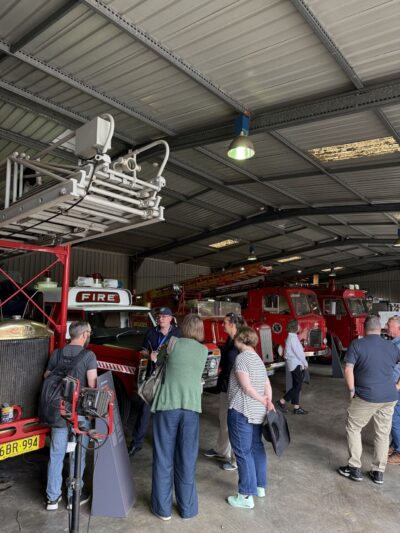
Tour of the DFES Operational Heritage Fleet.
The Perth team is delighted to welcome Lorna Sweetwood as our new full-time Objects Conservator. Lorna joins us from the Science Museum Group in the UK, where she gained extensive experience working with industrial heritage objects, vehicles and hazardous materials.
Fremantle Prison
Last month, Eden Christian, Senior Conservator & Team Leader, Fine Arts, from our Melbourne office, visited Perth to carry out treatments on paintings on metal at Fremantle Prison, bringing her expertise to this important historic site.
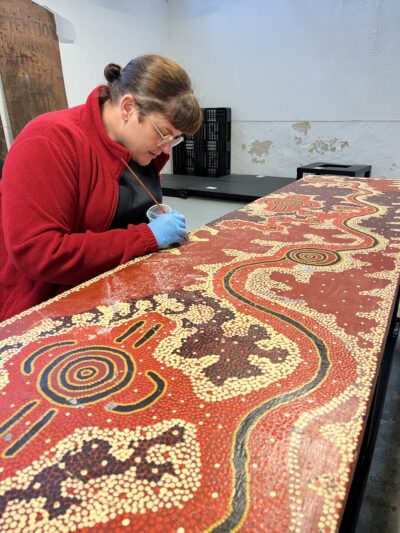
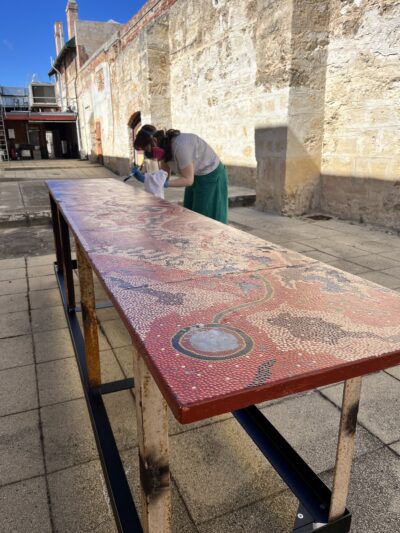
Claire Rowson performing a treatment at Fremantle prison.
National Trust WA, gift treatment
As part of ICS’s ongoing support and sponsorship of the National Trust WA, Claire Rowson and Lorna Sweetwood recently undertook conservation treatments on metal objects believed to have originated from Strawberry Hill at Barmup. The collection included five cast iron pots and a copper warming pan.
The cast iron pots were carefully cleaned, corrosion blisters removed, and a rust converter applied, followed by a protective wax coating. The copper warming pan was cleaned to remove polish residue and also given a protective wax finish, ensuring both preservation and longevity of these historic items.
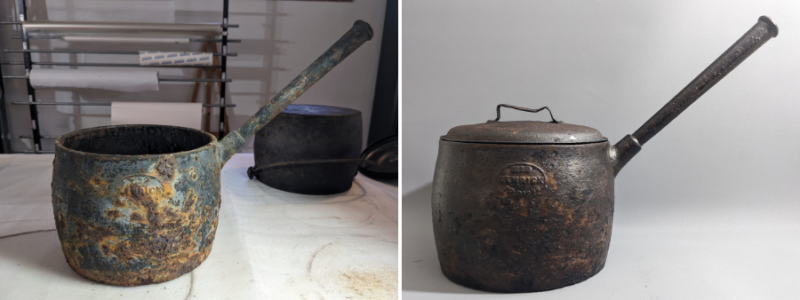
A cast iron pot before and after treatment.
Homo Fallible
Claire and Lorna undertook the conservation of the bronze and concrete sculpture Homo Fallible by esteemed West Australian artist Hans Arkveld.
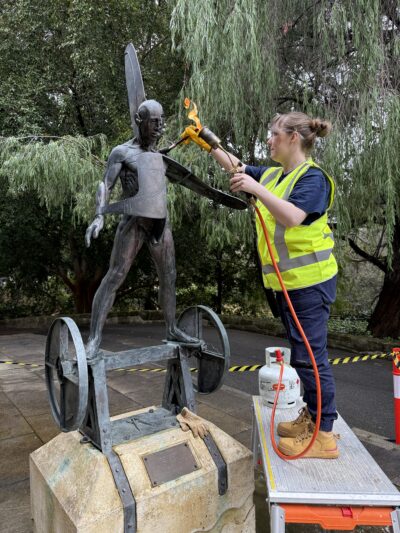
Claire and Lorna undertaking conservation of the bronze and concrete sculpture Homo Fallible .
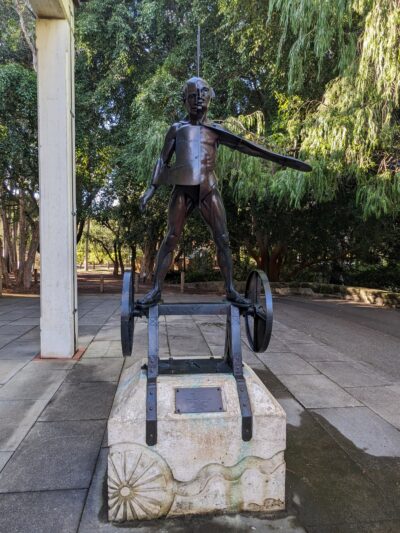
Homo Fallible after treatment.