
Anzac Hall redevelopment
After six years of planning, mount assessments, treatments, display preparation and installation, the new Anzac Hall and Atrium, featuring 13 new gallery spaces, was officially opened in June. The new gallery spaces reinvigorate the returning Bomber Command exhibition and include new additions such as the ‘Afghanistan’, ‘Peacekeeping’, and ‘Conflict in the Middle East’ exhibitions. Over 3000 small objects, 80 bespoke mannequins, and over 30 large technology objects have been fastidiously conserved and installed by our team of conservators across the paintings, paper, textiles, objects and photographs, film and sound labs to reach this long-awaited milestone for the Australian War Memorial. However, the gallery development is not yet over – after a brief pause we will begin preparing for the opening of the Pre-1914 and Frontier Wars galleries is 2028.
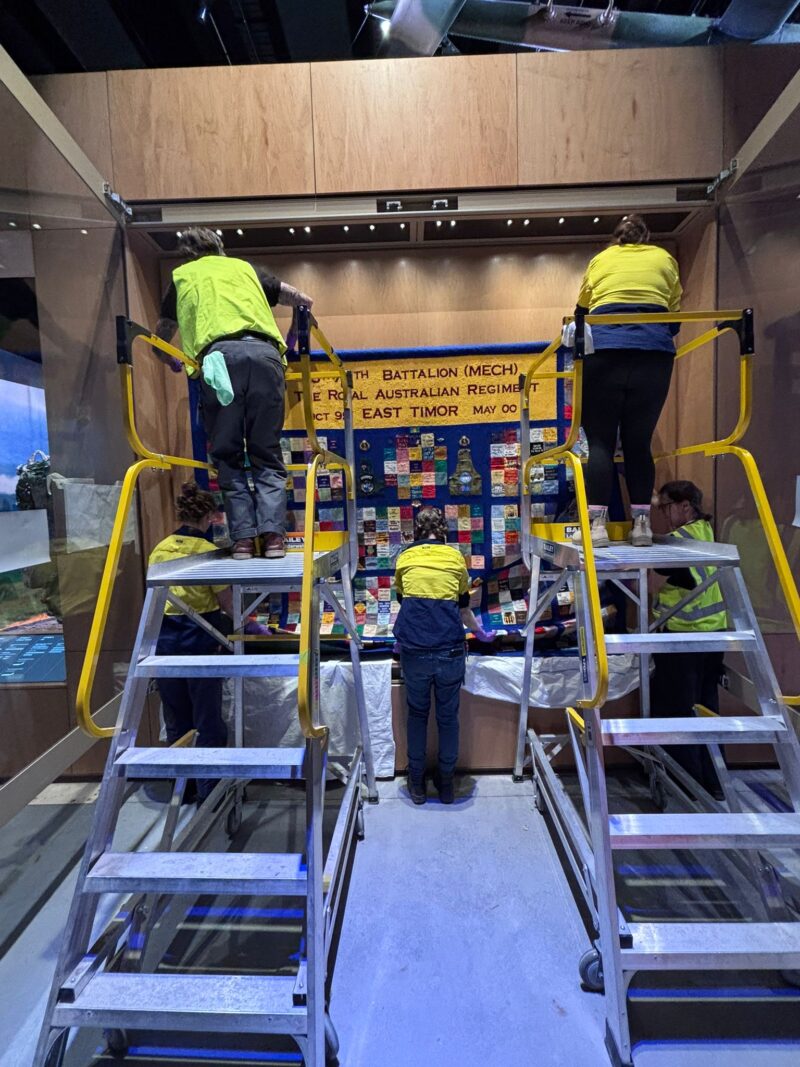
Team of Collection Services staff installing the East Timor Quilt.
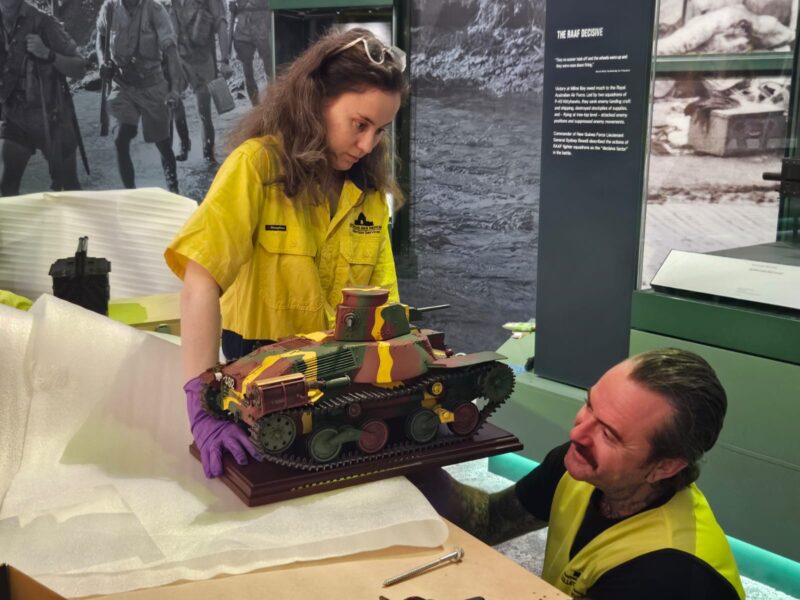
Jessica Goodvinn and Benny Tyrell preparing an object for display.
Harold Freeman’s Aircraft Hall mural
Conservation work on Harold Freedman’s 1968–1972 ‘Mural of Australian military aircraft’ has just been completed by the mural project team. After treatment was undertaken on scaffolding over a period of 18 months, the extensive 256 square metre mural over four walls in Aircraft all is now on display again after 25 years hidden from public view.
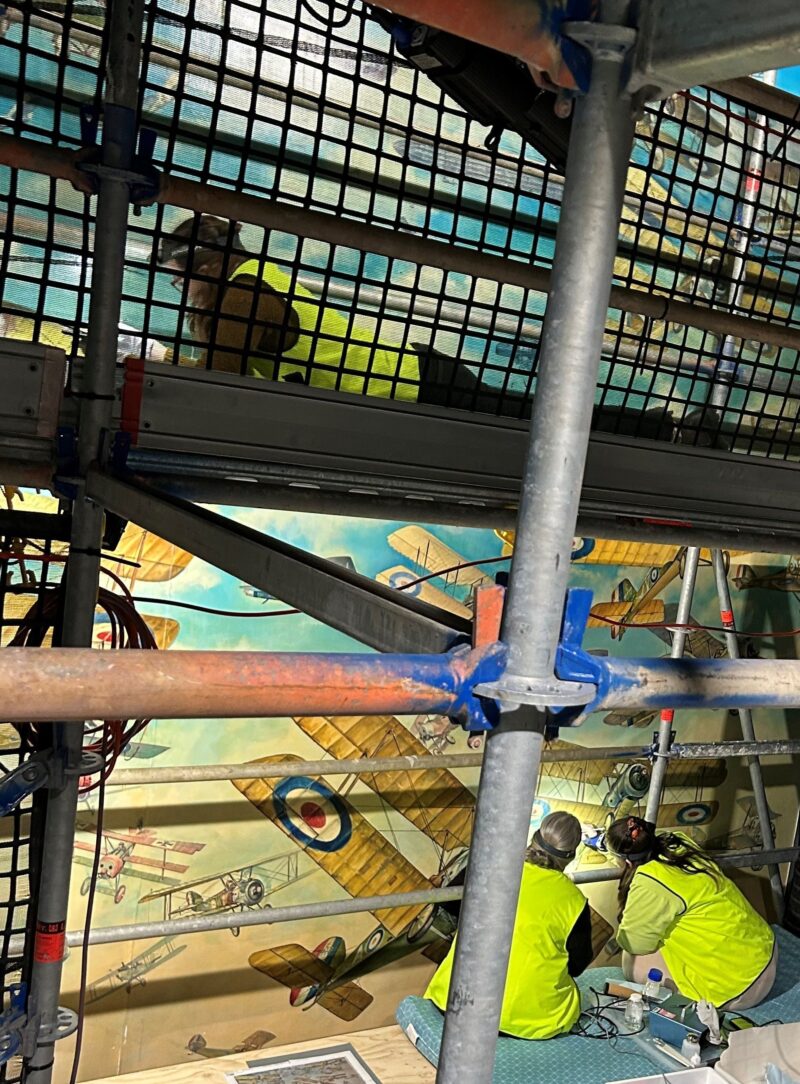
The team working on the 1914–1918 First World War section of the mural.
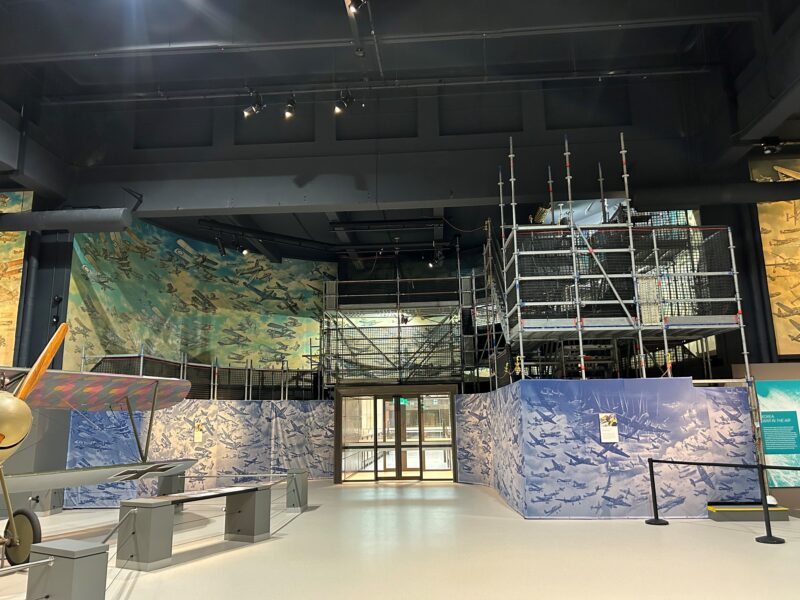
Multi-level scaffolding setup on the 4.5 x 25 metre long curved apse wall.
Professional development
In April, preventive conservator Taylor Moore attended the Treatment Strategies for Painted Outdoor Sculpture organised by the Getty Conservation Institute and the National Gallery of Victoria. This was an incredible opportunity to work with and learn from conservators with a range of knowledge on the management of outdoor painted sculpture. Different paint types, managements strategies and environmental considerations were discussed. It was a very comprehensive program and the facilitators did a fantastic job.
In June, Sophie Fairbridge, Helena Wardleworth and Kate Webster attended the Advanced Paper Conservation Techniques workshop presented by the University of Canberra. The two-day intensive workshop saw students experiment with stain reduction using gellan gum, various bleaching techniques and lining oversized posters. All the participants were eager to learn from our course instructor Ian Batterham, and each other.
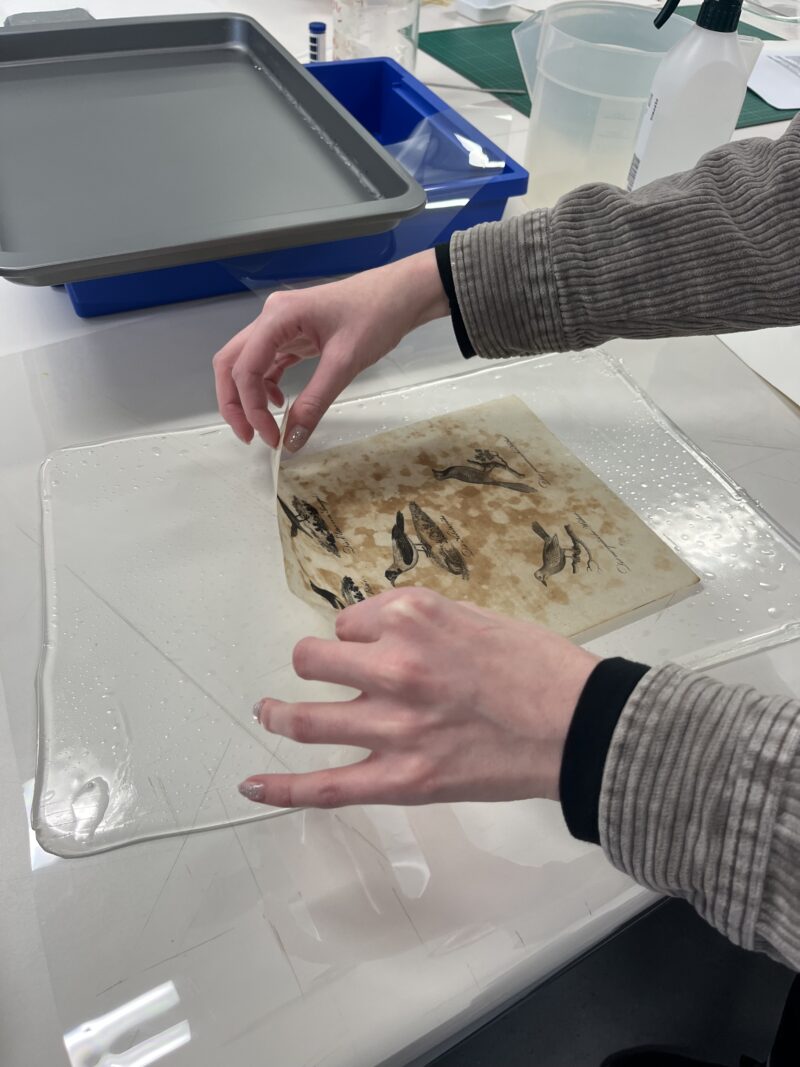
Stain reduction experiment using cast gellan gum plates.
John Gorton Building projects
Doug Rogan, Director Museum and Gallery Services & ACT, worked extensively with Hunter Mason at the John Gorton Building, along with conservators Lisa Hayes, Heidi Treloar and Karen Hall. They undertook the comprehensive cleaning and reinstallation of a metal leaf ceiling, which comprises over 20,000 individual ‘leaves’ of stainless steel hanging from the ceiling.
The team also worked to protect an important Aboriginal mural. They provided a condition report, undertook cleaning and conservation, and installed a new frame around the mural to provide protection during demolition and building works.
Large internal artworks that had been previously removed – coloured panels, graffiti panels and a circuit diagram artwork – were re-installed, cleaned and conserved.
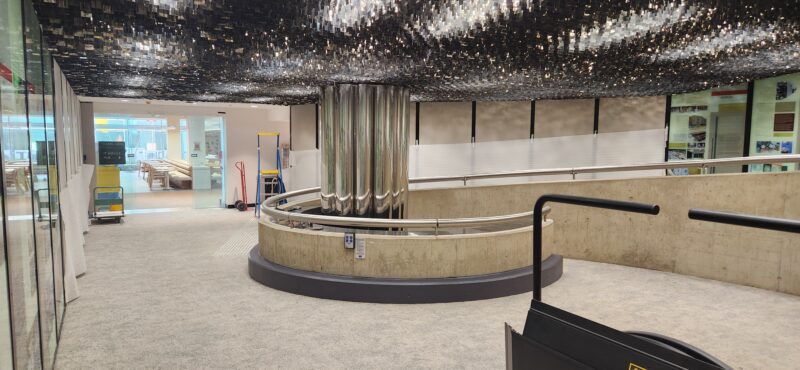
Metal leaf ceiling cleaned and reinstalled.
The National Archives of Australia recently purchased a new Kongsberg boxmaker to replace our old one, which was 25 years old. We are excited with the positioning tool and the cutting speed compared with the old one.
Emily Lyon and Maia Vincent are working on a series of WWII-era naval ship plans, preparing them for digitisation. The plan substrates are a mix of paper, draughtsman’s cloth, tracing paper and linen-backed paper. Some are very large; our longest so far has been just over 4 metres long.
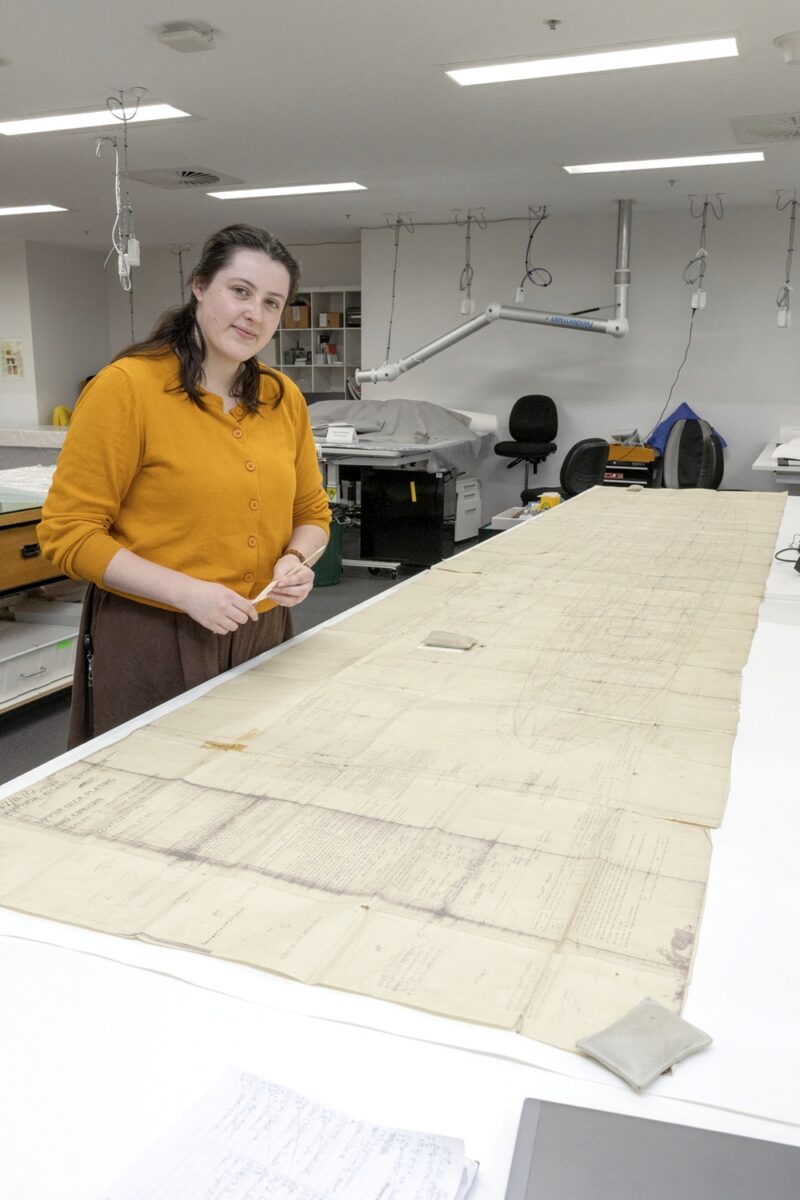
Maia Vincent working on some large WWII-era naval ship plans.
Prue McKay and Charlotte Hurst are working on a number of large, fragile and multi-sheet posters for an upcoming exhibition, which is opening in November this year.
We welcome Michelle Butler who has recently started at the Archives working on a project to prepare WWII ship ledgers and Displaced Persons files for digitising projects.
The Object section has been busy preparing collection and loan works for upcoming exhibitions ‘Rosalie Gascoigne’ and ‘Full Throttle’. They have also been spending time outdoors waxing, cleaning, and condition reporting sculptures for the ongoing Sculpture Garden Revitalisation project.
Hannah Stewart joined the paintings team in March as Conservation Technician framing. She hit the ground running, assisting Janet Hearne and Greg Howard with stretching the 29 large canvases for the exhibition ‘Ngura Pulka Epic Country’, which opened in April.
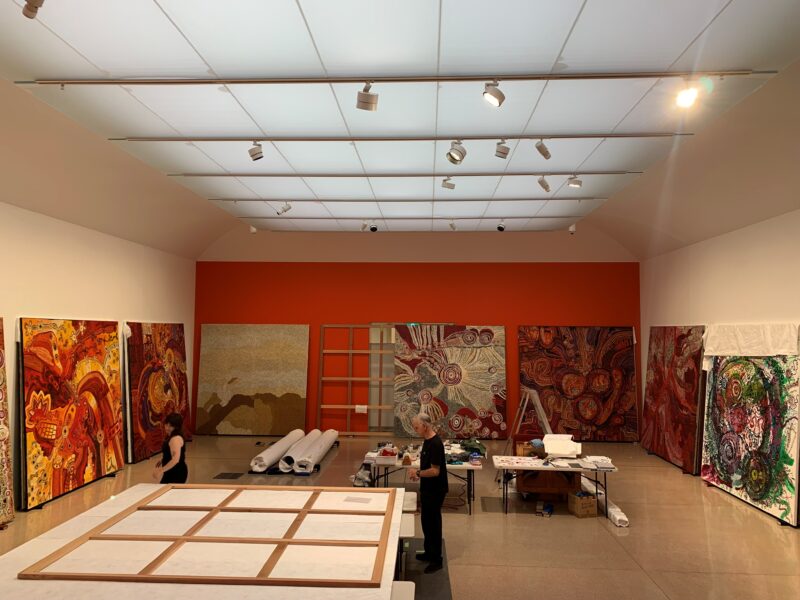
Hannah Stewart and Greg Howard undertaking stretching of works for ‘Ngura Pulka Epic Country’.
The team has been kept busy supporting the NGA’s active program of loans and touring exhibitions, including preparing 13 Arthur Boyd paintings from the Nebuchadnezzar series for loan to Bundanon. Jocelyn Evans has travelled to several locations to condition check the Clarice Beckett touring show, as well as giving lectures on the artist’s materials, technique and treatment of the paintings. Janet has collaborated with the textiles conservation team to assess and prepare four pichhavai painted textiles (shrine hangings) for display in the AGNSW exhibition Avatar, Forms of Vishnu. Jocelyn Evans will be heading to Buffalo US at the end of this month to attend a four-day workshop on polarised light microscopy.
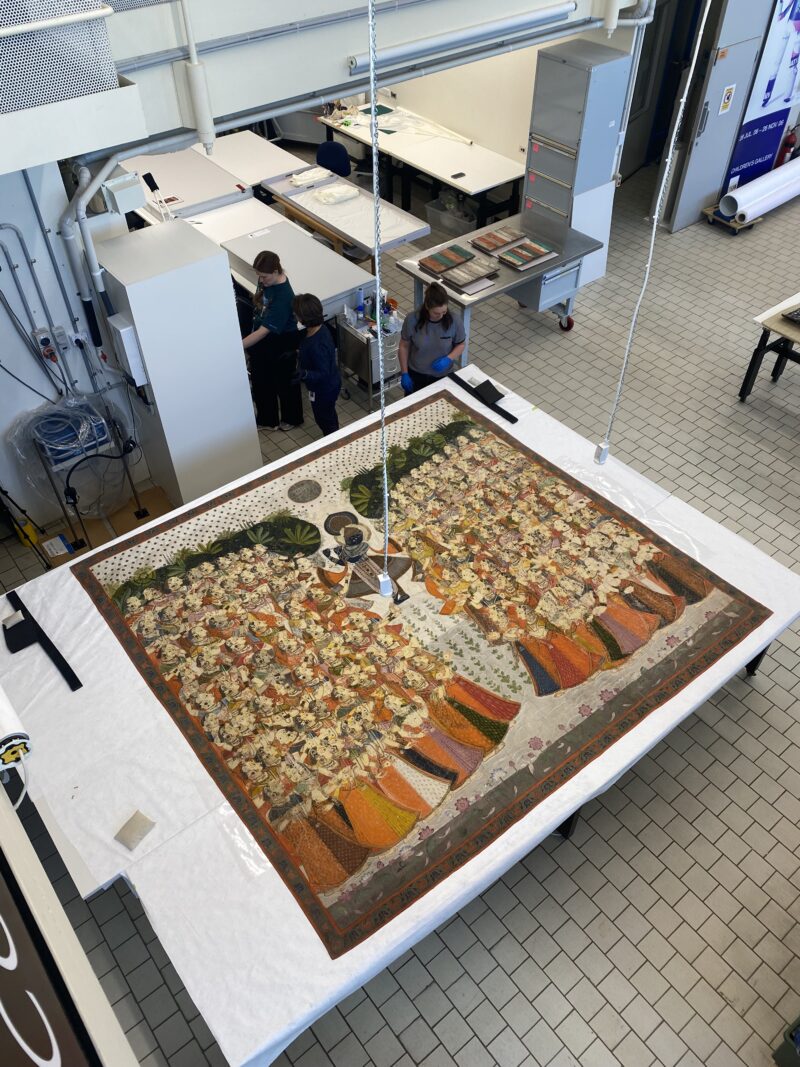
Janet Hearne preparing pichhavai Krishna’s ‘fluting summons the entranced gopis for Autum Moon festival.’
After the lab refurbishment, the Paintings team is settling into its new location and is enjoying using the new large electric easel supplied by RH Engineering.
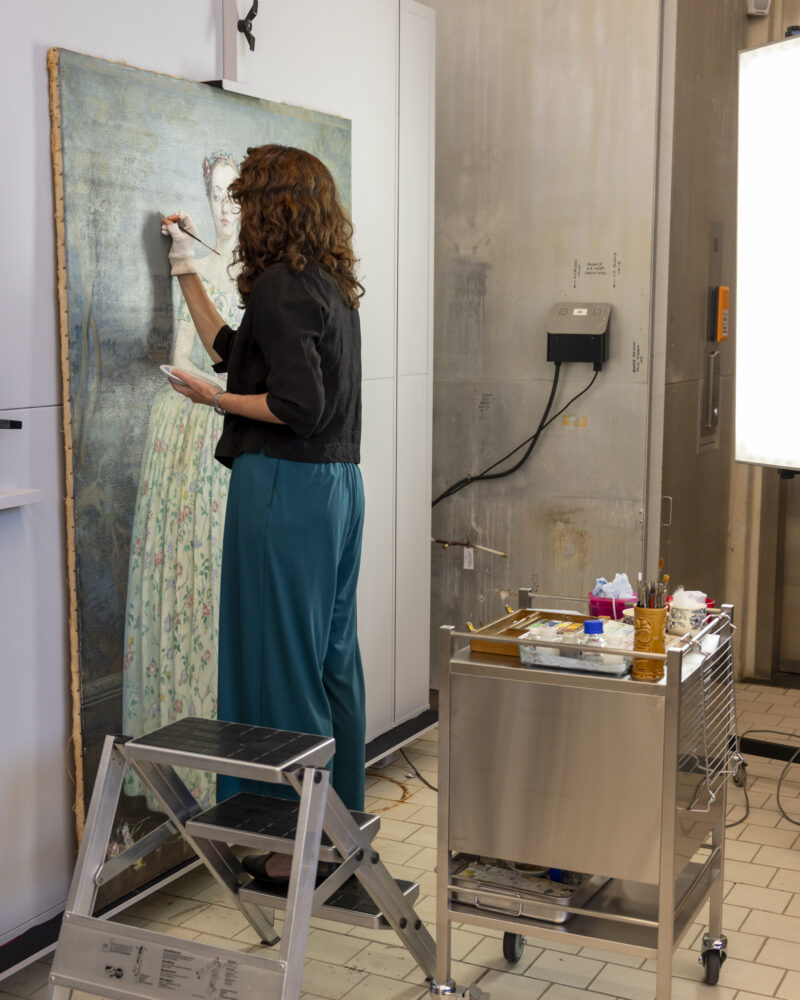
Jocelyn Evans undertaking treatment of Hilda Rix Nicholas ‘Les fleurs dédaignées’ © Rix Wright.
Early 2026 provided the entire NGA Paper and Mountcutting team with a challenging conservation problem-solving task with the installation and framing of the American ’80s artist Francesca Woodman’s ‘Blueprint for a Temple (II)’, currently on display. Inherent chemical instability required careful consideration. Surya Bajracharya and Masahiro Asaka were critical in creating the design and installation of the framework for this unique oversized work of art on paper. The Paper team is monitoring the work and environment weekly during display.
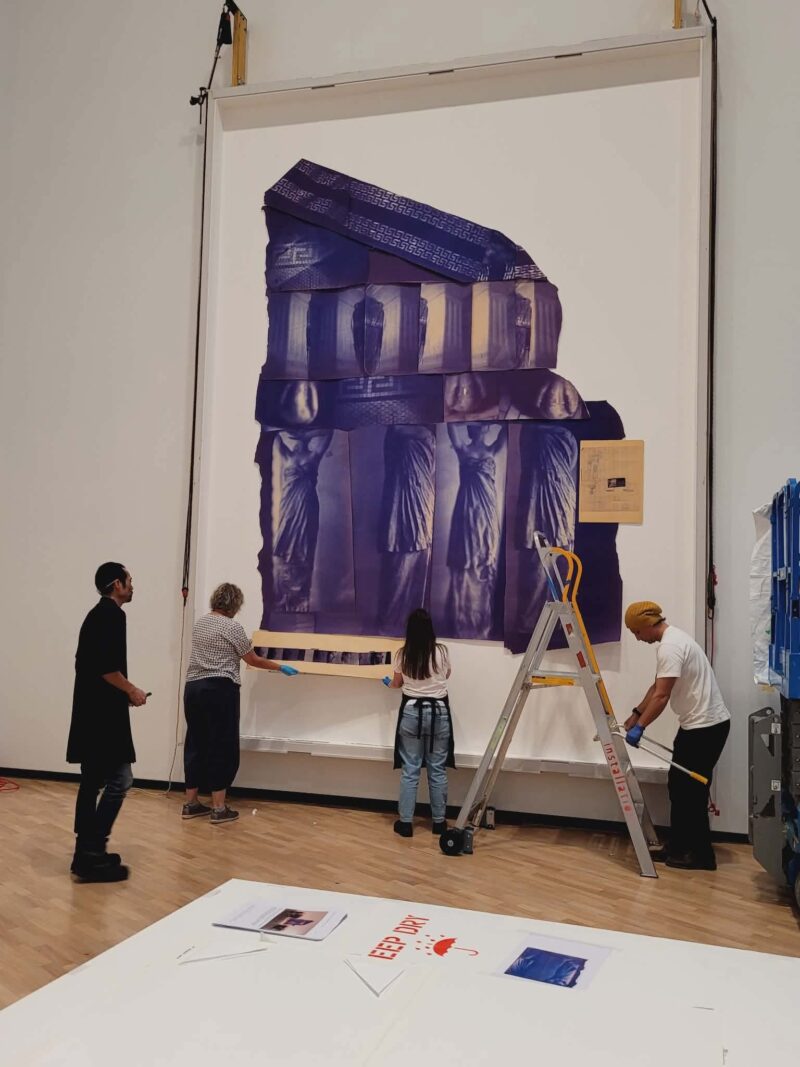
The Paper team installing ‘Blueprint for a Temple (II)’ © Woodman Family Foundation.
Rachel Sawicki has ‘got her magnets on’ and was successful in developing a magnetic display system for a large weave cartoon loan work on display for the ‘Boyd Tapestries’ exhibition. Other news of note is that we are excited that Kassandra Coghlan has been selected for the JPC ICCROM course in Japan, commencing late August. James Ward is still onboard and provides conservation wisdom and labours with complex paper treatments several days a week.
Isabelle Legg has joined the Preventive team part time to help manage the care of the collection during the upcoming years of capital works for building rectification and sculpture garden redevelopment. She will devote the remainder of her full-time role to assisting with sculpture garden projects.
In April, Michelle Newton-Edwards joined the section as a Textiles Conservator. The Textiles team has recently completed the installation of 20 tapestries depicting the ‘Life of St. Francis’ by Arthur Boyd. Woven at Manufactura de Tapeçarias de Portalegre in Portugal in the 1970s, it is the first time they have been displayed together at the Gallery. It has been exciting to see them all together and the team is looking forward to hosting a private tour with the Canberra Textile Conservators group at the end of the month. They have also been busy with preparing several outward loans, which has seen pichhavai, Ballet Russes, and costumes from Justene Williams’ performance of ‘Victory Over the Sun’ through the lab. The Textiles section has recently hosted University of Melbourne student Hannah Berry, who has been assisting with storage packing of new acquisitions by Australian fashion designer Jordan Gogos.
Our conservation units continue to have record numbers, with 28–30 students in each unit comprising a mix of our Bachelor students and our Graduate Certificate students. This mixed cohort seems to work really well, with the ‘grad cert’ students bringing a host of existing life skills and prior experience, and the undergrad students bringing an ‘eyes wide open’ enthusiasm and a confidence with digital skills that facilitates daily academic life.
One thing that is challenging us all is the impact of AI on learning. On the one hand we need to teach students how to use it critically and effectively, because it will certainly be a part of their future working lives, but on the other we need to ensure that students use it responsibly and reference their use like they would reference any other source of information. We are seeing a very mature use of the technology from our students, and to date the issue we have most had to manage is the tendency of AI checkers to flag things like the name of a unit on the cover page of a student’s work – which of course is what they have to put in! (Sigh … eye roll.)
Students have been helping us with the reactivation of the 10m radio telescope on the UC campus. This is being led by the Conservation staff in the Faculty of Arts and Design (not the Science faculty!) with a number of volunteer astronomers, engineers and electrical engineers. Our conservation students have been assessing the condition of the material side of the telescope including using ground penetrating radar to assess the all-important concrete support slab; using XRF with Geroge Bailey and Taylor Moore to determine whether the paint has lead in it (it doesn’t); and working out whether we can use a biocide to wash and maintain the telescope dish given the presence on the site of the endangered sun moth and some experimental bee hives (we have decided to stick with a plain water wash). After we held a solstice celebration (tea, cakes and a countdown along with our atomic clock), this work has attracted a flurry of local media attention and drawn out a surprising number of local people who have secretly watched and wondered about this telescope for years and are hugely pleased to see it being taken care of.
We continue to run our regular Heritage Engineering courses, which attract conservators, architects and heritage officers as well as engineers, thus introducing people to the other professionals they may one day meet on a job. Natalie Ison is running Contexts for Heritage Engineering this June/July in Newcastle, and Alison Wain is running Materials for Heritage Engineering in Brisbane in October (online learning) and November (two-day onsite workshop).
In the week of 22 June, we ran two two-day courses on paper conservation. On the Monday and Tuesday our presenter, Ian Batterham, introduced students to the preservation issues associated with paper-based collections.
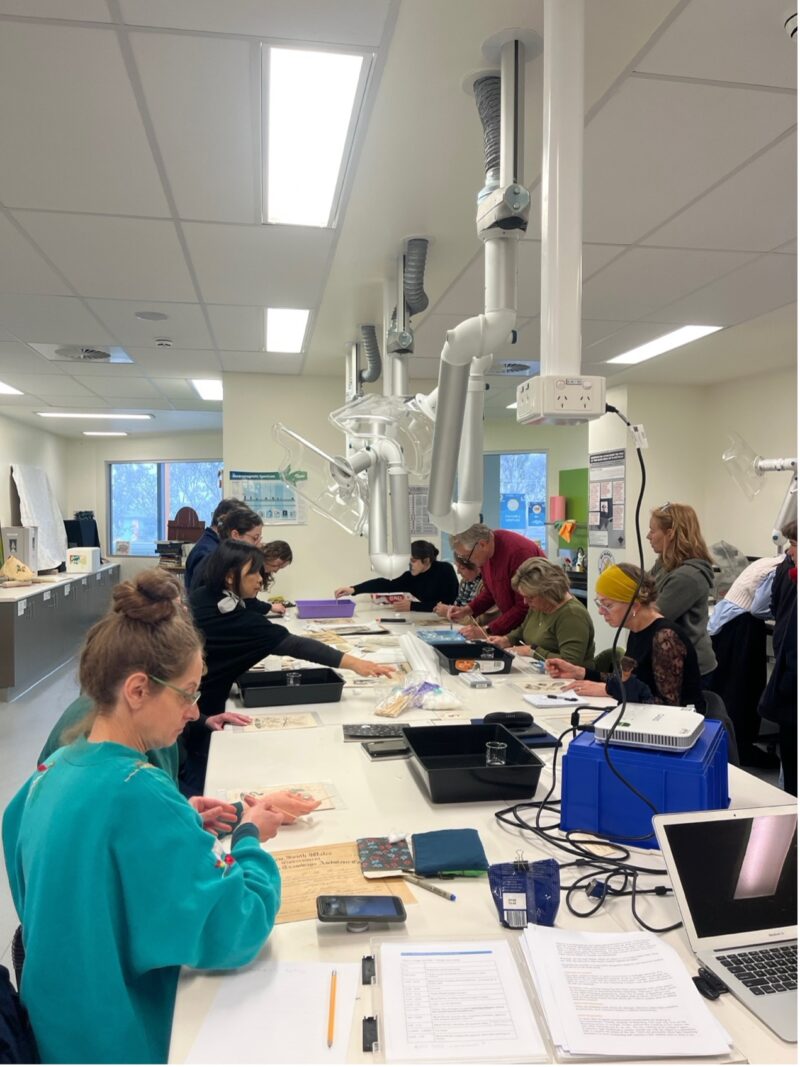
Attendees at the introductory course.
On the first day, the 18 participants received information on storage and handling, the history of paper and printing, and hands-on experience of dry cleaning and flattening of paper. On the second day, there were demonstrations of paper mending and Japanese lining techniques where the students had a chance to use Japanese brushes and a Karibari board.
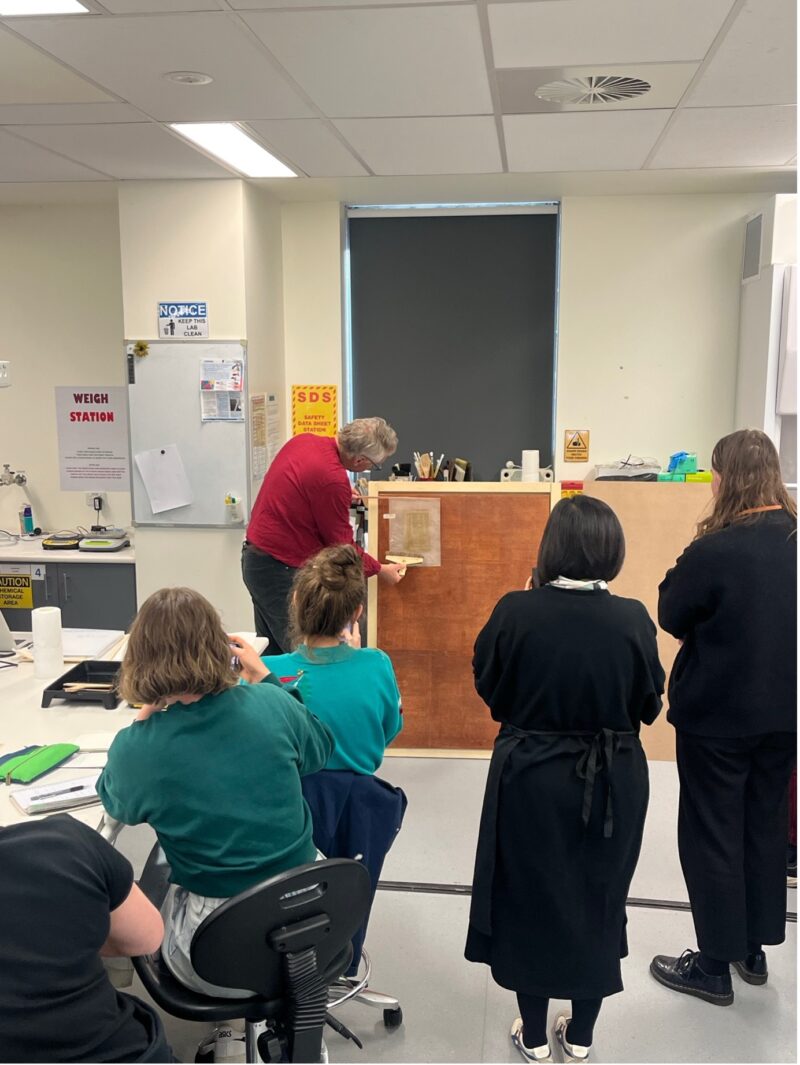
Japanese lining using the Karibari board.
On the Thursday and Friday, there were two days of advanced paper conservation, which focused on hands-on experience of the use of gels, washing and deacidification, bleaching and the treatment of outsize paper items. With the last, the group helped deacidify and line a delightful Bollywood poster printed on very poor groundwood paper.
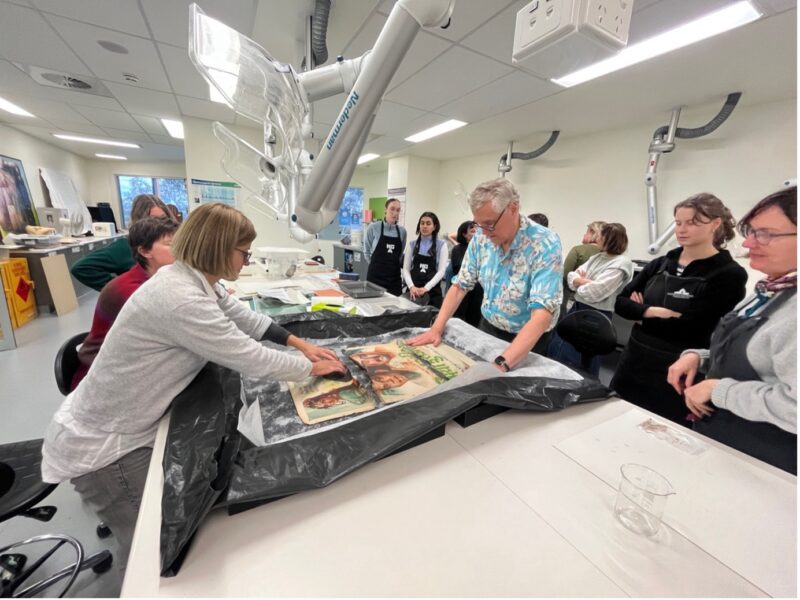
Washing the segments of the torn Bollywood poster.
The attendees were very enthused about the gel exercises, and many gel plates were made and tested. There were also experimental treatments where the gels had agents such as bleaches, solvents and deacidifiers added. These met with variable success!
Throughout the week our good friend Conservator Ken was ever helpful!
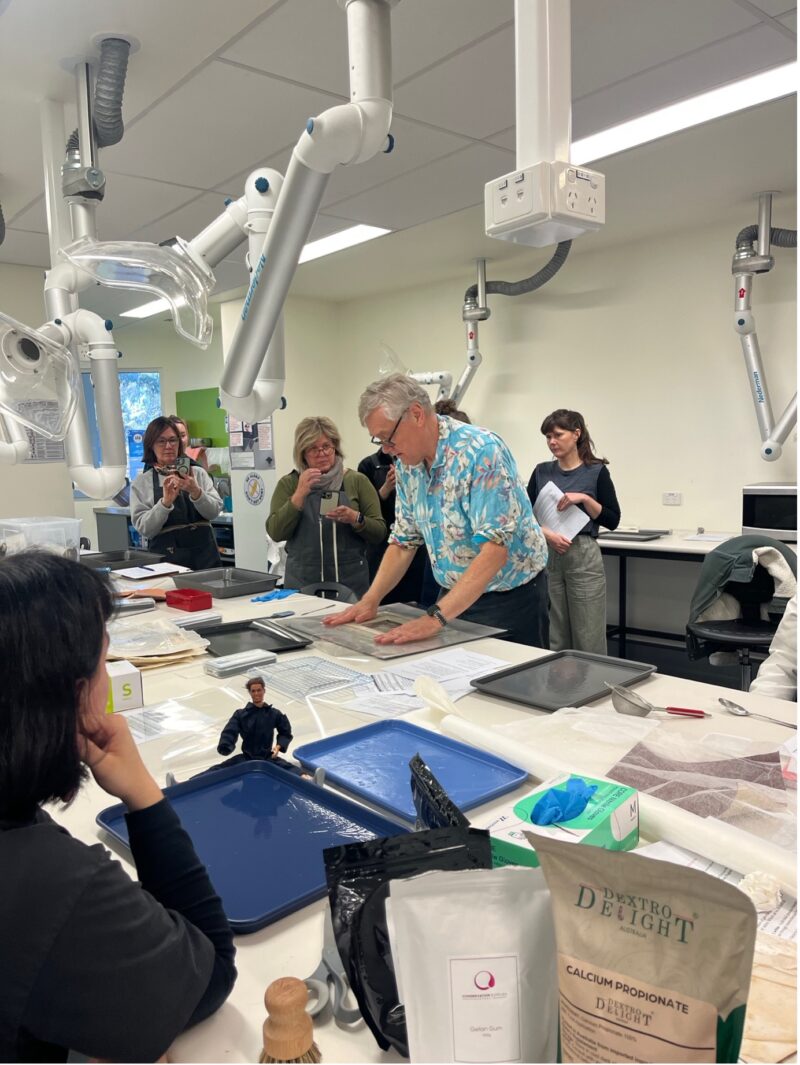
Gel treatment experiments. Notice Ken getting involved!
Inside the faculty:
Dr Wendy Somerville is currently working with three students to rehouse the spears in the FAD First Nations Art and Artefact Teaching Collection. Sophie Miller and Annalise Sharp are both students of the Graduate Certificate in Heritage Materials Conservation and they have researched and documented the spears and proposed storage configurations for them as well as designing custom boxes to fit with our tricky shelving. Additionally, Natalie Ison is a PhD candidate helping Sophie and Annalise build and fit-out the boxes and also working with Wendy on digital collections storage.
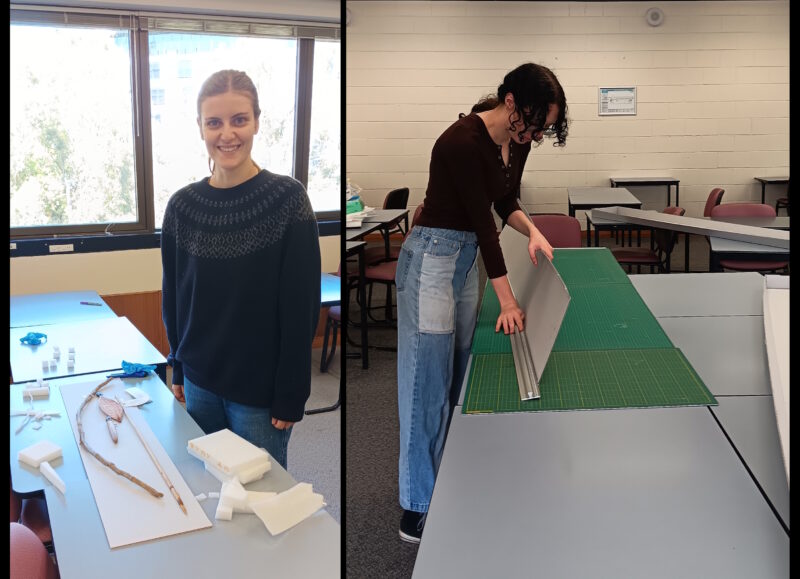
Sophie and Annalise at work rehousing the collection.
UC short courses:
The EHA course Contexts for Heritage Engineering ran on 23 and 24 July in Newcastle. We had 14 students from a variety of engineering and heritage specialisations who investigated significance and conservation management planning for objects and sites with complex heritage engineering needs. Our case studies were in collaboration with Newcastle Museum, and we had a fantastic group of experienced engineers and heritage professionals talking about the projects they worked on in this city – we looked at Christ Church Cathedral and the Craven Crane at Newcastle Museum.
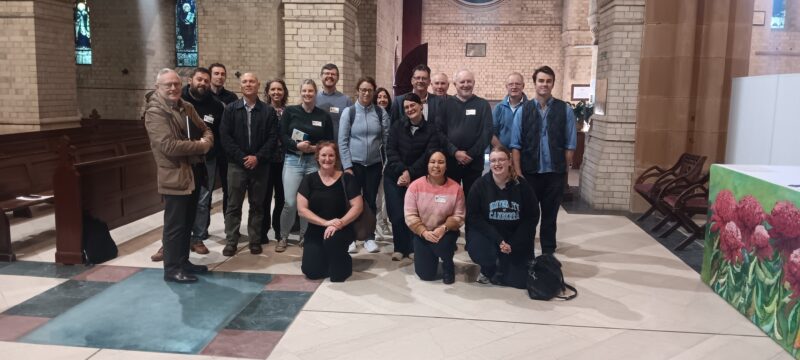
The group at Christ Church Cathedral, Newcastle.
The next course in the series is Materials for Heritage Engineering. This will be held in Brisbane and will be enrolling soon for online learning from mid-October and an onsite workshop on 19–20 November. If you would like to be notified when this course opens for enrolment, please contact ucheritageshortcourses@canberra.edu.au
We have updates from some of our PhD candidates currently working on their theses:
Karen Sorenson’s career as a specialist registered nurse working in the area of palliative care and bereavement support spanned 40 years. After her retirement from nursing she completed a BA Visual Arts at the ANU in 2018, and a Graduate Certificate in Heritage Materials Conservation at the University of Canberra in 2024. She is currently in the final year of her PhD entitled ‘Transforming Objects: Assembling Care in Grief’. This interdisciplinary practice-led research project explores how creative interaction with objects can impact bereavement processes. Drawing on research from health, heritage conservation and creative arts, it develops a method of ‘Expressive Conservation’ that is underpinned by concepts of care and ontological transformation. Through a systematic, experimental auto-ethnographic approach, the project challenges common perceptions of objects as passive and inert remnants, highlighting their active role as cognitive, sensory and relational anchors in bereavement processes. It asks: ‘How can creating with objects help the bereaved find meaning in grief?’
This research project draws on personal object archives and the lived experience of the researcher as a nurse, bereavement professional and trained artist to develop a non-clinical, self-guided approach to bereavement support that can be conducted in everyday domestic settings. The exhibition of creative outputs as site-specific assemblage functions as modes of inquiry for researcher and audience, demonstrating how creative engagement with material objects can awaken feelings and thoughts that help us reconnect and transform. The exhibition will be held at Rusten House Art Gallery, opening 21 November 2026 from 2–4pm. The exhibition continues until 12 December 2026. The gallery is open Wednesdays to Saturdays, 10am to 4pm.
Natalie Ison’s PhD is investigating ‘The implications of a phasing out of fossil fuels on government-funded operating heritage machinery’. She’s currently writing chapters and looking at data, but her other current joy has been interviewing a range of fabulous people who are custodians of some wonderful machines. If you would like to talk to her about this research, please send her an email at Natalie.ison@canberra.edu.au