
Art Gallery of NSW
Frames
Mark Searle and Barbara Dabrowa from the Frames Conservation team have worked on 35 works going on outward loan, many of which have required treatment. The changeover of the 20th century gallery has required several minor and major treatments including the production of a new frame for Eileen Mayo’s Lobster Pot, which is a new acquisition. A major frame conservation treatment for Hilda Rix Nicholas’s Grand Mere painting has been completed by Mark in preparation for the Dangerously Modern exhibition, which will open at the AGNSW in October 2025.
Tom Langlands (Reproduction Frame Maker) has been awarded the Edmund Capon Fellowship, offering him the opportunity to travel to Bali to learn traditional carving techniques from a long-established master carver. In his new offsite workshop, Tom has also been working on a number of both contemporary and historic style frames for upcoming exhibitions, including a frame for Eleanor Ritchie Harrison’s painting A Winter Morning 1888.
Time-based Art
Lisa Mansfield and Mei Wilkinson from the Time based Art (TBA) team have been processing some significant art gifts, including seminal 1990s digital works by Tracey Moffatt and Shaun Gladwell. These are currently being condition checked and prepared for storage in the AGNSW’s new digital storage platform Preservica by TBA Conservation and Digital Preservation staff. Lisa, Mei and the AV Exhibitions team of Mark Taylor and Daniel Kilp are preparing works for Kaldor Public Art Project #38, Thomas Demand: The Object Lesson, which includes Bill Viola’s Incrementation and Flash-created software-based works by Paul Chan.
Paper & Photography
Lois Waters from the Paper team prepared works for the recently opened exhibition Janet Dawson: Faraway, So Close, including the preparation of a selection of lithographs, pastel and charcoal drawings, as well as a wonderful selection of photographs, drawings and ephemera from the artist’s archive. Analiese Treacy had the wonderful opportunity to work on the Yolŋu power: the art of Yirrkala exhibition, preparing close to 80 prints from the Yirrkala Print Studio Archive at Buku-Larrŋgay Mulka in addition to several works from the AGNSW collection. The team is now working on several upcoming exhibitions including Kaldor Public Art Project #38, which will include a number of large scale and multipart artworks including works by Christo & Jean-Claude, Gilbert & George and Sol LeWitt.
The team is also continuing a four-year digitisation project aimed at digitising the entire collection of works on paper at the AGNSW. The project, now in its second year, is progressing well with over 1700 works (many multipart) now available online. The team had a recent visit from a generous benefactor supporting the project, offering an opportunity to share the benefits of digitisation in terms of making the collection more accessible to a wider audience. Work is also progressing on the Library & Archive Digitisation Project, with Conservation and Photography working together to process items from the Rex Irwin Archive, including 55 fax works by celebrated pop artist David Hockney.
Paintings
Simon Ives has completed a major treatment on a painting by John Salvana, Afternoon on the Namoi, which went on loan to Tamworth for the Bushline exhibition. Simon also carried out treatments on paintings by Richard Larter for the recently opened High Colour exhibition. Andrea Nottage has carried out several paintings treatments and conservation support for exhibitions Janet Dawson: Faraway, So Close, and Mitch Cairns. She is currently treating a Cy Twombly triptych painting, which has been on display for many years. Selina Halim has been occupied with the preparation of paintings for Dangerously Modern, including a major treatment of Hilda Rix Nicholas’s Grand Mere, as well as minor work in preparation for Kaldor Public Art Project #38, and Yolŋu power: the art of Yirrkala.
Loans and Tours
The Loans team (Frances Cumming, Lois Waters, Mark Searle, Simon Ives, Lisa Mansfield, Asha Gilmour) has been busy in recent months preparing works for loan to regional, national and international institutions, including Gippsland Art Gallery, Art Gallery of South Australia, Artizon Museum, Tate Modern, Pinnacles Gallery, Macquarie Uni, Tweed Regional Gallery, Manning Regional Gallery, Heide Museum of Modern Art, Govett-Brewster Gallery, Institute of Modern Art, Queen Victoria Museum and Art Gallery, Art Gallery of Western Australia, Monash University Museum of Art, and Western Plains Cultural Centre. Additionally, touring exhibitions including the Wynne 2024 completing its tour at the Blue Mountains Cultural Centre while Archibald 2024 was deinstalled at the Araluen Arts Centre in Alice Springs and installed at Lismore Regional Gallery.
Australian Museum
People
Maria Genetzakis joined the team as our Paper and Books Conservator. Maria has been a wonderful addition to the team, bringing a range of skills to care for our collections. It has been great to have a paper conservator back with the team.
Jessica Gray-Hart joined the AM conservation team to cover our Collection Enhancement role. Jessie applied her extensive knowledge in preventive conservation to the role and implemented the ABC Risk Assessment methodology. These assessments have been long overdue, and Jessie made great progress in this area. Very sadly for the team, Jessie has moved on from the AM, and we wish her all the best in the future.
Kerry Etherington joined the team on a short-term contract to help work on a storage optimisation project at one of the Museum’s storage facilities. Kerry coordinated the many moving parts of such a project with ease, seeing several hundred specimens rehoused. This project has wrapped up, and we thank Kerry for all her hard work. We look forward to working with her again soon!
In June, the Museum received new acquisitions from Rapa Nui (Easter Island) for the Pasifika collection. Kyra Kim processed these new acquisitions, which included a wooden bust, petroglyphs, a stone sculpture and Moai. The newly commissioned Moai, a traditional statue carved from basalt, was installed into our permanent Pasifika gallery, Wansolmoana. We were fortunate enough to have community members from Rapa Nui visit to undertake a cultural blessing to awaken the mana in the Moai to bring it to life.
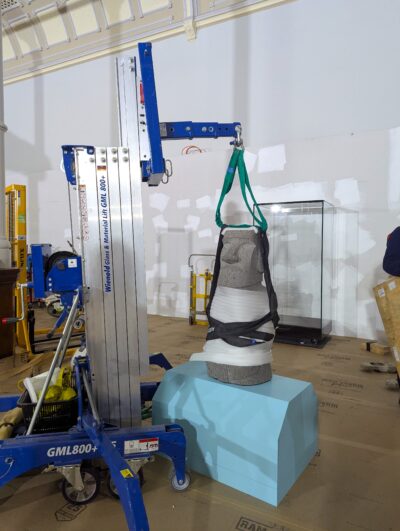
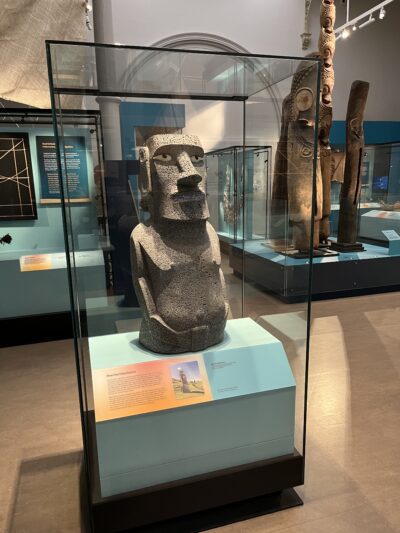
Moai being installed and now on display in the Wansolmoana Gallery.
Sheldon Teare and Heather Bleechmore have secured $150K in Australian Museum Foundation funding to begin an 18-month major treatment project. This project will conserve a four-metre-long manta ray taxidermy mount from 1868. The specimen holds holotype status and was described by former Australian Museum direct Gerard Krefft. Treatment will include removing deteriorating internal materials, stabilising tears in the skin and reintegration of a pectoral wing.
Kyra and Melissa Julliard met with Andrew Ickeringill – a touken-togishi (Japanese sword polisher) – to discuss the safe handling, storage and conservation of a selection of valuable Japanese swords in the World Cultures collection. Kyra and Melissa learnt how to disassemble the different swords for storage and oil the blades for regular maintenance.
The conservation section of the Australian Museum website has recently undergone a refresh with more up-to-date information about our work and our team. The website includes a new video presented by Heather and Sheldon about the work the team is involved with across the Museum.
Projects
The Space Optimisation Project, a large rehousing project happening at our offsite store, has come to an end. Kerry, with the support of Sheldon and Melissa, completed some huge goals for the project. These included: the rehousing of 104 dry fish specimens, with several of these undergoing treatment by Kerry; the removal and replacement of all the corflute boxes, or corflute walls on stillages, including for 107 mammal specimens and 40 Cultural collection items; and having custom covers made for the 29 Pukumani poles.
Exhibitions
Sophie Phillips has been leading the conservation work on our new permanent gallery, a revamp of Surviving Australia. The gallery was deinstalled earlier this year and since then a huge amount of work has gone into condition reporting and treating the roughly 200 specimens that will be installed in September. The specimens are from across the Life and Geosciences collections held at the Australian Museum, including some incredible new fossil additions, which will be on display for the first time.
Most of the treatment work has focused on stabilisation and repair of taxidermy mounts on areas that are at high risk of damage – ears, legs, claws, toes and feathers. Japanese tissue and Lascaux adhesive have been used extensively to repair and rebuild areas of instability and loss. Below are some images of the repair and inpainting work on two specimens going on display.
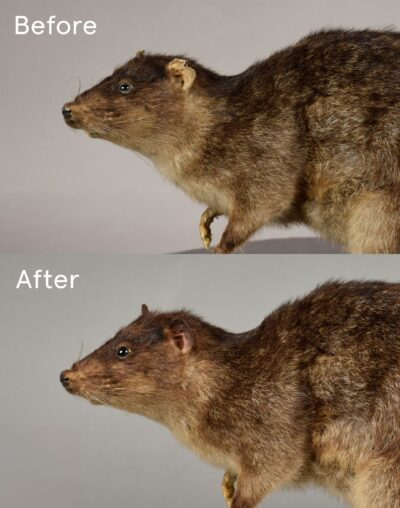
Water rat (Hydromys chrysogaster) ear stabilisation, repair and inpainting.
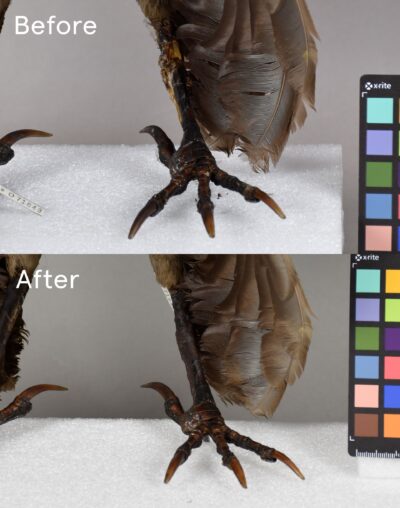
Superb lyrebird (Menura novaehollandiae) leg stabilisation, repair and inpainting.
In June, the Australian Museum became the latest host of the travelling STORYBOX digital cube. For this display, material from the Museum’s Ornithology and Archives collections were added to create the exhibition The Birds of Australia: John & Elizabeth Gould. Elizabeth Reed gave some taxidermy mounts a clean and brush-up. Sheldon undertook some feather recolouring trials on some of the very faded specimens with varying results. Maria treated two volumes from The Birds of Australia series, with one plate drawn from a specimen loaned from the Australian Museum’s collection. These books were prepared for short-term display, which included leather consolidation to the covering materials and dry cleaning of the plates.
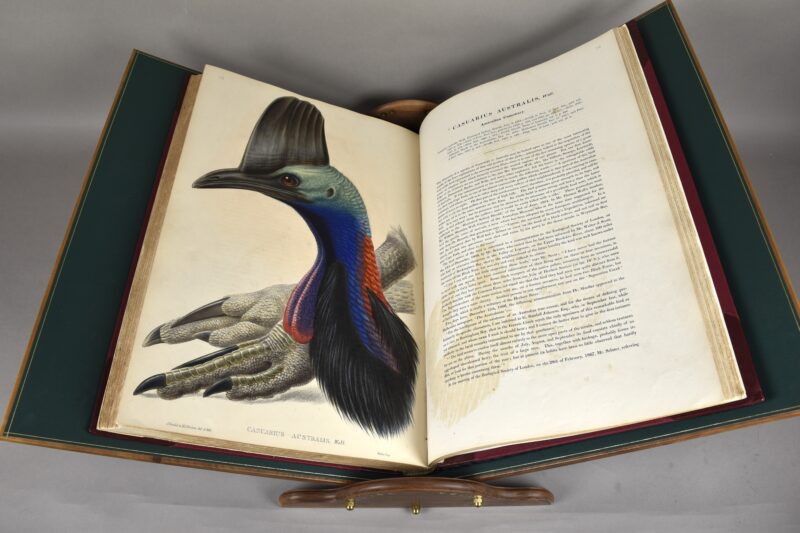
Cassowary from The Birds of Australia. Supplement by John Gould, 1869. A cassowary specimen from the Australian Museum is believed to have been used as the model for this image.
Treatments
Maria has completed treatment on a set of significant field notebooks owned by conservationist Les Chandler. As the binding was broken and the signatures were loose, the volume was disbound, thoroughly stabilised, and rebound on new supports. These notebooks will be used by University of Sydney students to digitise and describe Chandler’s photograph collection alongside our archivist.
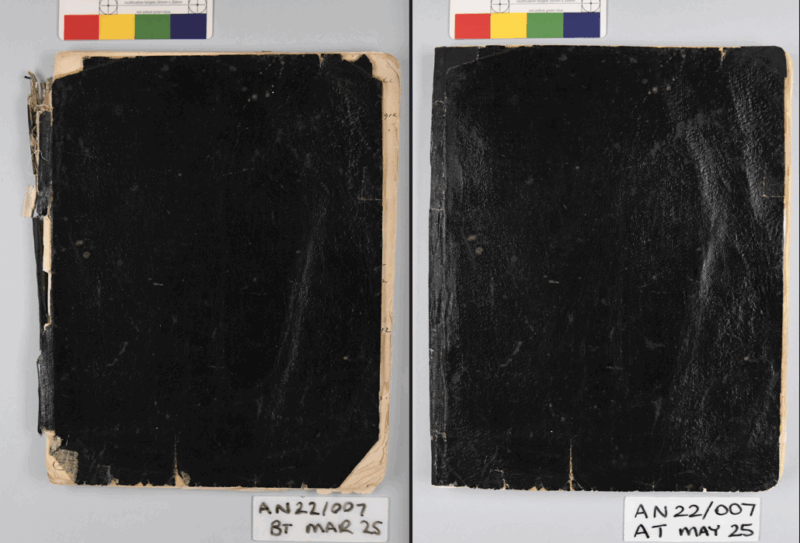
AMS737/1 before and after treatment.
Melissa has been working on a collection of wet plant specimens that are currently in an unknown liquid. She has been doing analysis on the liquid to identify it but also replacing the fluid in some that are significantly low.
Sheldon happily continues to work on desiccated marine invertebrate specimens. These specimens have dried out and become mouldy due to failure of their containers. Specimens are carefully rehydrated, either in a water bath or humidity chamber, and then stepped back up through increasing concentrations of ethanol for long term storage.
Conferences/Workshops
Sophie, Maria, Sheldon and Kyra completed the ABC Risk Methodology Workshop with Andor Vince online over two days in February. Sophie and Kyra attended the online component of the Modular Cleaning Program workshop, presented by Chris Stavroudis, in March.
International Conservation Services (ICS), New South Wales
Awards
National Trust NSW Awards
Julian Bickersteth, CEO, and Shrief Eissa, Objects Conservator, were thrilled to be at the awards ceremony as The Great Synagogue, Sydney, won the Highly Commended Award in the Interiors and Objects Section for ‘The Relocation of the Bimah Project’. The Great Synagogue in Sydney is a major work of Victorian design, construction and decoration, and a centre of Jewish worship in Sydney since its consecration in 1878. We worked with Orwell and Peter Phillips and Project X Fitouts to restore the building layout to its original configuration. Areas of the original floor and grand steps to the Ark were revealed, and the stunning brass pulpit returned to its original location in front of the Ark.
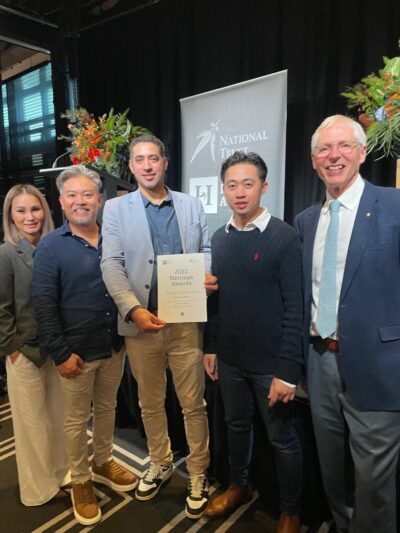
Julian Bickersteth, Shrief Eissa and the Project X team at the National Trust awards ceremony.
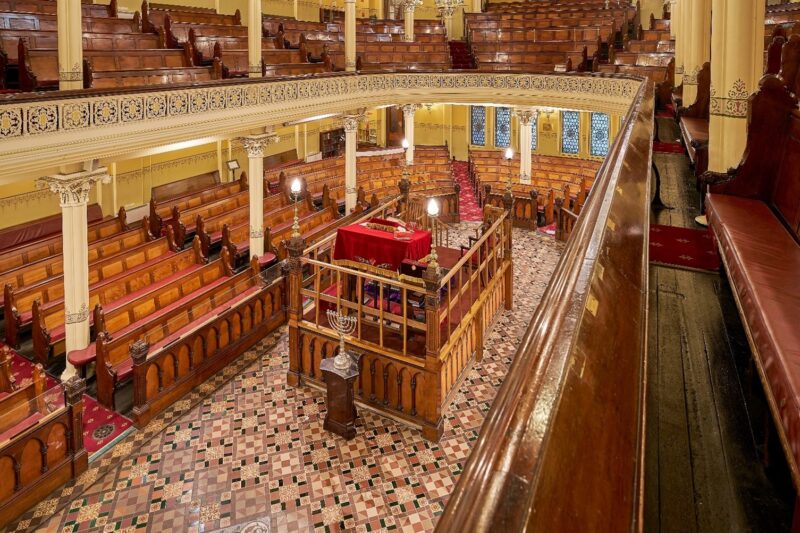
The Great Synagogue Sanctuary after the bimah relocation.
Paintings
Matteo Volonté, Head of Paintings, with his team of painting conservators, including Suati Rojas, Monica Renn, Francesca Elia, Jenny Dawson and Annabelle Silk, have been working on paintings from a large institutional collection, which has taken up much of their time.
The team has been working with multiple mould-affected collections, both private and institutional. The increase in mould issues is a testament to the rise in humidity levels in NSW, especially in summer, due to climate change and the rise in ocean temperatures.
Suati Rojas has been working on paintings for the National Trust NSW appeal, including a Fish Still Life, on which a new-to-us mist-lining treatment technique was used. This conservation technique is used to reinforce damaged or structurally compromised canvases. The primary aim is to reduce the amount of adhesive, harmful solvents, heat, and moisture applied during the treatment, factors that can create long-term issues for the artwork. The system was developed in the 1990s at SRAL by Jos van Och in the Netherlands. Mist linings strengthen paintings by attaching a new lining to the back of the original canvas. The ‘mist’ refers to the fine spray of adhesive used to do this. Minimal use of adhesive reduces its penetration into the original canvas and helps maintain its flexibility.
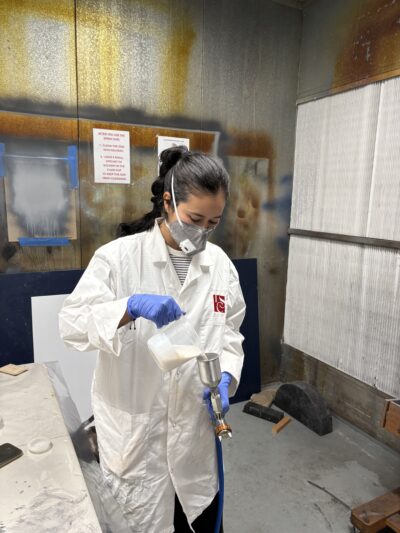
Suati Rojas preparing adhesive for the mist lining.
Francesca and Jenny treated an old painting for St John’s College, The Entry of the Crusaders into Constantinople, after Delacroix, 1890, which included the removal of an old lining and repair of multiple tears.
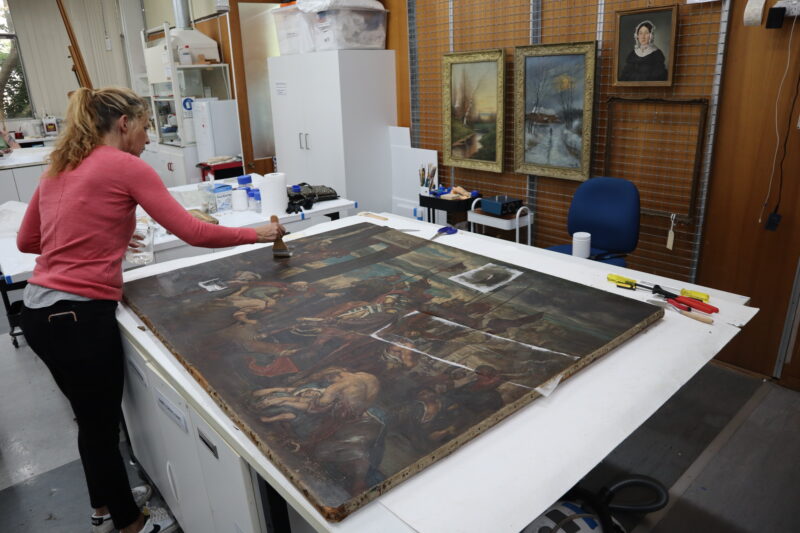
Jenny Dawson treating The Entry of the Crusaders into Constantinople.
Elric Ringstad, Senior Conservation Framer, worked with pieces from the Mosman Art Gallery, preparing them for their new exhibition Between the Heads: Views of Middle Harbour. After cleaning by the paintings team, Elric framed a double-sided painting by Emanuel Phillips Fox, allowing both sides of the canvas to be viewed.
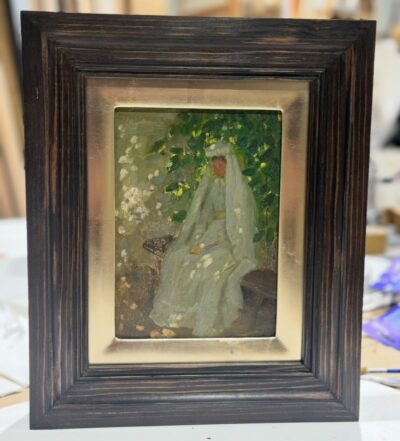
Emanuel Phillips Fox, side 1.
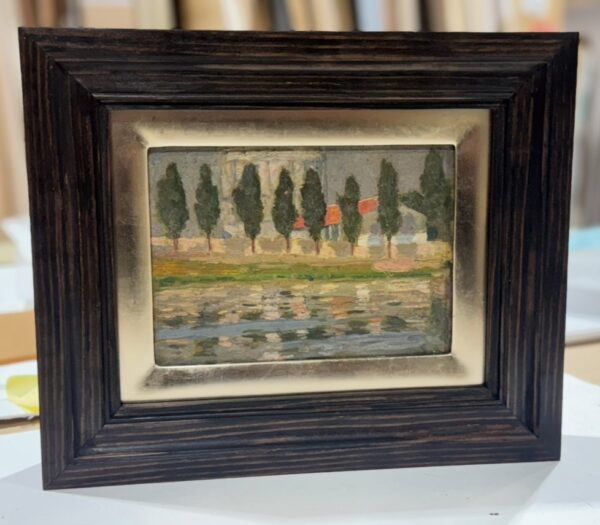
Emanuel Phillips Fox, side 2.
Paper
Katie Wood, Head of Paper, with her team Suati Rojas, Caroline Whitley and Rebecca Clendinen, has had some oversized artworks in the lab for washing and stain reduction. This has required the use of our large sink (which is generally only used a couple of times a year), and a lot of creative thinking around logistics of the space. We recently invested in a pump to remove the water from the large sink, which is far more efficient than our previous drainage system.
The paper team has also just started treatment on a collection of photographic panoramas, which are all attached to acidic backings, so they are looking forward to many hours of backing removal (a paper conservator’s dream!). After removal, they will be mounted onto cotton rag backings, and digital reproductions will be used for display purposes.
Caroline Whitley has been working on a late 19th to early 20th century large-format Sydney suburban estate plans scrapbook. The book was cleaned, stabilised and made safe for handling by digitisers and future researchers.
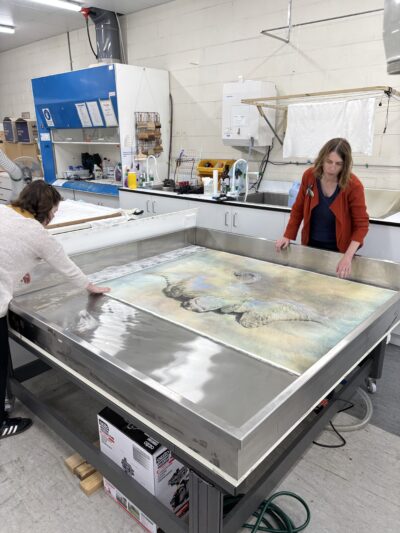
Katie Wood and Rebecca Clendinen bathing a large print.
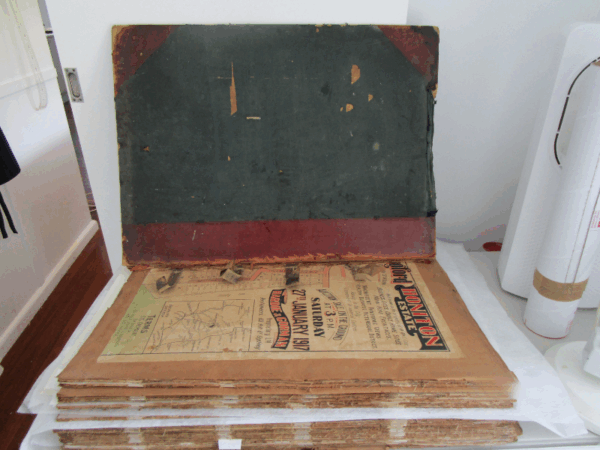
19th–20th century suburban scrapbook.
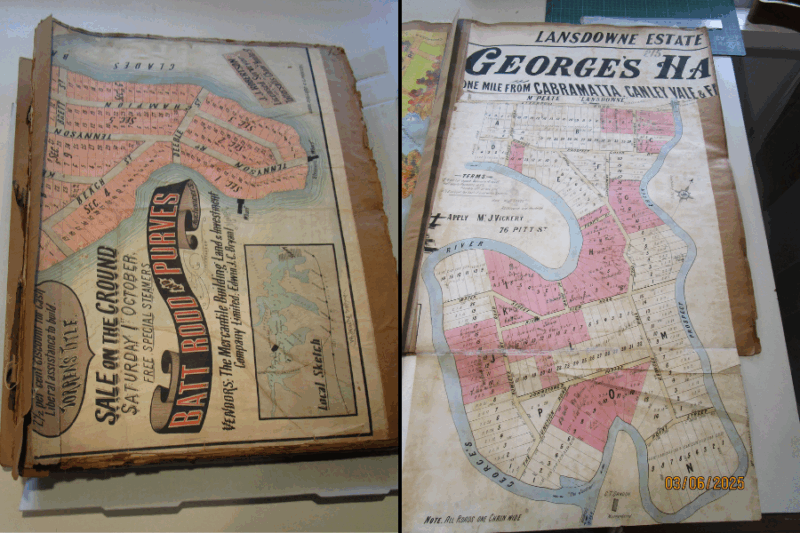
The scrapbook showing pull-out posters.
Textiles
Christina Ritschel, Principal Conservator & Head of Textiles, has been helped in the lab by Annabelle Silk and Lisa Sharp. Annabelle has been busy completing treatments for two fur carriage blankets, ahead of being prepared for framing. Lisa Sharp has been helping mount textiles for framing, such as a bearing cloth from the National Trust and a wonderful Japanese painted landscape.
Christina worked on a wonderful vintage dress from 1846. It arrived folded extensively and in a very small cardboard box. It was heavily discoloured and had obtained many folds and creases from its lengthy storage in the box. It was surface cleaned, humidified and realigned, whereafter it was placed full-length in a large archival storage box.
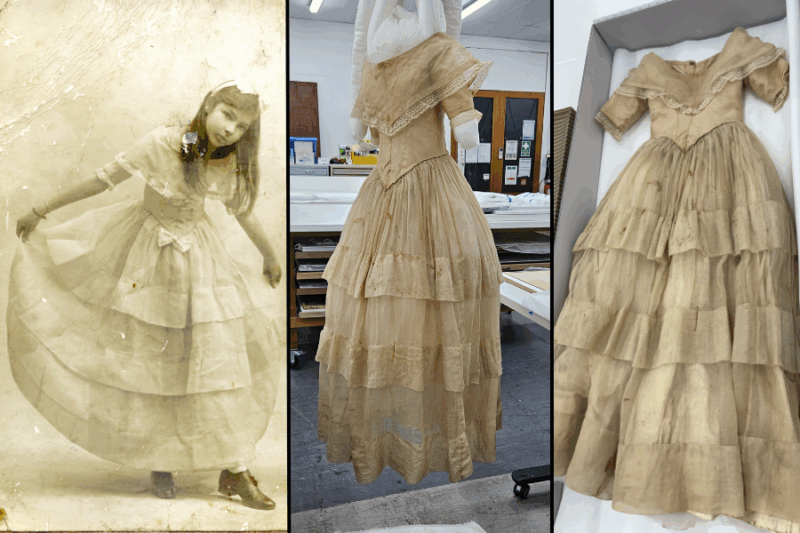
The vintage dress worn in a photograph, 1910. The dress was cleaned, realigned and placed in an archival storage box.
Two rugby caps from St Joseph’s College in Brisbane required extensive stabilisation and loss compensation as the silk velvet pile was completely powdering. Custom-made stands were made for use for both display and storage, minimising the need for handling.
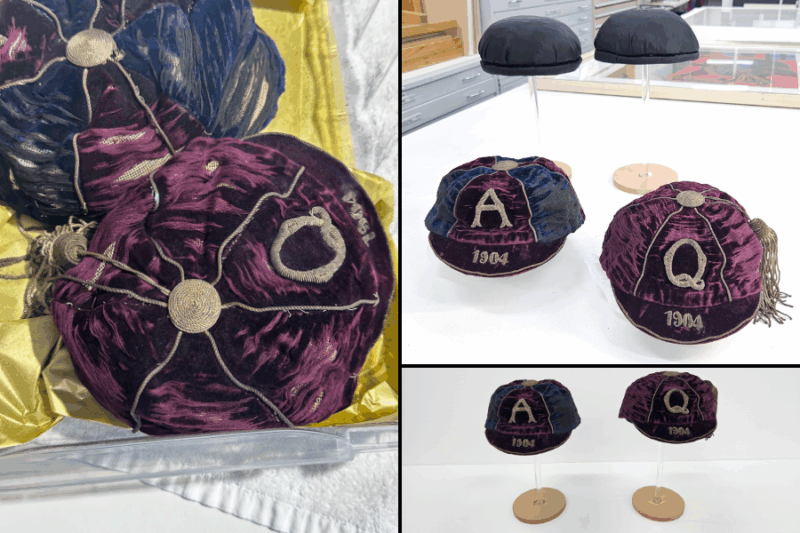
Two rugby caps from St Joseph’s College in Brisbane.
Objects & Outdoor Heritage
The Objects and Outdoor Built Heritage team worked with the City of Sydney and Henry Tsang OAM of Tsang & Lee Architects to project manage and deliver the conservation of the Chinatown gates in Haymarket, Sydney. The project is a key element in the revitalisation of Chinatown. The conservation works preserved the intricate architectural details of the gates and reinforced their cultural significance as symbols of community identity.
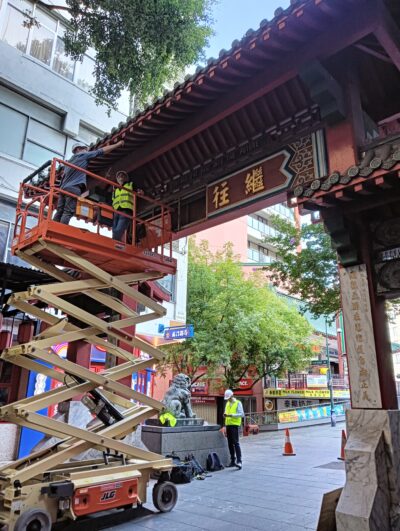
Inspecting the Chinatown gates.
ICS was engaged by Transport for NSW to undertake a paint investigation of the Sydney Terminal Building at Central Station, Sydney. The aim was to determine and record the nature of the original and early internal and external paint finishes of principal building elements of the Sydney Terminal Building. This investigation would then inform the detailed design of the project currently being developed by the project team. Uncovering the historic layers of paint has offered a glimpse into the building’s architectural evolution and heritage, helping to inform its future.
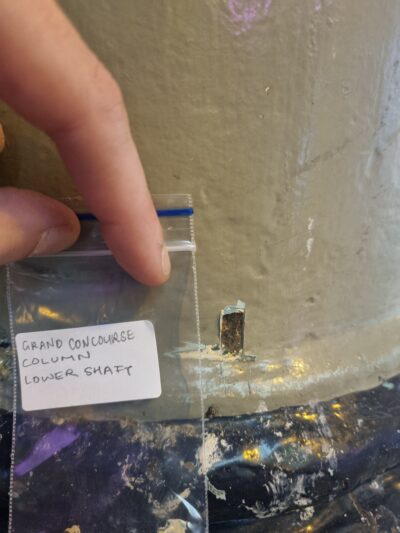
Sample of paint taken from a column in the Grand Concourse, Sydney Terminal Building, Central Station.
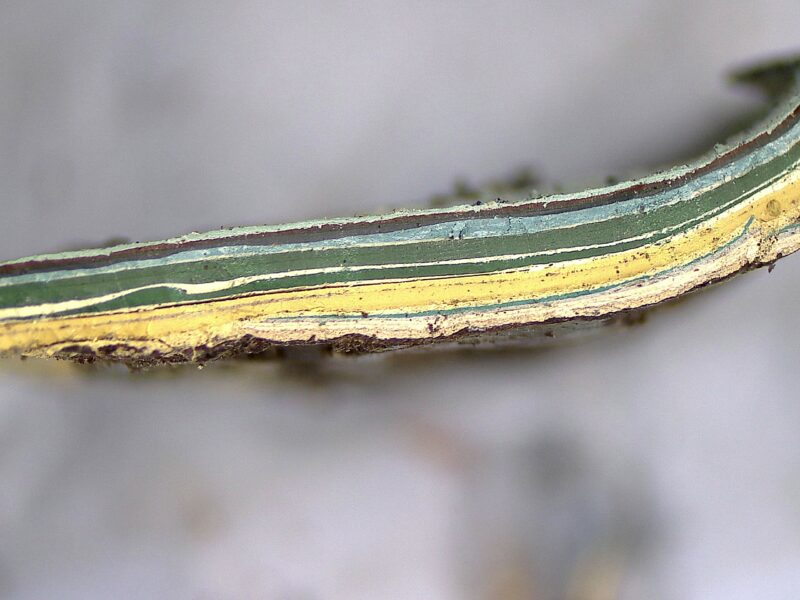
Close-up of the paint sample showing paint layers.
ICS was contracted by Royal Botanic Garden Sydney to prepare a significance assessment and heritage opportunities and constraints report for the former Show House / Show Pavilion, now known as the T4 Glasshouse. The site comprises the 1910–11 brick base of the original Show House and is part of a collection of early glasshouses located on the Central Depot site. The assessment provided valuable insights into the complex history of the structure, highlighting its role in the history of botanical research and public engagement.
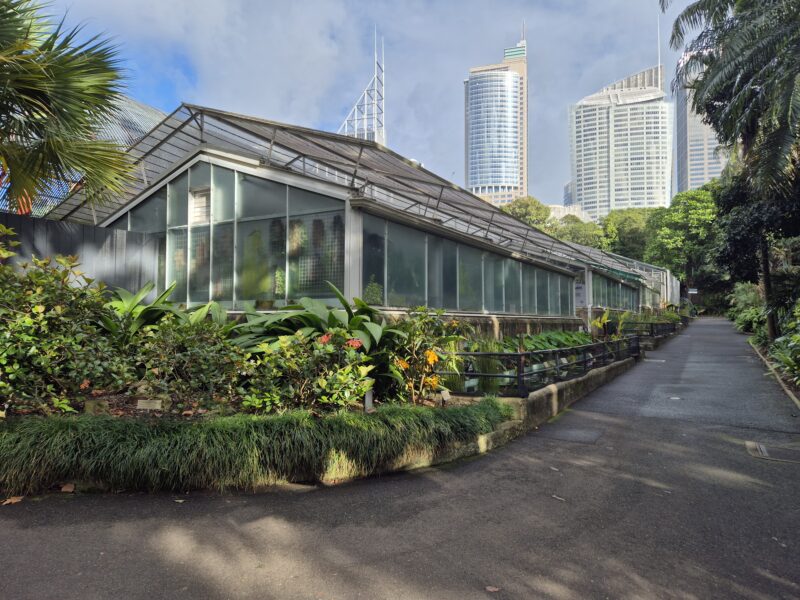
The Show House Glasshouse from the Royal Botanic Garden Sydney.
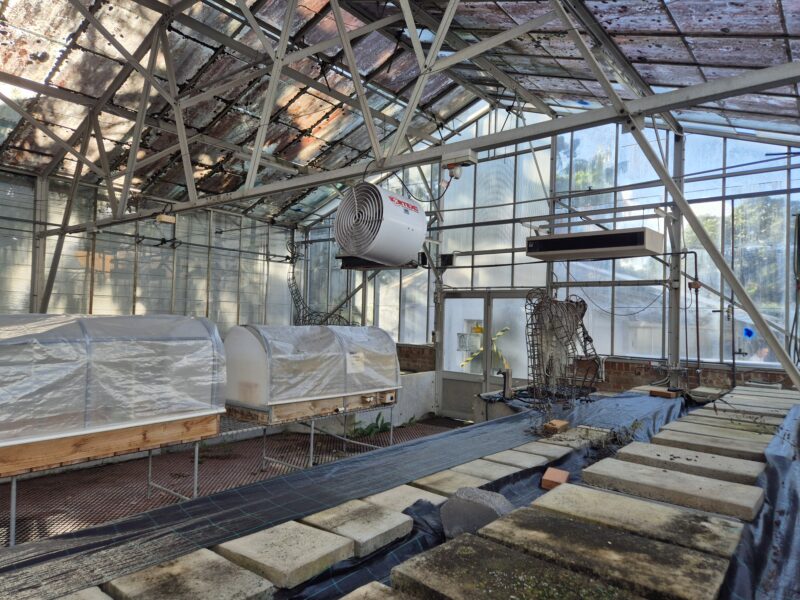
Interior of the Show House Glasshouse.
O’Sullivan Conservation
Staff news
It’s hard to believe we’re already in the second half of the year! Time has flown since O’Sullivan Conservation wrapped up 2024 with a photography course in The Rocks, followed by a celebratory lunch at the Museum of Contemporary Art restaurant, Canvas.
We’re excited to share that we recently added two electric vehicles to our fleet, marking a significant step in our ongoing commitment to sustainability and innovation. These EVs will help reduce our carbon footprint, lower fuel emissions, and contribute to cleaner air quality for everyone.
Looking ahead, the team is eagerly anticipating the upcoming AICCM National Conference in Brisbane this November. It’s been two years since the last gathering, and we’re looking forward to reconnecting, learning, and sharing insights. The conference always delivers engaging, high-quality presentations and discussions.
O’Sullivan Conservation is also advertising for a Graduate Objects Conservator, or Objects Conservator, to come on board in a full-time capacity.
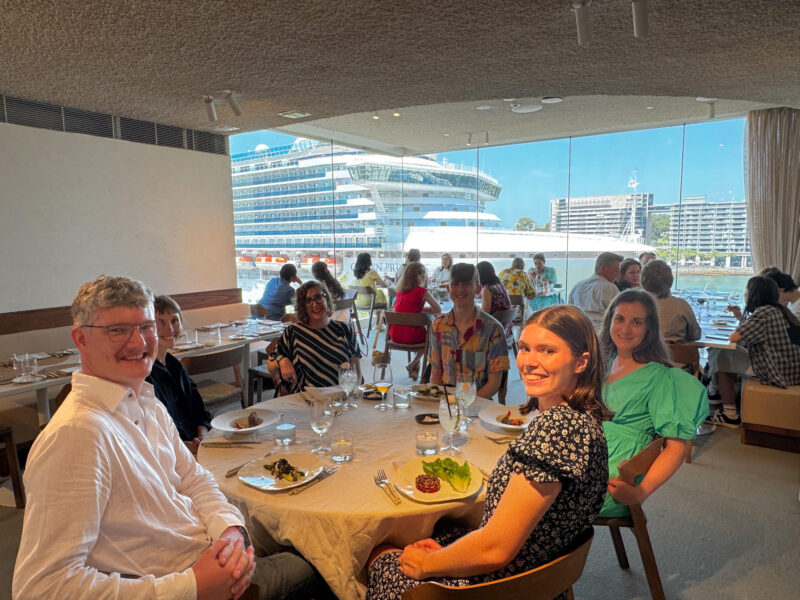
The team enjoying lunch at Canvas, MCA.
Amongst the beautiful architecture and endless decorative arts, Hannah’s trip to India in February provided insightful examples of how conservation is practised outside of Australia.
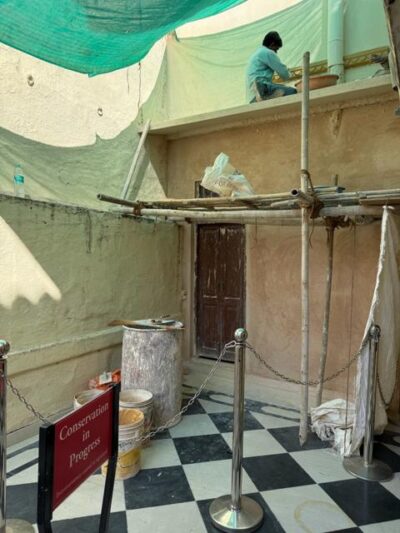
Conservation in Progress’ at the City Palace (Raj Mahal), Udaipur.
Treatment projects
The team started the year with a flurry of activity, completing multiple projects, including the next stage of work on the NSW Rail Museum battery boxes.
Prior to cleaning the battery boxes, 44 batteries had to be removed and safely disposed of at a suitably accredited B-Cycle recycling yard. This was followed by conservation cleaning of the boxes.
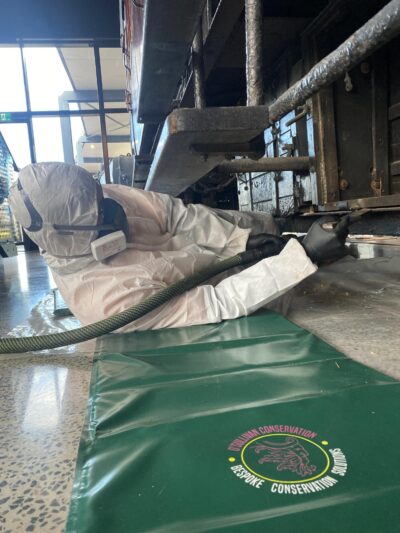
Eoin O Suilleabhain undertaking conservation cleaning.
The team then went straight into conservation maintenance works on various public art collections. Emily and Anna undertook a clean and hot wax treatment of Athena, a bronze sculpture of the Greek goddess who was symbolically gifted to Sydney by the Mayor of Athens during the Sydney Olympic Games. She was left radiating a freshly waxed green patina for the passing commuters to enjoy on their way to work.
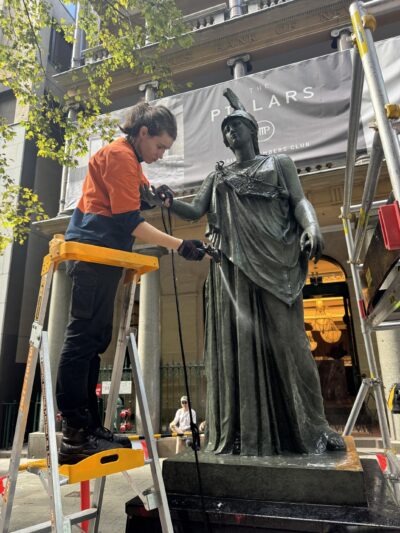
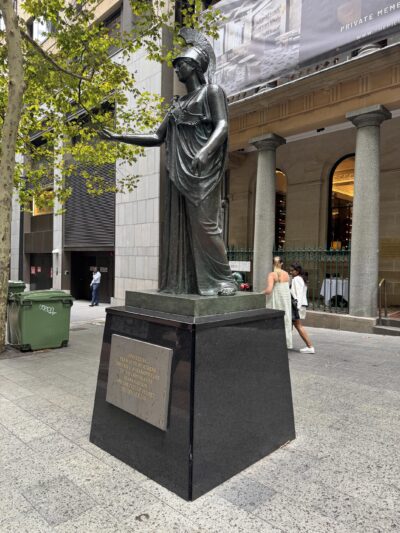
Anna washing Athena prior to waxing; and Athena cleaned and waxed.
A conservation maintenance treatment was undertaken to the cast-aluminium, eight-metre-tall replica of the 1960s Leyland Worldmaster bus in which the Parramatta Eels rugby team held meetings during the 1980s. The sculpture, named Place of the Eels, received a surface clean, buff and localised polish, as well as minor maintenance repairs. The result enhanced its already arresting spectacle as a primary art installation in Parramatta Square.
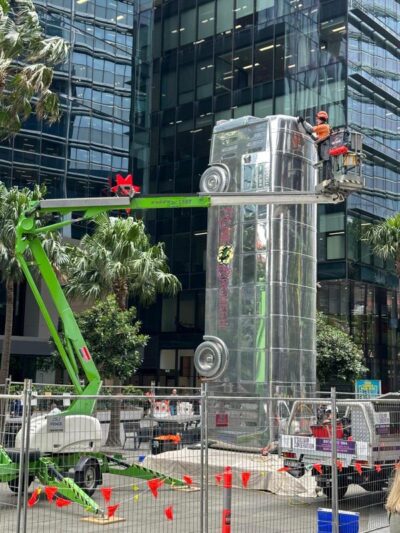
Eoin buffing Place of the Eels at height.
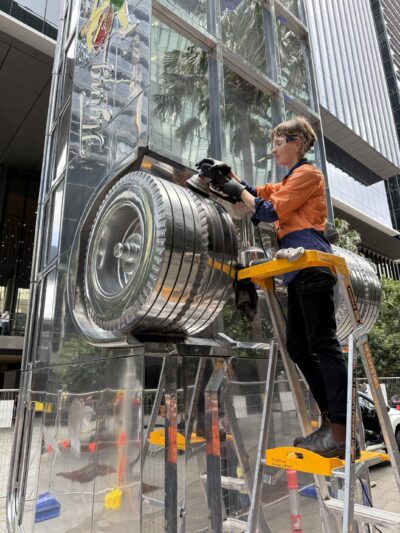
Emily buffing the details on Place of the Eels.
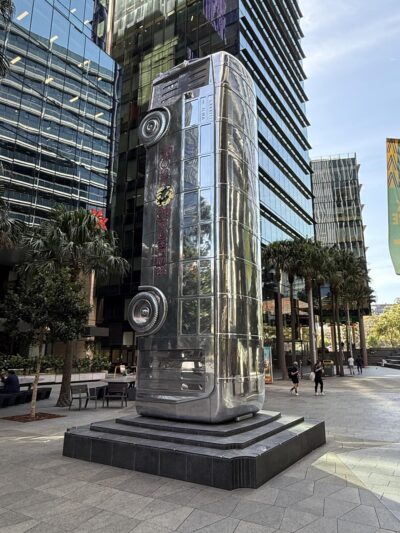
Place of the Eels after treatment
Eoin, Emily and Anna carried out a conservation maintenance treatment on the WWI Memorial to Pyrmont–Ultimo Servicemen in early March. The Memorial consists of four large bronze dedication plaques on a sandstone and trachyte pedestal, and one of a few remaining copper electrotype sculptures by the artist Gilbert Doble. The sculpture revealed numerous previous repairs during wax removal but, despite the scars, she maintains a resolute position among the community-centred Union Square. During June, a second stage was undertaken, which involved repointing the stone plinth.
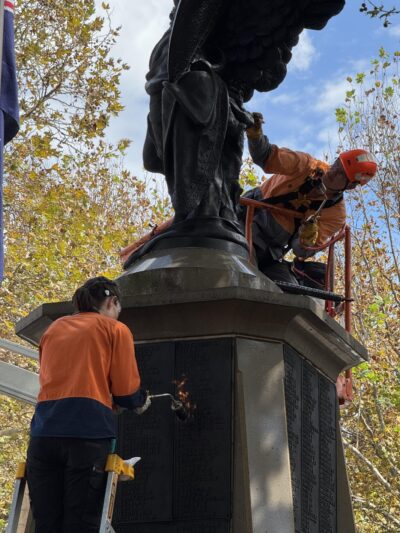
Eoin and Anna wax the bronze components of the WWI Memorial to Pyrmont–Ultimo Servicemen.
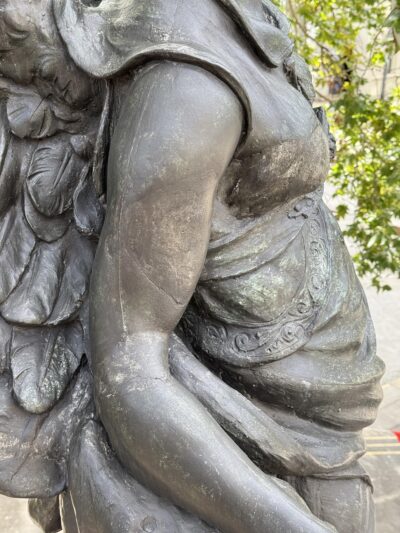
Example of previous repairs on the sculpture, a part of the WWI Memorial to Pyrmont–Ultimo Servicemen.
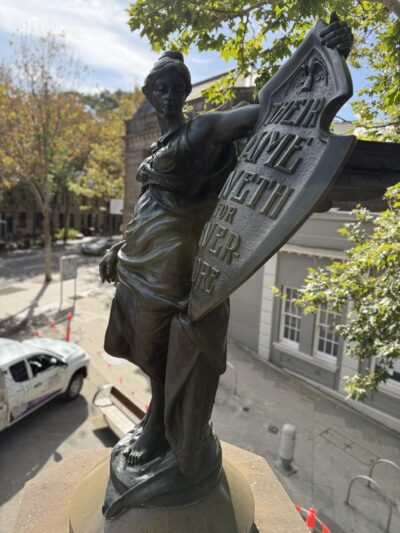
WWI Memorial to Pyrmont–Ultimo Servicemen cleaned and waxed.
International Conservation Services (ICS) Brisbane
Outdoor Sculpture Conservation in Brisbane
Principal Metals Conservator Keir Bayley, supported by Queensland State Manager Jochen Letsch, recently undertook the treatment of several outdoor sculptures across Brisbane. One of the more memorable projects involved the cleaning and re-waxing of a bronze sculpture depicting two sea birds, uniquely situated in the centre of a lagoon. Carrying out the treatment from a boat added a novel and challenging dimension to the work.
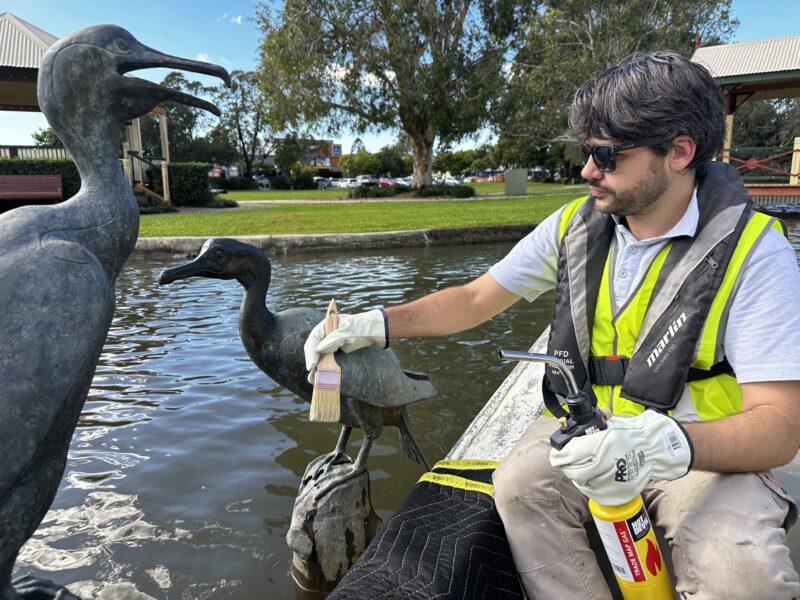
Keir Bayley treating two bronze sea birds.
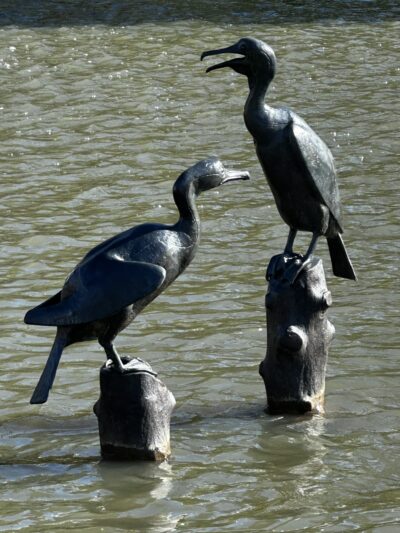
The bronze sea birds cleaned and rewaxed.
Restoring historic flooring at Parliament House, Brisbane
Jenny Snowden, our Senior Built Heritage Specialist, together with Jochen Letsch, recently planned and oversaw the restoration of a tessellated tile floor at Brisbane’s Parliament House. The project involved the careful removal of non-original tiles that had been introduced during earlier works. To maintain the floor’s historical integrity, an exact match to the original tile pattern and material was sourced from the UK, allowing for a seamless and authentic restoration of this important heritage feature.
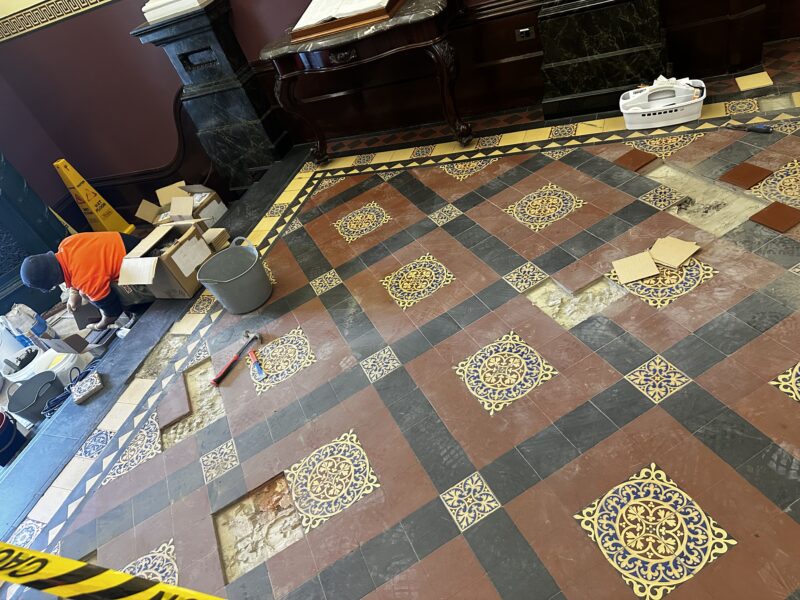
Restoration of a tessellated tile floor at Queensland’s Parliament House
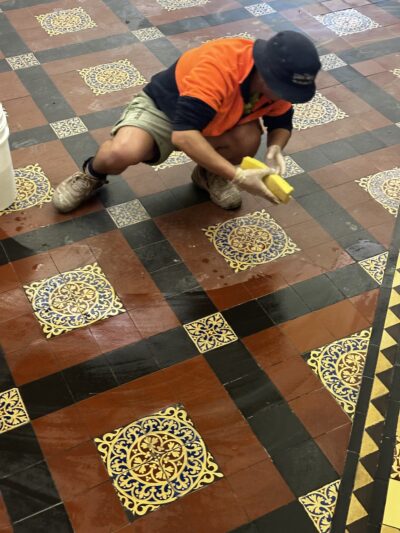
Restoration of a tessellated tile floor at Queensland’s Parliament House
Museum of Lands, Mapping and Surveying
Behind every great museum are the people who preserve and care for its collections! At the Museum of Lands, Mapping and Surveying in Brisbane, a dedicated team of staff and volunteers supports the ongoing conservation and curation of Queensland’s land administration history.
As a museum that celebrates the people, tools and techniques that have helped shape the Sunshine State, this work includes conservation, research and collection management—ensuring Queensland’s surveying and mapping legacy is preserved for future generations.
The Museum of Land, Mapping and Surveying is administered by the Queensland Government’s Department of Natural Resources and Mines, Manufacturing and Regional and Rural Development. The Museum was established by Bill Kitson in 1982 to preserve the history of surveying, cartography and land administration in Queensland. Bill, a long-serving departmental surveyor, was the Museum’s inaugural curator from 1982 to 2007. During his tenure, he laid the foundation for the collection, sourcing historic surveying instruments, artworks, maps, photographs and biographies.
Following Bill’s retirement, the role of Senior Curator was taken up by Kaye Nardella, who led the Museum for 17 years until her retirement last year. With a background in cartography, Kaye played a key role in broadening the Museum’s public reach—introducing land research services and significantly expanding online access to the map collection, opening it up to a wider audience across Queensland and beyond.
In March, Gab Garde, an objects conservator, commenced as the Museum’s new Senior Curator. Gab is currently focused on strengthening preventive conservation measures and reviewing the Museum’s collecting priorities. This includes establishing in-house capability for conservation treatments through updated work areas and equipment.
Research Officer Georgia Feehely continues to play a key role in managing public land research enquiries. As is the case in many small museums, Georgia wears many hats—from support object re-housing, to monitoring the environmental conditions in the collection spaces and maintaining the collection database.
The team has recently expanded with the addition of 10 collections and conservation volunteers: Areej Albukhari, Jessica Brown, Georgia Cartwright, Luke Colombo, Ashley Ahmer, Emily Everett, Sebastian Harris, Jordan Harwood, Natalie Miller and Anna Viktorova. These emerging professionals are gaining hands-on experience in conservation and collection management, developing skills in object nesting, cleaning, labelling and cataloguing. They are also currently assisting with the preparation of 40 objects for a short-term loan to the Eumundi Museum.
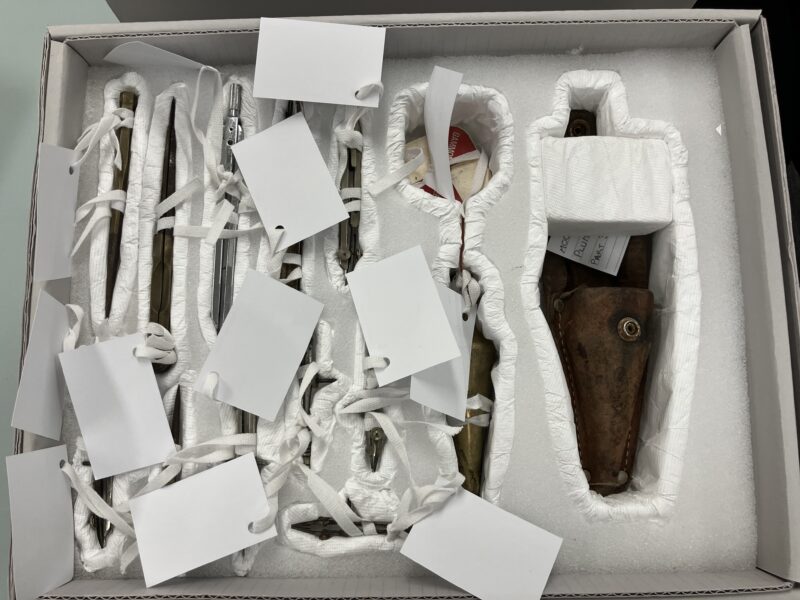
Various objects in custom fitted nesting.
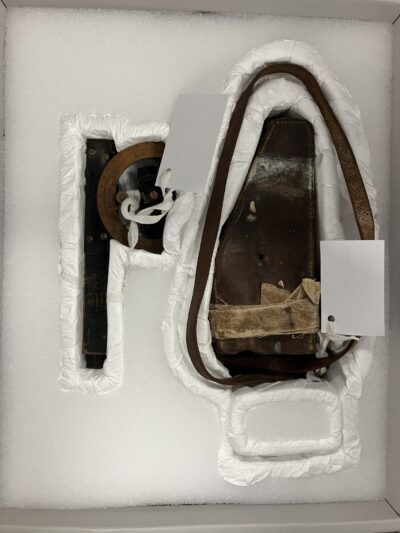
Clinometer and leather case in custom fitted nesting.
The Museum is supported by photography volunteer Ashleigh Shaw, who assists with the visual documentation of object condition. Ashleigh’s keen eye for detail is crucial in this work, contributing to the ongoing monitoring and long-term care of the collection.
Lending their decades of expertise are the Museum’s research volunteers, all of whom are retired departmental staff: Graeme Rush, Jim Hawker, and former curators, Kaye Nardella and Bill Kitson. As subject matter experts in surveying, cartography and departmental history, the research volunteers continue to contribute valuable insights that deepen the Museum’s understanding of the collection and its historical context.
Visit the Museum of Lands, Mapping and Surveying at 317 Edward Street, Brisbane, open Monday to Friday, 9:30 am to 4:00 pm or visit the website.
Artlab
Textiles
The textiles team (Mary-Anne Gooden, Kristin Phillips, Victoria Thomas and Petrina Killey) has eased into the second half of 2025 after a busy few months of exhibition preparation, installation and deinstallation. The last part of 2024 saw the installation of the Art Gallery of South Australia’s (AGSA) large textile show Radical Textiles, which came down in April after a very successful run. The show featured textile works from over 100 artists, designers and activists, and the textiles conservation team was involved on the preparation side with several treatments, mounting of flat works and custom mannequin preparation. A particularly fun challenge was the mounting of a steel chainmail dress by Sydney designers Nicol & Ford, which, due to the weight of the garment and the importance of displaying it on a queer body, meant that the team had to first source a suitably built body, and then ensure it remained standing with several modifications to the shape of the foot and the manufacturer’s leg mounts (with the incredible help of objects conservator Kenny Monger).
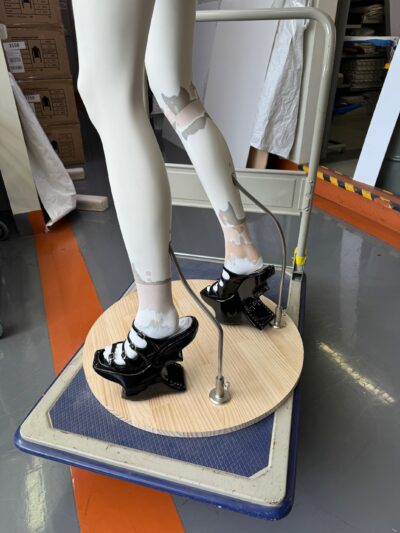
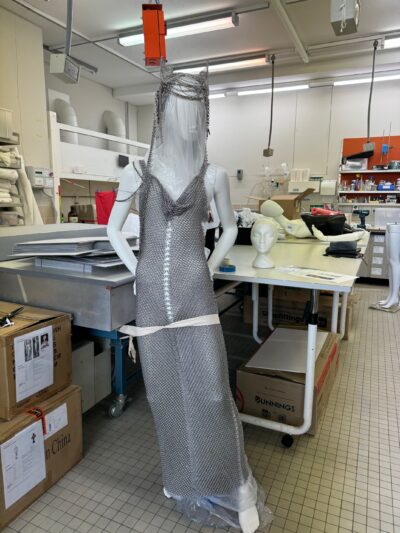
‘Look 24’ (chainmail dress) by Nicol & Ford and its customised mannequin in progress in the Artlab textiles lab.
The textiles team has also recently completed some major treatment projects: Kristin worked on the treatment of an 18th century embroidered silk waistcoat from the David Roche gallery collection; and Victoria worked on a 19th century tartan dress from the Art Gallery of South Australia. Part of this treatment involved working with Artlab photographer Eleanor Adams and Frankie and Swiss, a fabric printing company, to produce a replica of a section of missing sleeve.
Paintings
A large icon depicting Christ Pantocrator from a local Greek Orthodox church is being fully treated with Marek Pacyna, Maria Kubik and Eugene Taddeo developing a mounting technique to place the painting back onto the ceiling.
Rosie Heysen has recently completed the conservation of a beautiful leather flower-decorated frame for the Town of Gawler, which involved the reproduction of several varieties of flower in leather and for which Rosie led some Artlab-wide workshops in the technique.
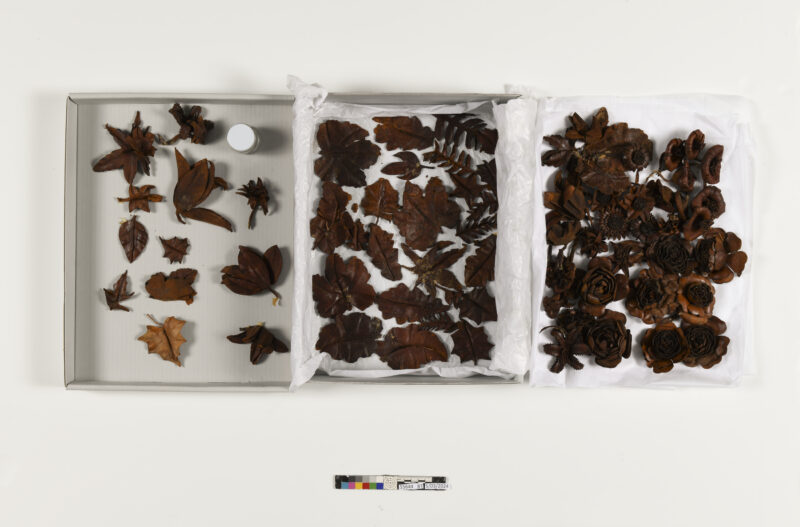
The original leather flowers from the frame
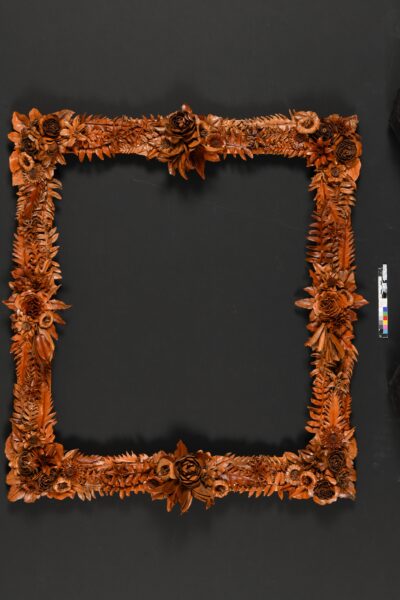
The frame after treatment, which incorporated the extant flowers as well as reproductions made by Rosie and other Artlab staff during a skills-sharing studio workshop
Rosie and Rita Costible also finished off the financial year with some gilding, working to refresh the lettering on an outdoor marble sculpture of the poet Robert Burns. This work is situated in the courtyard adjacent to the State Library of South Australia.
Objects
Sophie Parker, Senior Objects Conservator, enjoyed conserving a significant folding chair of casuarina timber and kangaroo hide crafted by the explorer John McDouall Stuart. (Stuart led several attempts to cross the Australian mainland, eventually achieving this goal in 1861–-62 by crossing Australia from south to north and back, later enabling the Australian Overland Telegraph Line to follow his route.)
The chair had been partially restored in the 1960’s. A mixture of hand- cut and machine- cut kangaroo thong/hide had become embrittled and broken with some losses. The breaks were commonly where the hide was threaded into holes in the timber frame, leaving very little space for new support material to be added to join and reinforce the hide. Using a previous technique Sophie had developed for repairing basketry, she dyed smooth Tyvek (spun bonded polyethylene sheet) with Deka silk dyes and attached strips to the old hide using Beva 371 film and heat.
The chair is back on display at the Royal Geographical Society of South Australia thanks to a grant from the History Trust of South Australia.
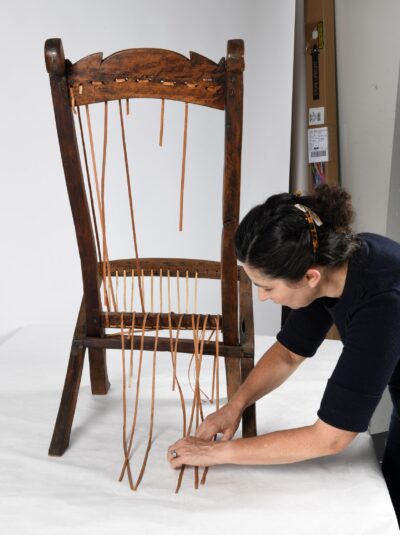
Sophie with John McDouall Stuart’s chair before treatment.
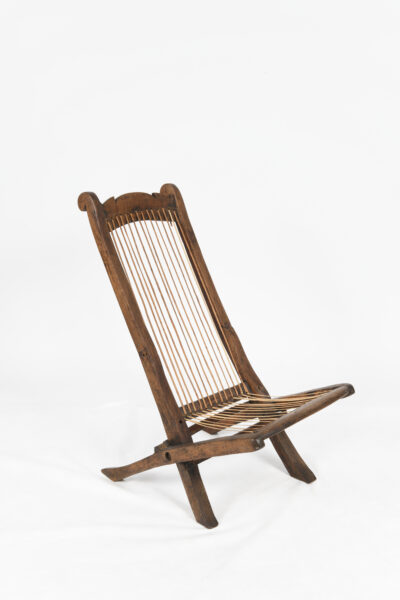
John McDouall Stuart’s chair after treatment.
Interns
We have welcomed three interns from the University of Melbourne so far this year: Fei Stokes in paper/ books; Renae Bruno who undertook an internship in the paintings department and completed a full treatment on a painting titled Hungarian Village and its frame from a private client; and Megan Kamei in textiles, who worked on a range of projects in the lab, including the treatment of a small silk flag, packing the large Sally Smart work Performance/ Punokawan/ Chout (The Choreography of Cutting), and assisting with some research into soap nuts as a potential biodegradable alternative surfactant.
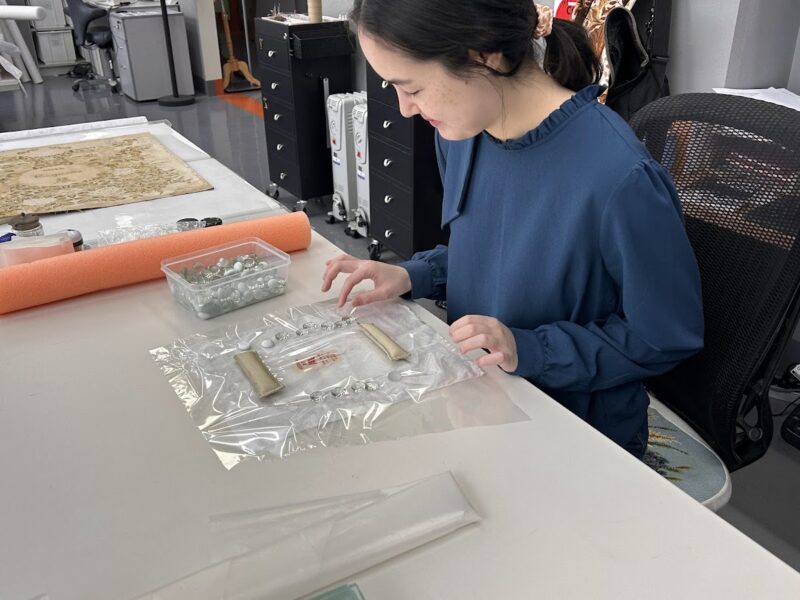
Megan Kamei at work in the Artlab textiles lab
Arts Centre Melbourne
At Arts Centre Melbourne, the Australian Performing Arts Collection is preparing for an exciting new chapter. This December, the Australian Museum of Performing Arts will officially open its doors to the public. Located in Hamer Hall and overlooking the Yarra River, the museum will present two exhibitions annually, each celebrating the richness and diversity of the performing arts. Keep an ear out for the announcement of the inaugural exhibition in September.
While preparations for the new museum have been underway, Bronwyn Cosgrove and Carmela Lonetti from the Conservation team have been hard at work on several significant projects.
Thanks to the generosity of Professor Barbara van Ernst AM, three graduate conservators have been funded to carry out complex treatments on opera costumes worn by Dame Joan Sutherland for the Vancouver Opera. It has been a pleasure to welcome Gemma Ghoukassian and Portia Lawson to the lab and to see the results of their work, now on display in Smorgon Plaza, State Theatre building. An online story showcasing their work will be available soon. Keep an eye on ACM online exhibitions and stories for its release.
Vicki Car, the 2025 recipient of the Barbara van Ernst Internship, is currently conserving a velvet robe trimmed with fur, worn by Dame Nellie Melba in a production of Otello at the turn of the 20th century.
We are also deeply grateful to long-time volunteer and supporter Virginia Boon for funding the purchase of an FTIR (Fourier-transform infrared spectrometer). This valuable addition enhances our analytical capabilities, helping us identify the wide range of materials in the collection and support long-term preservation planning.
As part of our loans program, Carmela has dedicated over 100 hours to stabilising the Lyrebird Costume tail, designed by Sidney Nolan for the 1964 ballet The Display, choreographed by Robert Helpmann. Parsilk covers were sewn for each section of the tail to provide protection during transit and a custom-made mannequin was made to replicate a pose from the original ballet. The costume is currently on loan to the Canberra Museum and Art Gallery as part of their exhibition, A Total Work of Art: Sidney Nolan and the Stage
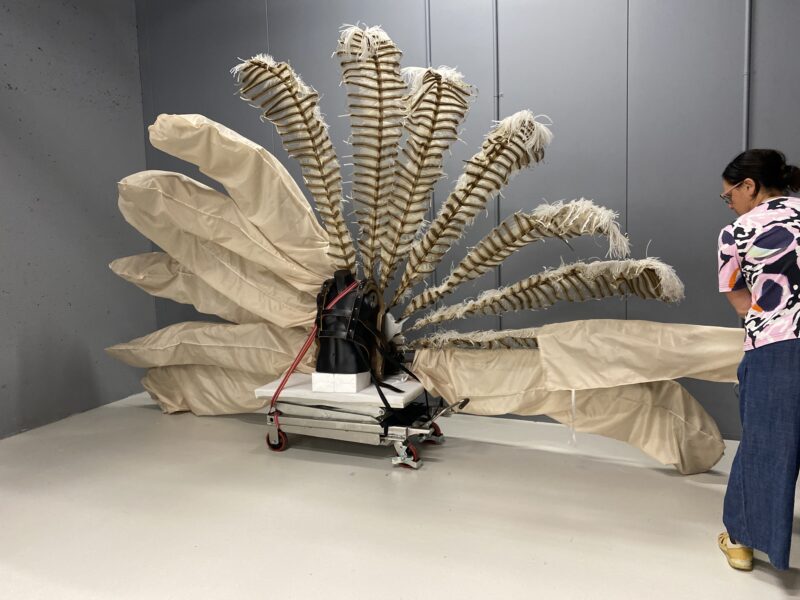
Carmela Lonetti, Conservator, Arts Centre Melbourne with custom sewn covers for Sidney Nolan’s Lyrebird Costume tail.
Grimwade Centre for Cultural Materials Conservation / Grimwade Conservation Services
Celebrating the launch of the Robert Cripps Institute for Cultural Conservation
A significant milestone was marked on 7 May with a launch celebrating the Robert Cripps Institute for Cultural Conservation and recognising over 25 years of extraordinary partnership between the Cripps family and the now home of the Cripps Institute, the Grimwade Centre.
The evening brought together colleagues, collaborators, students and friends to celebrate the Cripps family’s enduring commitment to cultural conservation. The program featured powerful reflections and artistic tributes, including a Welcome to Country by Aunty Joy Wandin Murphy, and a moving performance by Gabriel Nodea, who also spoke of the Tennent family’s long-standing relationship with the Warmun community.
Guests heard from Robert Cripps, Angus Grimwade, Amy Tennent and Vice-Chancellor Professor Emma Johnston, and enjoyed a showcase of student conservation projects that exemplify the transformative work of the Grimwade Centre.
The launch of the Institute marks an exciting new chapter, deepening our shared commitment to protecting cultural heritage and expanding the reach and impact of conservation practice in Australia and beyond.
‘The launch of the Robert Cripps Institute for Cultural Conservation honours a truly visionary partnership,’ said Institute Director, Professor Robyn Sloggett AM. ‘It allows us to look forward, to deepen our commitment to conservation practice, and to support new generations of students working to protect cultural heritage in all its forms.’
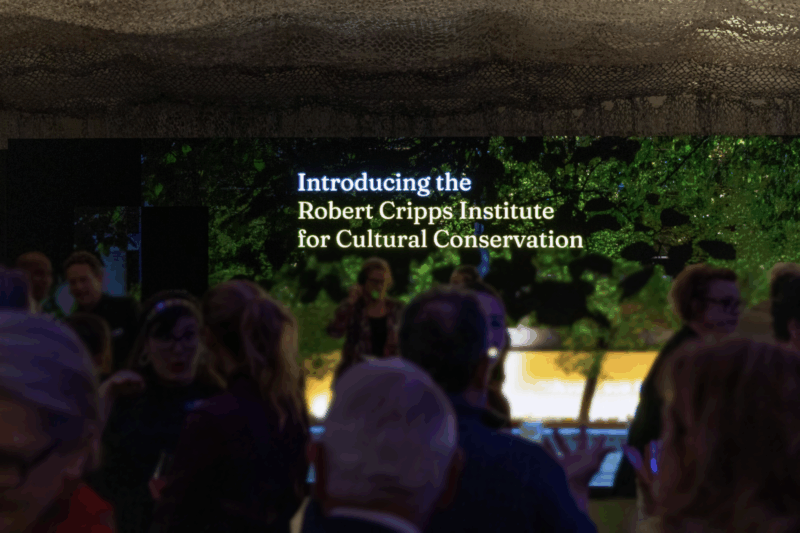
Launch of the Robert Cripps Institute for Cultural Conservation, 2025.
Conservation treatment
Following on from a fire on 17 February 2024 at the See Yup Temple, the Grimwade Centre has been part of the ‘make safe’ phase of the recovery process, with the See Yup Society, temple caretakers, volunteer community, Sophie Couchman, Janet Beeson and Jenny Dickens from Heritage Victoria. Our collaboration under the leadership of Nicole Tse has supported the collection response and recovery efforts as part of subject learning in Sustainable Collections, which also continued into 2025 with ABC risk assessments and PNA reports, and a year-long student volunteer program supported by the Willem Snoek Award (with awardees Mollie Liu, Danni Lin, Hernan Lopera, Zeejay Tan, Lucinda Papas, Laura Jane Delaney, Ameliah-Rose Tioriori ,Yori Akbar Setiyawan, Jiahe Yi, Mengxuan Zhang, Satriyo Wibowo, Sarah Johnston, Brigid Stapleton, Chuqing Huang, Ju-Wei [Rita] Hsu, Debbi Min, Hannah Berry, Qianyu Tang), and a Hansen Little Public Humanities Award to Mollie Liu to support a fund-raising campaign (see some of Mollie’s design work for the campaign). With the See Yup Society, Sophie Couchman and Nicole Tse, we have several competitive grant applications in submission and research papers and projects underway with the goal to offer future graduate opportunities in collection conservation, cultural care taking and training. The partnership has enabled us to gain a deep understanding of the See Yup Temple living practices and spiritual collections, their materials, the fire-damaged effects, cleaning pathways and, importantly, the situated and collective dialogues (which also draw on graduate student Chinese language skills when communicating with the temple caretakers and society members). Recently we won an international award, a 2025 Global Award for World Heritage Education Innovative Case (AWHEIC UNESCO award). More on this later. To see more about the collaboration see the See Yup Temple and the temple is seeking donations for the See Yup Temple Recovery Appeal 四邑關帝廟維修籌募捐款.
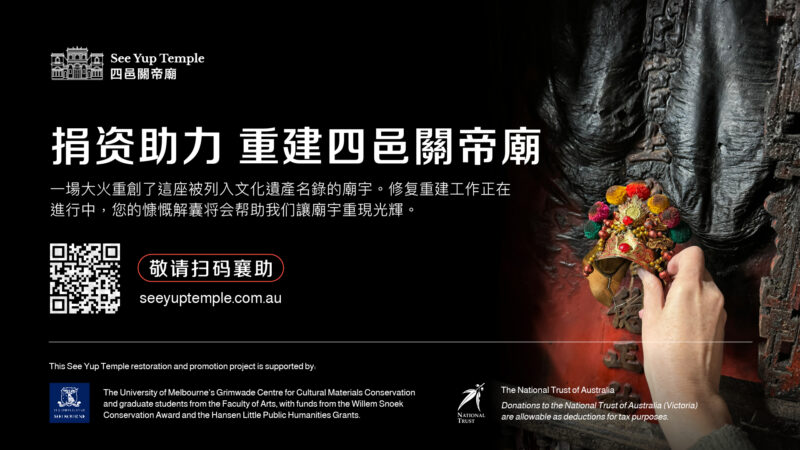

See Yup Temple Fundraising campaign posters (in English and Cantonese), design work by Mollie Liu, Master of Cultural Materials Conservation.
Master of Cultural Materials Conservation
The Grimwade Centre conducted its annual Ngarranggarni: Gija Art and Country subject at Warmun Community in the Kimberley region of Western Australia in July. Twelve Grimwade Centre master’s students participated in the program, alongside subject coordinators Jonathan Kemp and Sabine Cotte, as well as alumni of last year’s subject – Ameliah-Rose Tioriori and Stephen Bollard.
The cohort was welcomed on Country at the Warmun Art Centre with a Manthe smoking ceremony, where they met Gija Elders and learned the Warrananj Ngarrannggarni (story of Warmun). Students heard significant stories tied to Warmun in situ, including those of Ngalangangpum School, Wangkawal (the Rainbow Serpent), and Texas Downs Station (ancestral country for many Gija people).
A core aspect of the Ngarranggarni on-Country teaching program is storytelling, aligning with traditional methods of teaching, learning and preserving Gija law. Students engaged with Gija knowledge through its connection to Country, language, and practices like Manthe (welcome), Joonba (ceremony) and painting (storytelling). As part of the two-way partnership, students and staff also contribute to the art centre. This year, they divided into working groups to assist with tasks such as stretching canvases, crushing ochre and cataloguing artwork or audiovisual materials.
This year’s program was led by Mark Nodea, supported by Gija Elders Patrick Mung Mung, Eileen Bray and Shirley Drill, alongside art centre workers Andrew Daylight, Michael Daylight, Lazarus Johnson, Jonathon Malgil and Cecil Mosquito (among many others). The immersive teaching week concluded with a Gurirr Gurirr Joonba, bringing students and the community together in celebration.
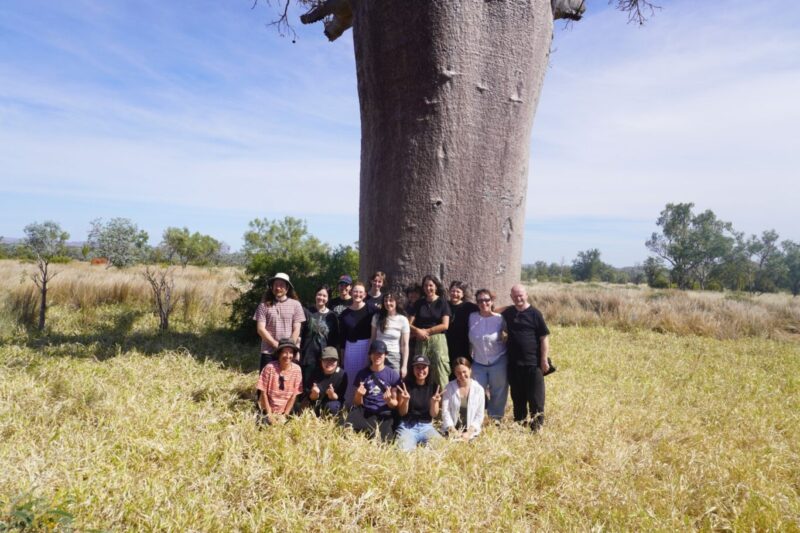
Grimwade students in Ngarranggarni. 2025. Image: Stephen Bollard.
Artist workshop
Renowned Melbourne street artist RONE (Tyrone Wright) delivered an exclusive guest lecture and workshop to conservation students at the Grimwade Centre on 4 July 2025, offering rare insight into his immersive installations and constantly evolving techniques.
The event was organised by the Student Conservators at Melbourne and Dr Caroline Kyi, with the aid of a Special Grant from the University of Melbourne’s Graduate Student Association (GSA).
Both students and practising conservators participated in the session, which began with a presentation by RONE, where he shared personal insights into his creative process as well as his materials and methods. Workshop participants then had the opportunity to examine the wall mural from RONE’s work The Waiting Room (which was part of his large scale Empire installation at Burnham Beaches mansion in 2019), as well as trial paper conservation tear repairs on areas of the work.
Through the workshop, participants reflected on the inherent ephemerality of street art, particularly works painted directly onto walls. They explored how this transience poses challenges for preservation, and how creative alternative methods, such as creating large-scale works on paper and mounting them with conservation adhesives, could challenge this notion. This approach could potentially allow large-scale wall murals to be removed, remounted and re-staged, preserving both their material and conceptual integrity beyond their original setting.
Conservators and student conservators also tested various conservation adhesives for mounting papers to more durable backings. The workshop opened up a dialogue between artist and conservators, fostering a two-way exchange of knowledge, which could feed into each other’s practices.
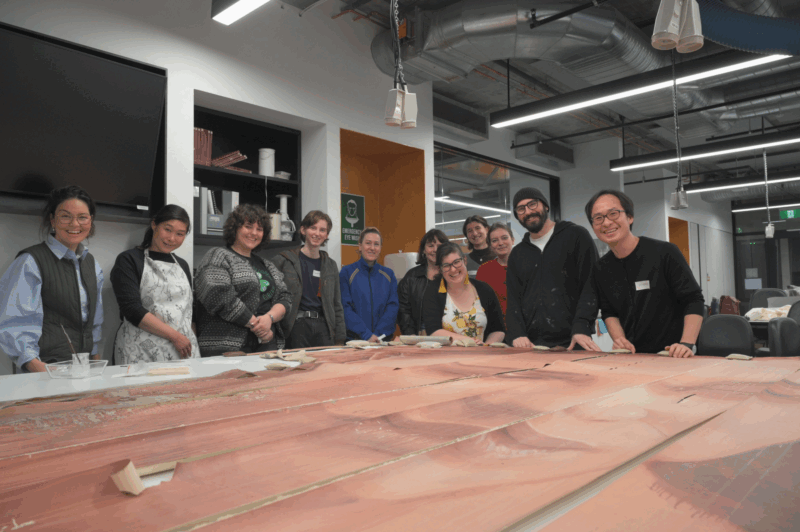
University of Melbourne students from the Master of Cultural Materials Conservation Program, Grimwade Centre for Cultural Materials Conservation, with Melbourne street artist Rone, 2025.
Family & Friends Night 2025
On 10 July 2025, family, partners and friends of Grimwade students were welcomed into the Grimwade conservation laboratories for this year’s Family & Friends Night. Organised by the Student Conservators at Melbourne (SC@M) and Grimwade Centre, attendees were able to view examples of a range of cultural objects that had been treated by students as part of their Advanced Conservation Practice subjects. These included items ranging from textiles/garments, ceramics, musical instruments, anatomical models and computer games/digital art, to paintings. It was also a rare occasion where food and drink were allowed in the conservation labs (‘The horror! The horror!’).
The night offered a unique opportunity for conservation students to share their work with loved ones and friends. Most importantly, the event gave insight into the passion, purpose and values driving the conservation field and the students currently training to be the next generation of conservators. As the Director of The Robert Cripps Institute for Cultural Conservation, Robyn Sloggett, noted that night, conservation is, after all, at its core, about cultural wellbeing—for culture and community, and for the materials that carry our stories forward.
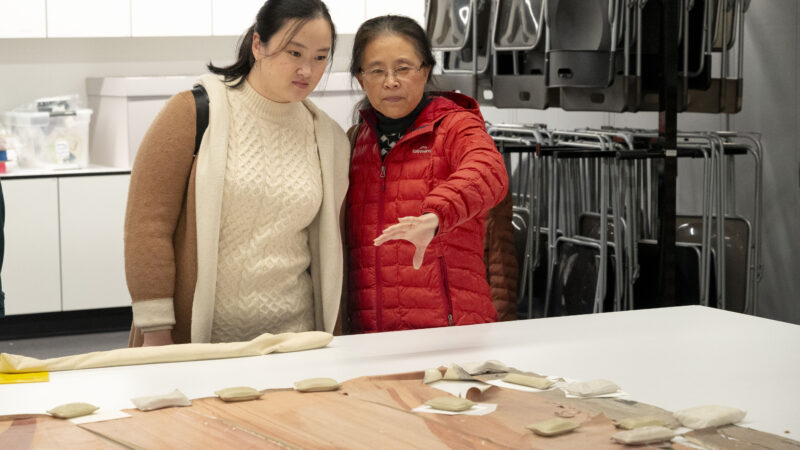
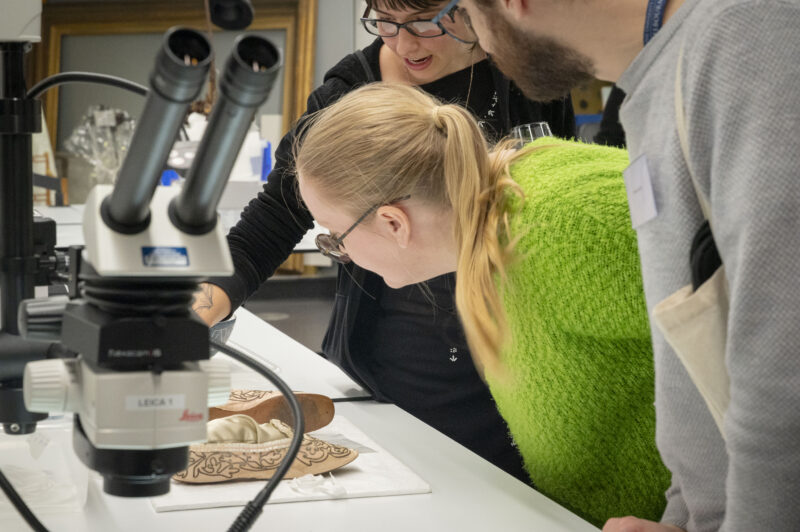
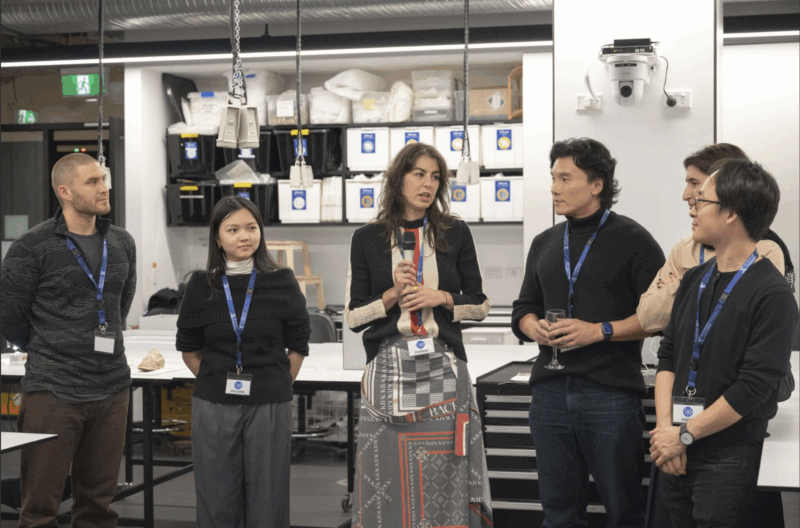
Guests at the Family & Friends event co-organised by Grimwade students and staff. Melbourne, 2025.
Conferences – WAC-10 (World Archaeology Congress)
In mid-June, Dr Holly Jones-Amin co-presented at WAC-10 with Heritage Victoria curator Annie Muir, Grimwade conservator Marica Mucic and archaeologist and conservator Lucy Welsh. WAC (World Archaeology Congress) is the world’s largest archaeology congress. It was hosted by Flinders University and Charles Darwin University and held on the unceded sovereign Country of Larrakia. Thirteen hundred (yes, you are not seeing things) papers were delivered over four days by delegates (archaeologists, heritage professionals, anthropologists, historians, and Indigenous leaders and community members) from 70 countries in ~20 parallel sessions. These included climate change, repatriation, archaeological activism, threats to Palestinian heritage, Indigenous sovereignty, the role of digital heritage, rock art and the decolonisation of curricula and institutions. The conference was enriching and, despite the 2000 delegates, felt inclusive. Our session was concluded by Tiwi men who co-authored another paper spontaneously sharing the song they had sung to their objects in institutions in Europe.
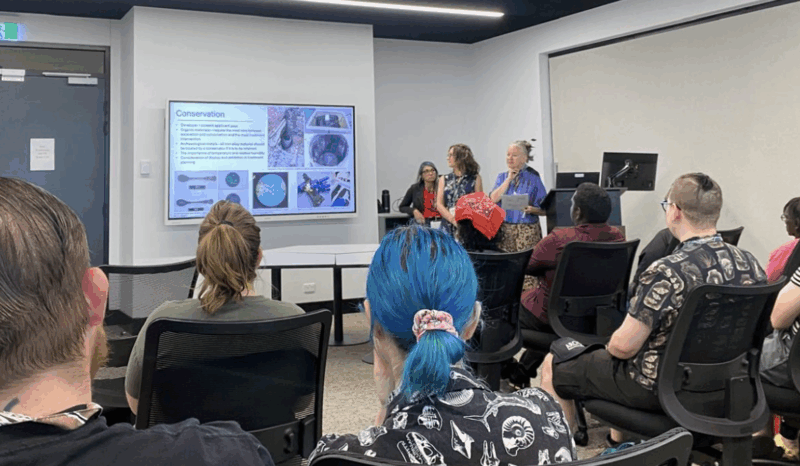
Dr Holly Jones-Amin co-presenting at WAC-10 with Heritage Victoria curator Annie Muir, Grimwade conservator Marica Mucic and archaeologist and conservator Lucy Welsh.
Grimwade Centre for Cultural Materials Conservation (academic programs)
Mary Lugton Postdoctoral Fellowship (2025–27)
Earlier this year Dr Eliza O’Donnell commenced the Mary Lugton Postdoctoral Fellowship at the Grimwade Centre to undertake her project Material Mobilities and Cultural Exchange: Mapping Indonesia Diaspora Art Practices in Australia. Building on the history and current practice of cross-cultural and artistic exchange between Australia and Indonesia, this project focuses on documenting the materials and techniques of expatriate Indonesian artists living in Australia and co-developing new methodologies for collaboration between artists and conservators. Ten Indonesian artists—established, mid-career, and emerging—currently based in Australia will be joining the project. They will participate in long-form studio-based interviews and have the opportunity to join Eliza in the conservation lab for technical analysis of their artworks to further understand their materials from a conservation perspective. This research builds on Eliza’s PhD, focusing on issues surrounding art authentication and attribution in contemporary Indonesia, and early findings from this project will be presented at the upcoming AICCM National Conference in November.
Professional development – Indonesia
Indonesia Art Study Tour 2025 (IAST) and Practice and Process Symposium
From 12 to 22 July, Eliza O’Donnell participated in the Australia Indonesia Art Forum (AIAF) Indonesia Art Study Tour, conducted annually for members of the Australian visual arts community to connect with colleagues in the Indonesian visual art sector to facilitate the building of relationships and knowledge sharing. The tour began with two days in Ubud, Bali, and over the following week ventured to Jakarta, Bandung, Solo and Magelang, concluding in Yogyakarta to coincide with the opening of the annual arts festival, Artjog. Highlights included visits to the studios of senior artists including Made Djirna in Ubud, Mangku Muriati in Klungkung, Tisna Senjaya in Bandung, Melati Suryodarmo in Solo, and Heri Dono, Mella Jaarsma, FX Harsono and Ucup Baik in Yogyakarta. The multi-city nine-day schedule is intense and fast paced; however, it also provides a unique opportunity for person-to-person engagement with artists, curators and collectors working across a variety of contexts and art forms in Indonesia.
Following the tour, the Australia Indonesia Art Forum (AIAF) partnered with local arts university Institut Seni Indonesia (ISI [Indonesia Institute of the Arts]) in Yogyakarta to launch a new one-day symposium, Practice and Process: Art Education and Art Ecosystems in the Asia Pacific. Eliza worked closely with AIAF and ISI to develop the symposium program and was the convenor of the event, which featured two keynote lectures and three core panel discussions centred on themes of Art Pedagogy, Entangled Art Ecosystems and Interdisciplinary Collaboration. The symposium brought together academics, curators, artists, conservators and arts practitioners from Indonesia, Australia, Thailand and Malaysia for a day of cross-cultural dialogue, knowledge sharing and exchange.
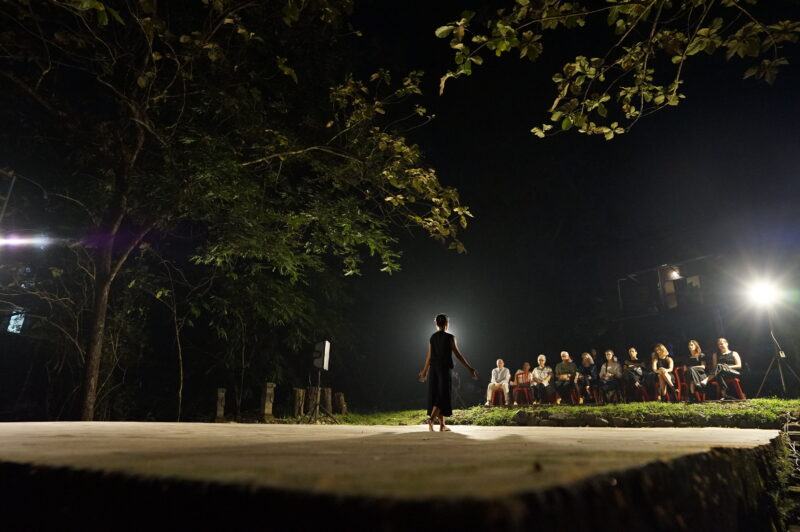
Mike Hapsari performing at Studio Plesungan in Solo, founded by leading Indonesian performance artist Melati Suryodarmo. Solo, 2025. Image: Nia Pithaloka.
Indonesia Council Open Conference (ICOC)
On 9 July, Grimwade Centre staff Associate Professor Nicole Tse and Dr Eliza O’Donnell, master’s student Yori Setiyawan and UCLA PhD candidate Saiful Bakhri presented ‘Beyond Borders: Cultural Materials Conservation as a Pathway for Australia-Indonesia Dialogue’ during a roundtable panel at the Indonesia Council Open Conference (ICOC), hosted by the University of Melbourne. The panel critically examined collection care for Indonesian material culture at the intersection of cross-cultural practices, global pedagogies and culturally embedded research. Speakers shared experiences working with Indonesian material culture across diverse public and private collections in Australia and globally. The panel speakers drew on their collective experience to engage with questions surrounding ‘best practice’ for material culture and conservation in Indonesia, the purpose of global connections and engagement in conservation theory and practice, and what it means to work with collections from Indonesia in Australia. The panel session concluded with an object-based discussion session centred on three wayang kulit from the Music Archive of Monash University (MAMU). During this wayang session, the panel was fortunate to be joined by dalang (puppeteer) Helen Pausacker to show the group how to handle the wayang.
International Conservation Services (ICS) Melbourne
Objects and Outdoor Heritage
From April to June, our conservators were in Ballarat, restoring the Petersen Fountain in Sturt Street. Opened in 1922, the fountain had fallen into disrepair. As part of the efforts to bring it back to the original design, our Melbourne objects team completed an overall surface clean and stain reduction on the stone along with consolidation and repointing areas of cracking and loss. The four frog figures around the basin, along with the central stork, were cleaned and repatinated before being coated in microcrystalline wax and buffed to bring out the shining metal. Most notably, the beaks of the marble storks supporting the central pedestal of the fountain were carved in Carrara marble and secured to the original carvings with dowels.
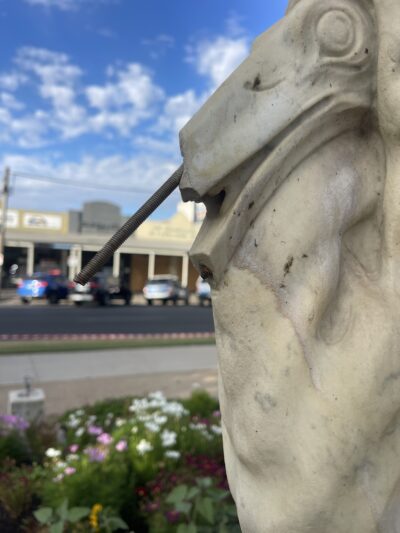
Detail of east-facing stork, before treatment.
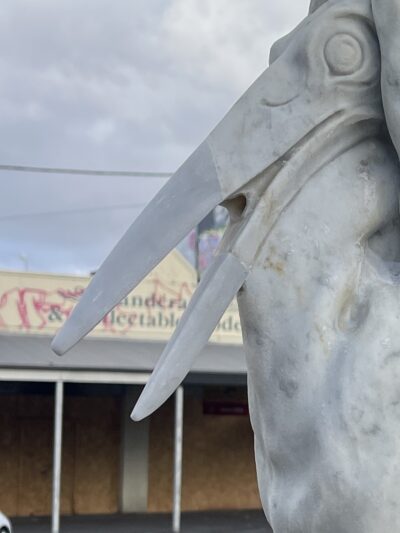
Detail of east-facing stork, after treatment.
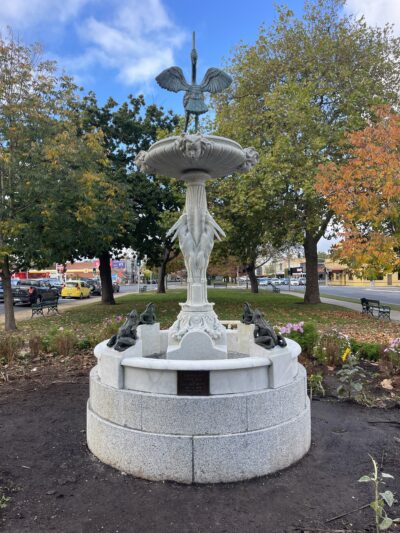
Petersen Fountain, after treatment.
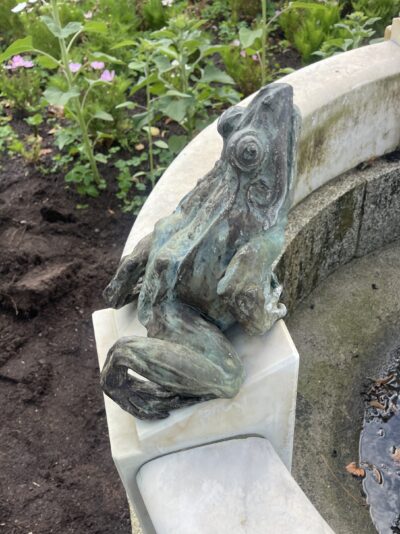
Frog, before treatment.
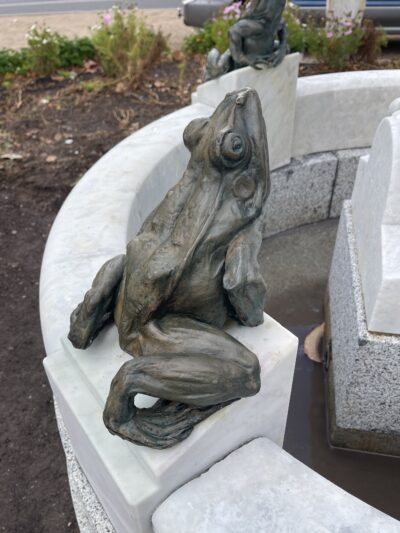
Frog, after treatment.
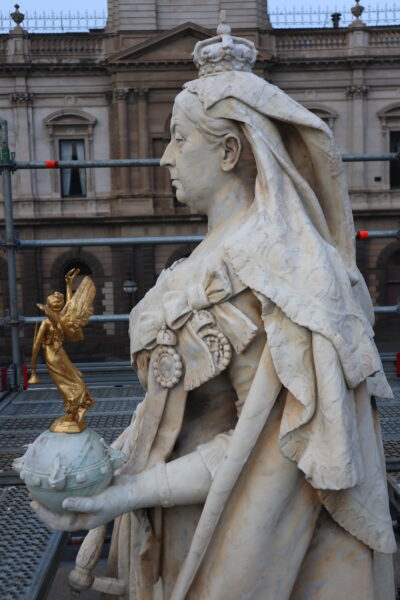
Detail of Queen Victoria, after treatment.
After a short break, the objects team returned to Ballarat, this time to work on the memorial of Queen Victoria. The first step was to laser-clean the limestone surfaces to remove dark soiling and biological growth. Other areas of the memorial were steam-cleaned, and the bronze plaques were heated and waxed as a final step. Winged Victory, a gilded figure in the palm of Queen Victoria’s hand, was also cleaned and regilded in 24-carat gold leaf.
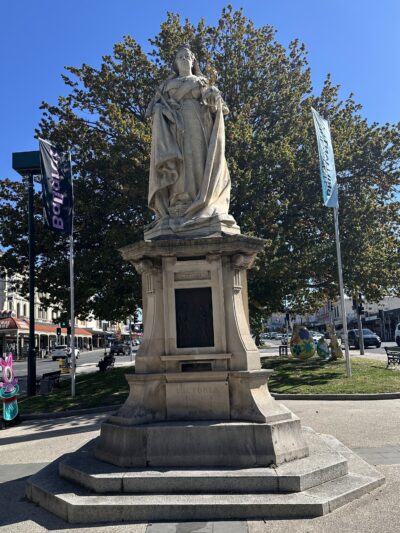
Queen Victoria Memorial Statue, front, before treatment.
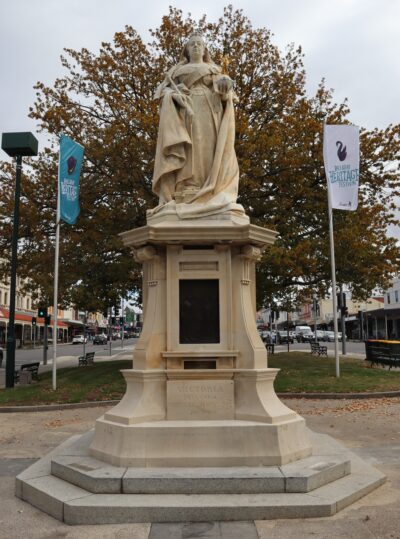
Queen Victoria Memorial Statue, front, after treatment.
The objects team has had a number of private clients bring through works to be treated. A bust of Frederick McCubbin was conserved to repair the break at the neck and then to improve the overall appearance by filling any losses, inpainting, and revarnishing the plinth.
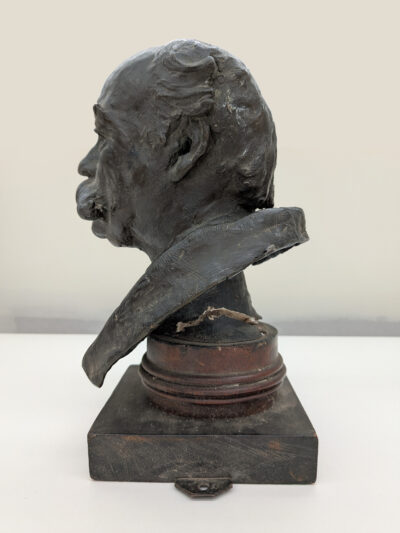
Bust, proper left, before treatment.
Bust, proper left, before treatment.
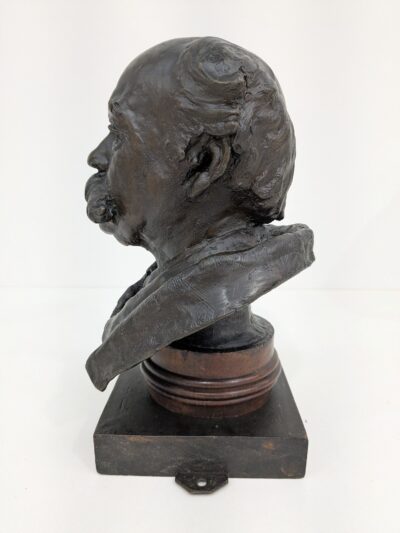
Bust, proper left, after treatment.
Fine Arts
In June, ICS Melbourne had the pleasure of welcoming Samantha Parkyn for a three-week internship. Currently in her second year studying conservation at the University of Melbourne, she joined the fine arts team in our Burwood lab before moving on-site to Trades Hall to complete the final stages of inpainting. We wish Samatha luck with the remainder of her studies!
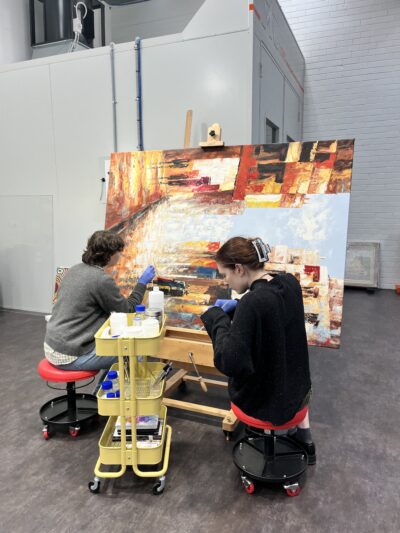
Samantha Parkyn, left, with Lucy More, Paintings Conservator.
The final stages of Trades Hall are in progress with the painting conservators working on inpainting the honour boards during the first few weeks of July. The last stage will include final touch-ups and cleaning, after which the site will be ready for reopening.
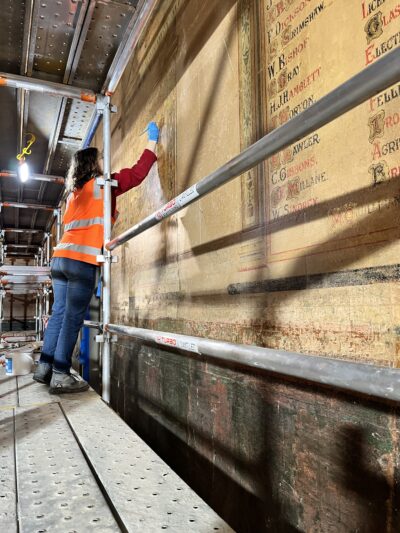
Lily Monk, Paintings Conservator.
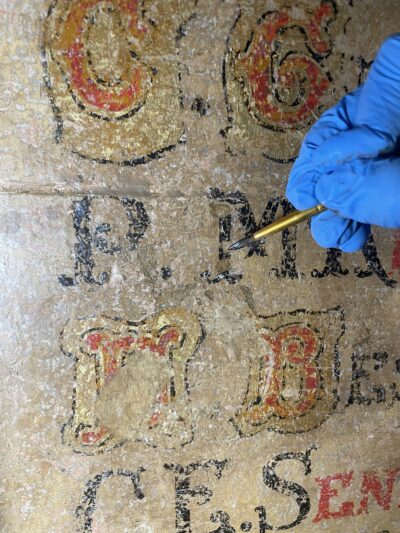
Inpainting the honour boards at Trades Hall.
Back in May when the sun was still shining, our paintings team was engaged to undertake a paint scrape analysis of the Bendigo Conservatory. This investigation sought to identify the earliest paint scheme on elements of both the interior and exterior of the building. Our painting conservators took small samples on site before bringing them back to the lab to be assessed under a microscope.
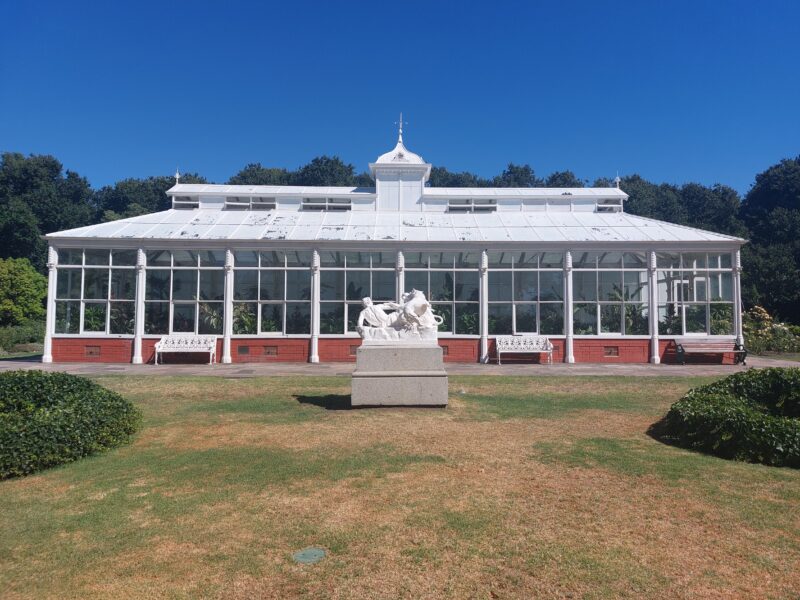
Bendigo Conservatory.
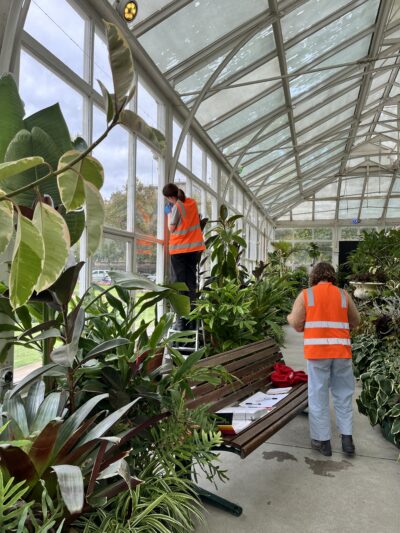
Paintings Conservators Lucy Moore, left, with Lily Monk at the Bendigo Conservatory.
As always, the fine arts team has had a variety of artworks to treat in the Burwood lab including cleaning paintings and prints, varnish removals, inpainting losses, restretching canvases, and repairing gilded frames.
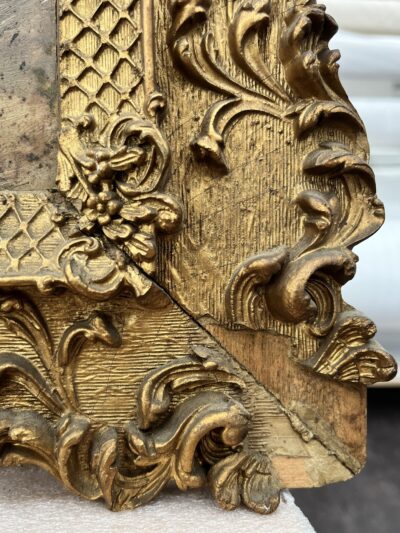
Detail of gilded frame, before treatment.
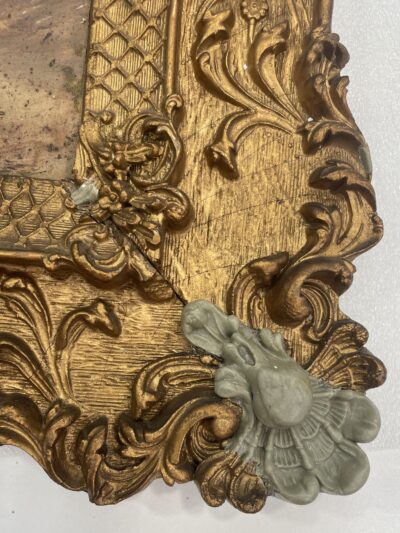
Detail of gilded frame, during treatment.
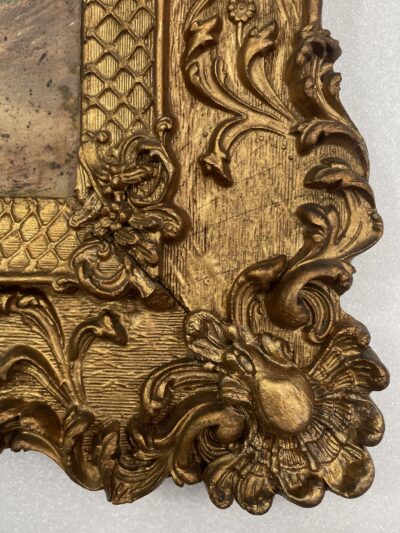
Detail of gilded frame, after treatment.
People
Heading into a new financial year, the Melbourne office has had a number of promotions among our staff, and we would like to congratulate them on their wonderful achievements! Zora Sanders has been promoted to Senior Objects Conservator and Team Leader, Objects and Outdoor Heritage; Kristine Allinson has been promoted to Senior Collections Manager; and Jura Stanek has been promoted to Principal Objects Conservator.
National Gallery of Victoria
First Nations Art
Genevieve Sullivan, Conservator of Indigenous Art, and MaryJo Lelyveld, Manager Conservation, visited central Australian arts communities to better understand community-led preservation strategies and meet with kin groups of works held in the NGV collection. The visits to communities such as Yuendumu, Papunya and Hermannsberg are being used to develop conservation protocols for First Nations collections.
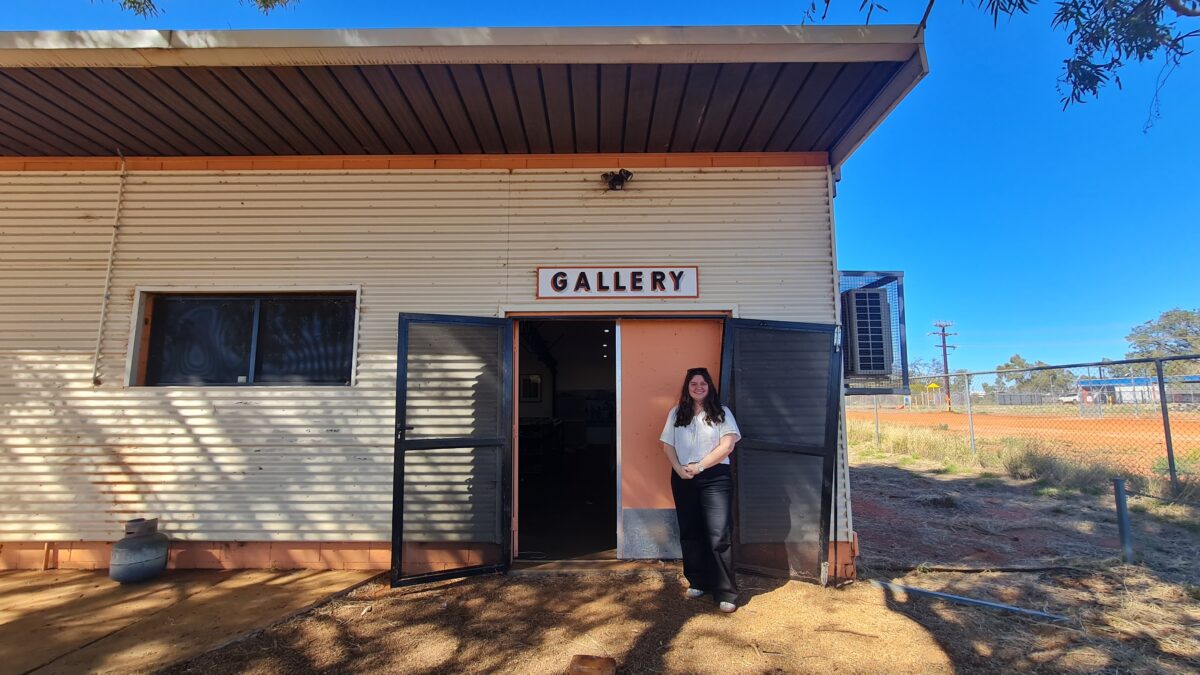
Genevieve Sullivan, Conservator of Indigenous Art, outside Papunya Tjupi Arts
Paintings
In May and June, the paintings conservation section hosted University of Melbourne paintings conservation students Satriyo Wibowo and Jiahe Yi for internships. Satriyo and Jiahe carried out extensive technical examination of paintings by Antonio Mancini and Eugène Boudin and were given the opportunity to work closely with all members of the paintings conservation team to learn more about an array of techniques including radiography, FTIR, modular cleaning systems for surface cleaning, XRF pigment analysis, infrared photography and cross-section analysis. They also received one-on-one training in the rehousing of paintings from our Senior Conservation Technician Gervais Battour.
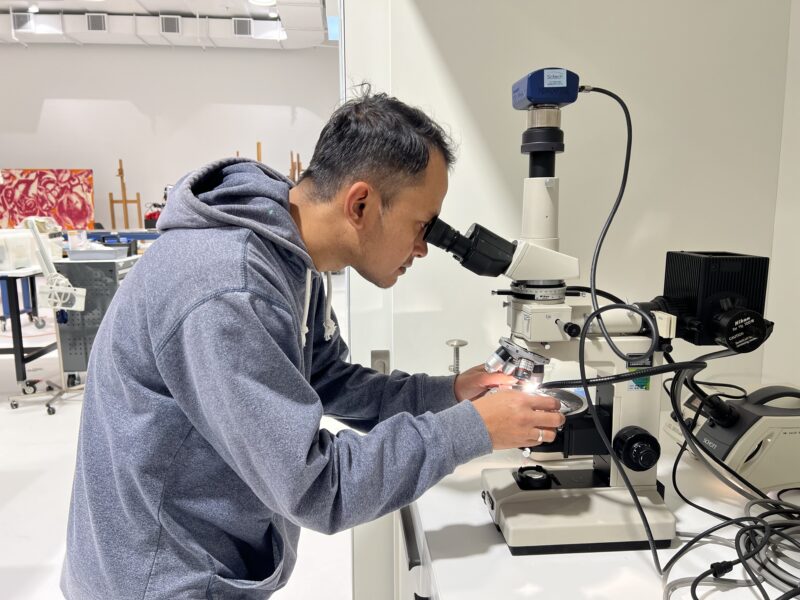
University of Melbourne conservation intern Satriyo Wibowo examining paint cross-section samples from Antonio Mancini’s Man holding a mandolin.
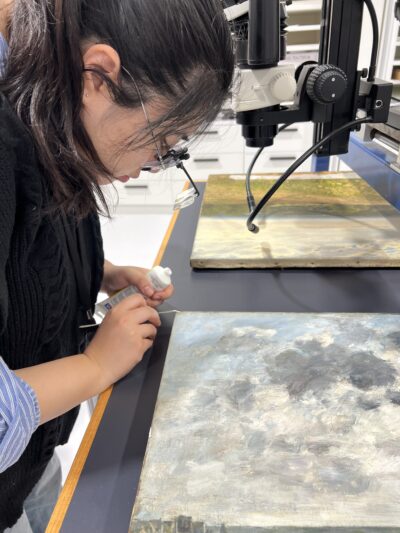
University of Melbourne conservation intern Jiahe Yi filling small paint losses in Eugene Boudin’s Low tide at Trouville.
Raye Collins has been collaborating with curators to acquire and process a sizeable artist archive containing documents and materials belonging to Constance Stokes. Meanwhile, Raye has completed treatment on Mark Gertler’s Agapanthus (1914) and has commenced varnish removal for René Magritte’s In Praise of Dialectics (1937).
Raymonda Rajkowski has continued her major treatment of the second and third large circular canvases by Peter Upward (c.1972), whilst playing a critical role in the preparation of numerous canvas and bark paintings for the major international tour of First Nations art to North American and European venues, commencing in Washington DC later this year.
Caitlin Breare has recommenced work following maternity leave with the varnish removal and restoration of Portrait of a Gentleman by Adèle Romany (1806) and structural treatment of John Clayton Adams’ Trespassers (1878). Emily Mulvihill carried out surface cleaning and restretching of Lee Krasner’s Combat (1965). Carl Villis has continued his large-scale treatment of Salvator Rosa’s Romantic Landscape with Mercury and Argus (c.1655).
Time-Based Media
Since our last update, we have successfully completed the State Agency Legacy Data Program funded by Creative Victoria. Significant outcomes of this program include the completion of the NGV’s Digitisation Project, an initiative focused on digitising a collection of significant video works on magnetic tape in line with the NFSA’s Deadline 2025. Additionally, over 65% of remaining collection works and archival material on analogue media was digitised on-site in the NGV’s newly established Time-Based Media Lab. This represents a major milestone for the NGV in its commitment to safeguarding culturally significant artworks and other content held on near-obsolete formats, facing urgent preservation challenges and ensuring the long-term preservation, accessibility, and integrity of TBM works in the Collection. In addition, Time-Based Media Conservator Manon Mikolaitis presented a lecture to University of Melbourne’s Grimwade Centre master’s students focusing on TBM acquisition and preservation workflows at the NGV.
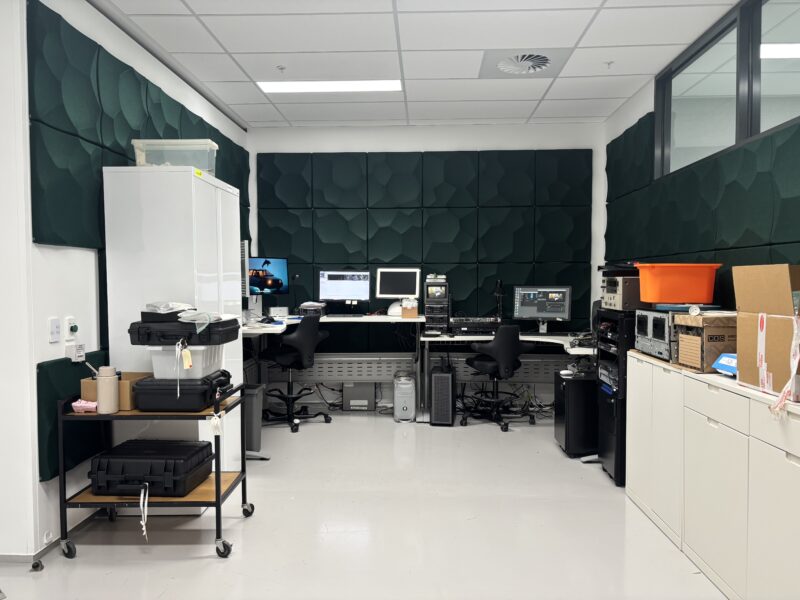
The NGV’s newly established Time-Based Media Conservation Lab.
Frames and Furniture
We were very happy to have Robyn McPherson join the Frames and Furniture Team for eight weeks as part of her role as NGV Decorative Arts Conservation Fellow. Robyn worked on a range of projects including the preparation of Schulim Krimper and Robert Prenzel furniture, an Isamu Noguchi lamp, and several frames for permanent collection changeovers, loans and photography. Robyn also had instruction in gilding from NGV Frame Maker Jason King. Robyn’s contribution allowed Suzi Shaw to focus on the treatment of a German late 17th century cabinet with tortoiseshell veneers. The cabinet has extensive bowing of the ebony and rosewood veneers, and substantial polish residue left in the depths of the silver repousse ornament. While further work is required, Suzi has stabilised and laid back down the bowing veneers, cleaned the silver components, and replaced missing ivory stringing using archival card strips painted to match.
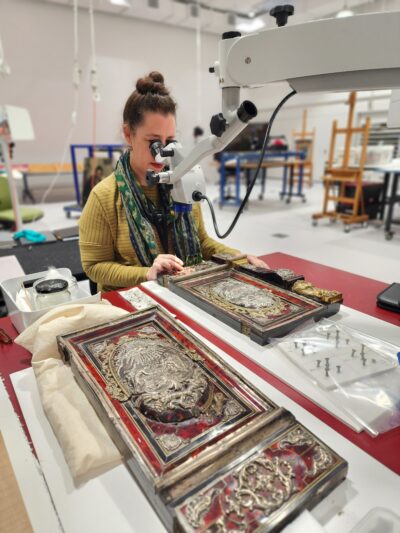
Suzi Shaw, NGV Conservator of Frames & Furniture, during the treatment of a late 17th century German cabinet.
Holly McGowan-Jackson worked with Robyn, Jason and other team members in the assembly of Gaetano Pesce Prototype no. 000-F for Moloch, floor lamp, recently acquired by the NGV. The lamp, designed and manufactured in (1971–72) is based on a 1930s desk lamp but of giant proportions, measuring around 2.3 metres tall. It was a complex assembly involving the reattachment of industrial springs, production of missing components and sampling for testing of potential asbestos insulating material.
Textiles
The Textiles Conservation team has been busy with NGV’s fashion-rich exhibition program. This has included the installation of Kimono, an exhibition dedicated to historically significant costume and fashion from Japanese history, displayed alongside the most experimental and innovative fashion designers of today. The team has also been preparing works for the recently announced Westwood Kawakubo exhibition, which will open in December.
NGV Textiles Conservation welcomes Vicki Car to the lab as Textiles Conservator, while we say farewell to Bella Lipson-Smith who will be going on maternity leave.
Paper and Photography
Bonnie Hearn has been undertaking technical examination of the first illuminated manuscript to enter the NGV collection, The Wharncliffe Hours. Purchased in 1920, this 15th century French Book of Hours was richly illuminated by Maître François, the head of one of the finest ateliers in Paris. In preparation for display at NGV International in August, Bonnie is examining the work using various techniques including FCIR photography and XRF to identify the pigments used by Maître François and the scribe Jean Dubrueil.
Ruth Shervington and Louise Wilson have been examining a selection of the NGV’s old master Italian drawings to help determine their date and origin. The collection ranges from roughly rendered cartoons on coarsely made wrapping paper to incredibly detailed studies in red chalk on fine paper made with incredible skill using meticulously prepared pulp.
Preparation is also underway to prepare works for the exhibition The Stars We Do Not See: Australian Indigenous Art, which is travelling to the US in September. This has involved technical examination of the NGV’s William Barak paintings to identify media, examine paper and rehouse them for travel.
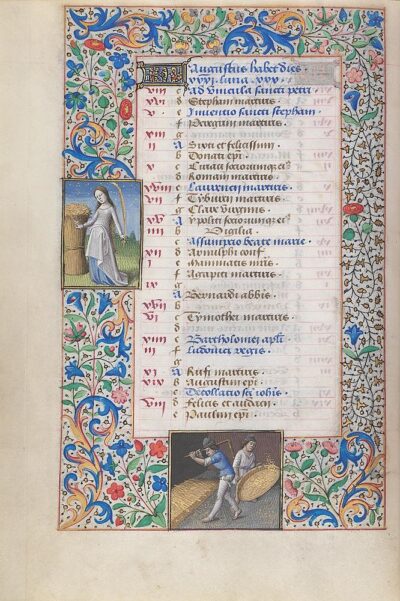
August: Virgo; the month of thrashing grain (c. 1475–80), folio 4 verso in The Wharncliffe Hours (c. 1475–80), Maître François (illuminator), Jean Dubrueil (scribe).
Exhibitions
The team Catherine Earley, Janelle Borig and Camielle Fitzmaurice installed The Melbourne Winter Masterpieces French Impressionism from the Museum of Fine Arts, Boston exhibition this May when it returned to the NGV for a second showing after the first was disrupted by COVID-19 lockdowns in 2021. Still beautiful! The exhibition was the first time our new battery-operated lights were deployed—a lifesaver as exhibition design has for some time been building over our powerpoints. No more snaking cords through rooms.
Catherine also deinstalled Floribunda, a collection show showcasing all things floral at Bunjil Place in Narre Warren, a new (2017) built community centre gallery with tall ceilings, glass enclosed foyer and contemporary design.
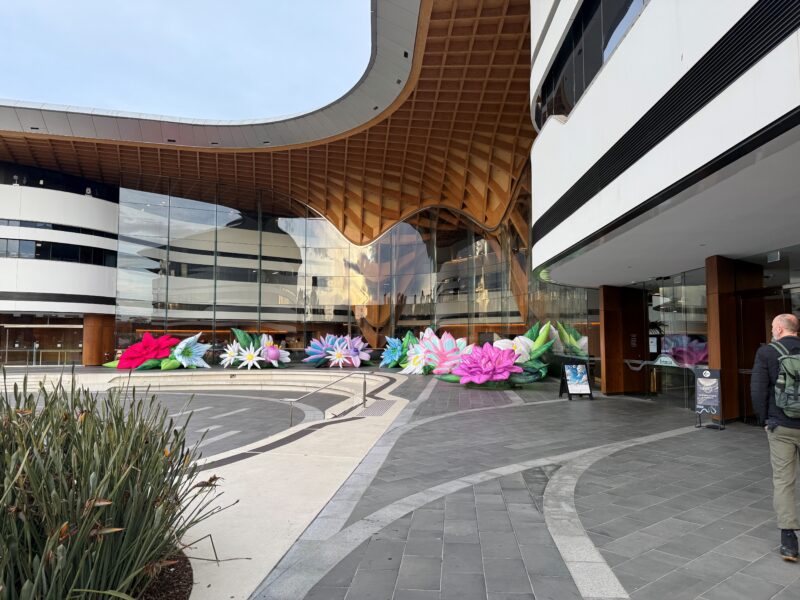
Floribunda opens at Bunjil Place.
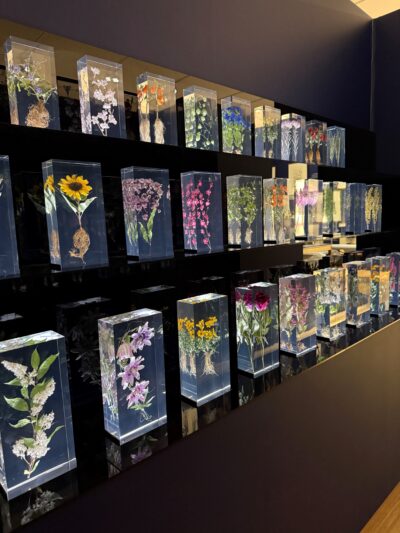
Block flowers (2023), Azuma Makoto.
continue here