The Gels and Nanofluid Workshop, hosted by Bay-Area business Art Conservation de Rigueur (ACdR), owned and directed by Elise Morin-Rousseau, brought together nanotechnology chemists and art conservators to explore recent developments in gel-based and nanofluid technologies for cultural heritage conservation.
The workshop was led by chemists from the University of Bologna, a world leader in colloidal science and gel innovation. Instruction was provided by Piero Baglioni, Emeritus Professor, and Giovanna Poggi, Associate Professor. Over several decades, Professor Baglioni and his colleagues have pioneered innovative ‘green’ cleaning solutions for art conservation. Their advanced gel and nanofluid systems allow highly selective removal of unwanted materials while maintaining precise control over solvent penetration and interaction with original surfaces.
Baglioni’s work is particularly significant because it promotes cleaning approaches that are safer for both conservators and the environment. Many of the materials developed in his research are derived from renewable natural sources or recycled waste products, reducing environmental impact. For example, many of the surfactants traditionally used in conservation cleaning end up in our waterways, depleting krill stocks, a crucial ocean foodsource. Supported and funded by the European Union, his research collaboration involved numerous cultural and academic institutions, representing an important move toward more sustainable conservation practices worldwide.
These relatively new cleaning systems can be used to selectively remove or physico-chemically detach unwanted materials such as dirt, aged varnishes, and pressure-sensitive tapes. For example, the placement of a microemulsion-loaded gel on a heavily yellowed varnish layer for only a few minutes can allow the varnish to swell and de-wet from the surface. After a determined time period, the gel can be removed and the softened varnish gently cleared with a dry swab, revealing a clean and unaltered surface beneath.
The workshop combined lectures followed by hands-on sessions focused on practical applications for paintings and works on paper. Approximately 30 conservators attended, ranging from recent graduates to mid-career professionals. Participants came from across the Bay Area and the wider West Coast, as well as from Canada, Hong Kong and several US cities including Louisiana, Chicago, New York, Washington and Denver. I was the lone Australian attendee eager to update my knowledge of these complex systems. Although aware of nanorestore gels and having read the literature over nearly a decade, I really wasn’t totally cognisant about the science and development of these systems.
As an extra activity, ACdR generously provided tours of its three conservation facilities, offering participants the opportunity to benchmark workshop setups and observe the laboratory’s technical expertise. During these visits, experienced Italian conservators demonstrated current projects, including mist lining treatments and, surprisingly, the application of EVA adhesive mousse dispensed using a cream dispenser! These informal demonstrations created valuable opportunities for discussion and the exchange of practical tips on equipment, materials and treatment approaches.
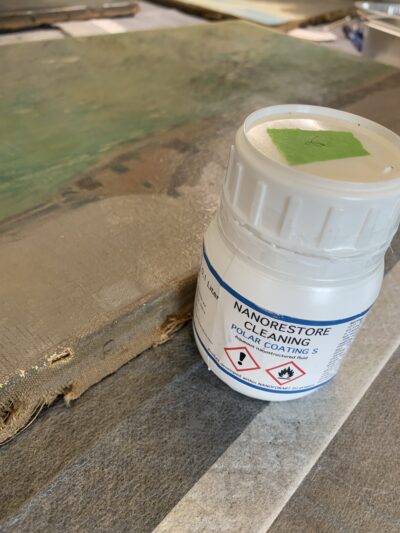
The outcome for my professional development is that the technical knowledge gained from the workshop will be passed on to my 14 colleagues at GCS and potentially to future interns and students. Since returning, I have already used the take-home kit provided to remove a particularly stubborn synthetic varnish from an Arthur Streeton painting using Peggy gels and Polar Coating S nanorestore microemulsion. Personally, meeting conservators from other countries is always rewarding to share professional pathways and expertise, benchmark our profession internationally and re-evaluate the conservation cohort and expertise we have here in Australia. San Francisco highlights were driverless Waymo cars taken daily to the workshop, riding the cable cars and historic trams, and traipsing up and down hills to see the architectural sights of the city.
Attendance at this workshop was generously supported by ArtsNational through the Patricia Robertson Fund, with additional professional development support provided by Grimwade Conservation Services. Overall, the workshop offered a valuable opportunity for knowledge exchange and practical training in emerging materials and methods for art conservation while highlighting the growing importance of sustainable approaches in the field.
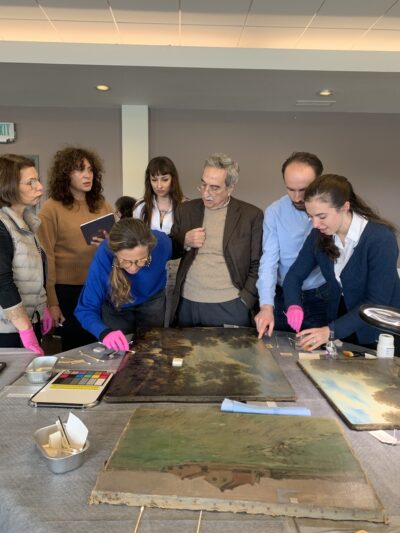
Professor Baglioni, University of Bologna. Gels and Nanofluid Workshop, San Francisco, 6–8 February 2026.
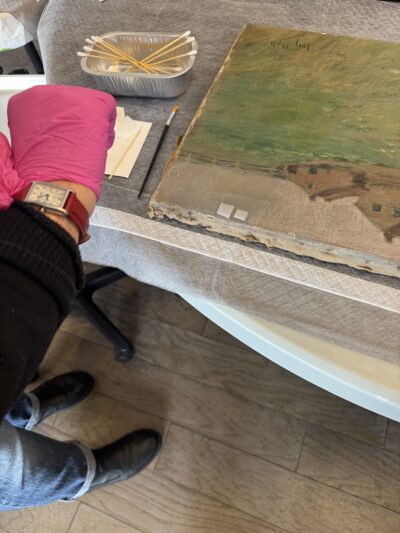
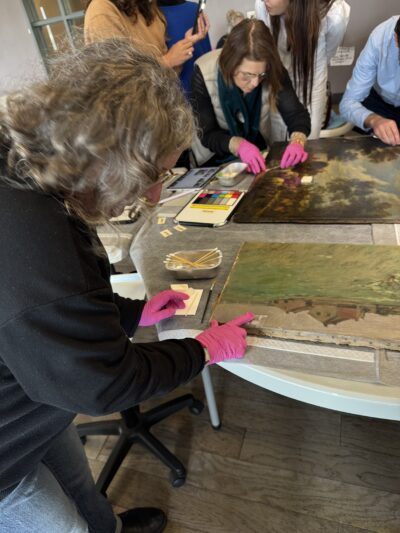
Cushla Hill, University of Melbourne, testing Peggy nanorestore gels to remove a polymerised surface coating from a 19th-century painting.
Results
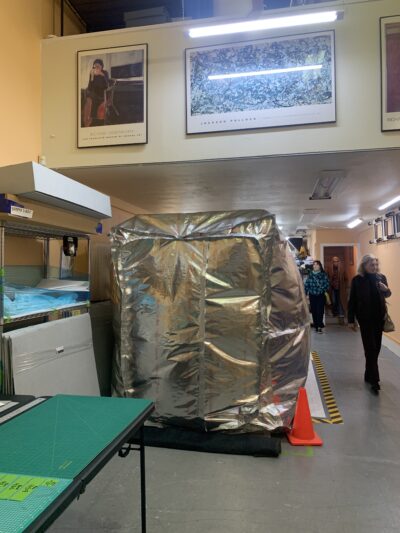
Anoxic treatment underway in the ACdR lab, San Franciso