
With an inadequate appreciation of the microclimate within a sealed box frame, where a stable relative humidity was required for the display of vellum documents and wax seals, the author fabricated a model with the same characteristics fitted with a small datalogger and analysed the RH stability via the resulting graphs.
Recently (2025), Elwing & Gurney evaluated five documents for a private company, comprising five foundation documents of vellum with wax royal seals. This had its origins with an internally generated enquiry via the board of directors about how well this material was being looked after. A casual eye would have said: ‘quite well’.
All the documents are on permanent display in the company’s headquarters in an enclosed cabinet facing external glass windows in the ninth-floor Lift Lobby Meeting Area for members. Each document is framed in a box frame.
The area having extensive window glass and the building a thermostat-based air conditioner, we checked light readings and datalogger graphs, outlined strategies to reduce annual lux-hours and air movement to and from the case.
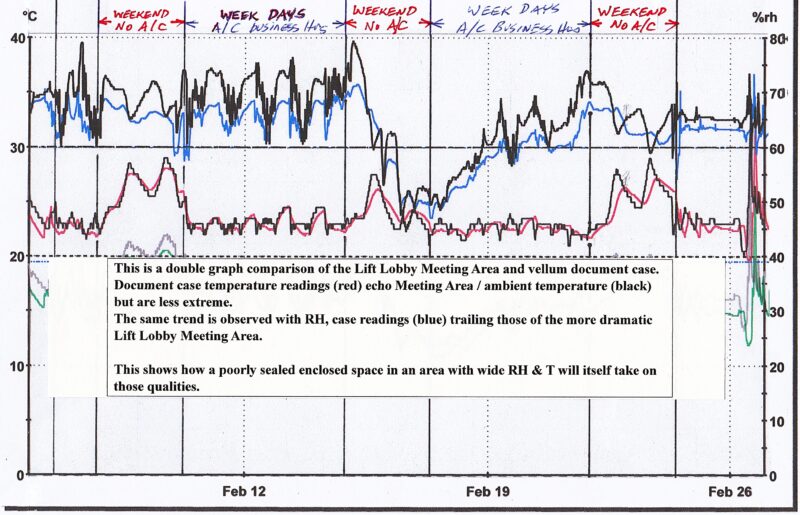
The above overlaid RH & T datalogger graphs taken over two weeks for the survey were not comforting. The RH fluctuated wildly and was high during the periodically wet month of testing, but there was no evidence of mould on the documents or anywhere else.
RH movement within the glazed case roughly followed ambient conditions, but was less extreme. The report, therefore, lacked real information regarding long-term relative humidity levels or RH stability within each box frame.
We relied upon each document being box-framed against an internal wall, sealed with a final backing of foamcore or heavy board, to provide sufficient moderation of humidity within each frame to make stress-inducing RH movement gradual and acceptable.
It has long been known that hygroscopic works framed behind glass, with a relatively impermeable backboard and without issues like hanging against an external wall, create a fairly stable graph of RH movement.
The RH graph from within a sealed case along the western wall of the Lift Lobby Meeting Room at the same time was encouragingly stable. This was the basis for recommending no drastic remedial action for the framed documents, but the comparison was a stretch.
A box frame and a normal glazed frame have dissimilar air volumes. A box frame, say 35–40mm deep, would contain 50 to 100 times the amount of enclosed air as a conventional glazed frame and mount along with roughly the same amount of hygroscopic material available to moderate RH.
In each case, mounting systems were complex and contained unknowns. There was evidence of old stress-related distortion of vellum within those frames from an older, different storage environment. Backing removal, opening of any of the box frames, had potential to cause considerable damage, so we had no sensible access to test the actual storage environment within each frame.
The best solution seemed to be to test a model with the same characteristics and materials in a similarly poorly controlled environment.
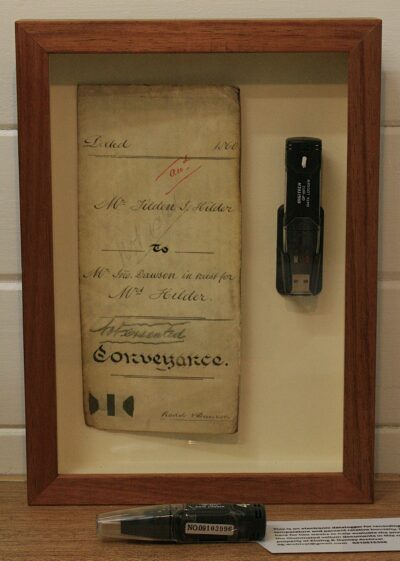
To this end, we assembled a 35mm-deep box frame lined with 4-ply acid-free mat board on internal back and sides containing a small datalogger and parchment deed. The frame, glazed with acrylic (as were those of two of the surveyed vellum documents), was backed with foamcore board and edge-sealed using gummed paper tape, again as with the collection frames.
As we wanted moderate RH figures to go with this report, we pre-conditioned the contents of the frame to around 55% RH. Two dataloggers were activated, the first inside and the second outside the frame, and the frame sealed and positioned.
Readings from 2/05/2025 to 19/05 were downloaded after 17 days, printed, and the box frame internal graphs overlaid in black via overhead projection film.
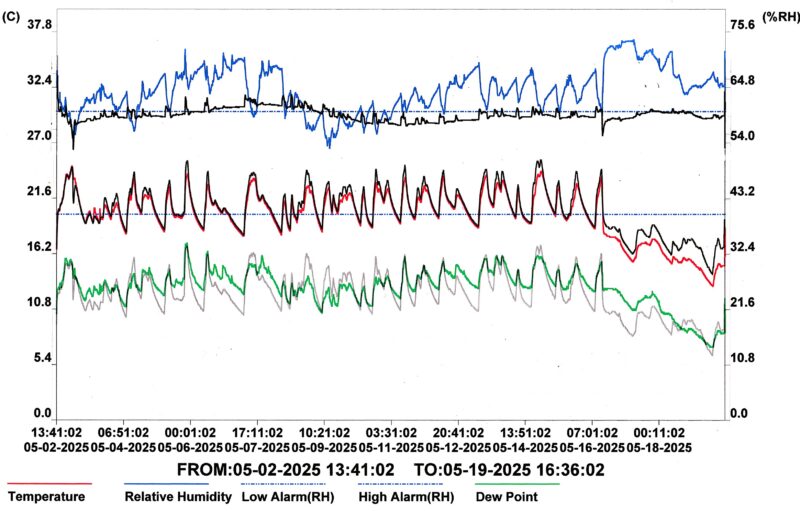
Ambient RH & T fluctuated wildly under the influence of a domestic air-conditioner, which is what we wanted for comparative testing.
Both temperature graphs (centre, red/black) followed each other but with relative humidity graphs
(top, blue/black), the internal RH (black graph at top) was visibly very well damped. However, it was still relatively high, like the Lift Lobby Meeting Area graph in our report, averaging 59% RH.
By converting the graph to spreadsheet readings, we extracted the following RH information:
External: 3.482% average RH (+/-) movement between 2am/2pm, from 34 readings at 12-hour intervals
Box frame: 0.767 % average RH (+/-) movement between 2am/2pm, from 34 readings at 12-hour intervals.
Thus, for diurnal (daily) changes, framed RH movement readings are only 22% of those of the external datalogger, meaning 78% of the movement was buffered by the case and materials, and not transferred internally. The times of 2am and 2pm were chosen to represent the extremes over each 24-hour period.
These readings are dry but pertinent, as they indicate the buffering capability and extent to which each frame creates satisfactory RH gradients, necessary to reduce the expansion and contraction of the mounted vellum that might lead to distortion and failure of its supports. They reinforce the visual evidence of the graphs.
The frame model we have used seems a suitable equivalent; thus, we felt more confident that their frames would each maintain a relatively stable RH environment for their vellum contents.
We still have concerns regarding the RH in the client’s case being relatively high, but the fact that no previous or current mould was observed within each frame, or in the local environment, indicates there is no urgent concern.
We put this down to having an air conditioner without a humidification function, and no hygrostat. A temperature/thermostat alone control tends to remove moisture from the environment.
Further, around the time of our inspection, Sydney had been experiencing unsettled weather.
Our main recommendation with this issue was that, because RH readings were high, we asserted that monthly datalogger readings should be made, and that whoever does that should also be familiar with light levels. Any extended RH period over 60% is cause for concern, or under, say, 40% in an extended dry period. We also recommended more attention to sealing the primary collection case, which seems to have more security and aesthetic function.
Our feeling is that the bare RH graph from our model gives the best indication of stability.
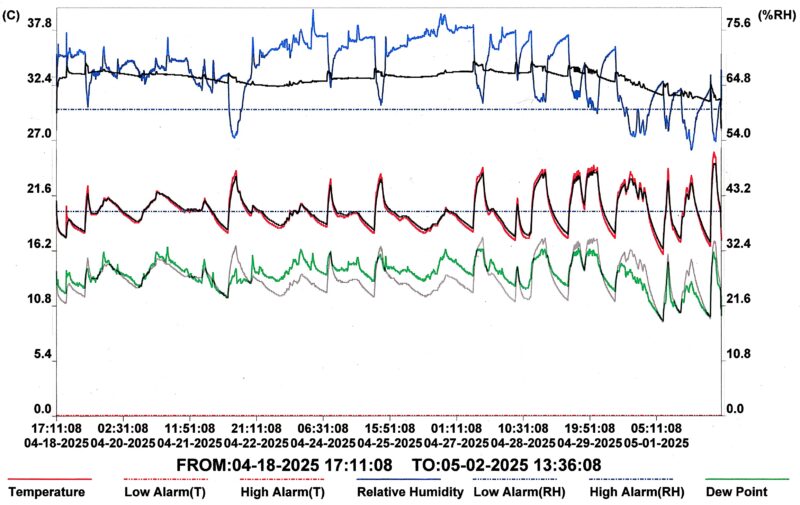
This is the first test of the model. We rejected this for comparison only because the RH was too high, but the black RH graph shows excellent moderation of RH movement.
Any spreadsheet mathematical interpretation is likely to be met with a dull stare from client and conservator alike. Complicating factors like the air exchange within such an enclosed space via variable atmospheric pressure changes along with RH & T are issues that make my head hurt.