
A collection from the History Trust of South Australia, featuring various early manufacturing companies in Adelaide, was sent to Artlab’s paper conservation team for treatment. Among the items was a photograph entitled A. Simpson & Son’s Cricket Club 1889 of A Simpson & Son’s tinware company, an important piece of local Adelaide industrial history.
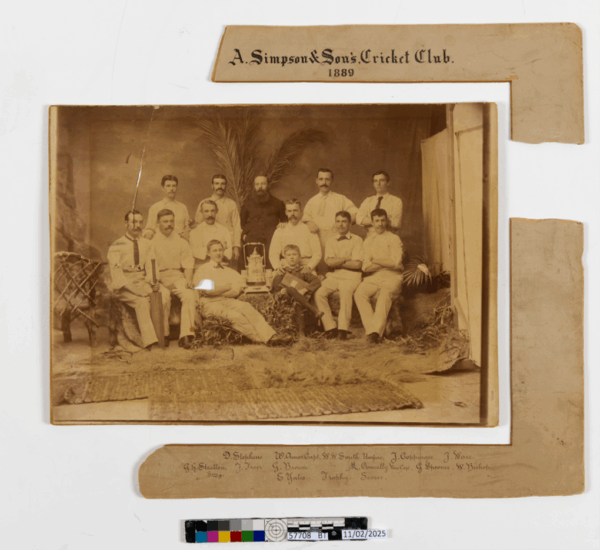
1889 albumen print before treatment.
After relocating his family to South Australia in 1849, Alfred Simpson established the A Simpson Colonial Tinware Manufactory, drawing on his expertise as a tinplate apprentice. This marked the beginning of a five-generation legacy for the Simpson family business. The family frequently travelled overseas, bringing back ideas for labour-saving machinery, new products, and advanced finishing techniques. By the time of Alfred Simpson’s death in 1891, the business had become home to the largest metal manufacturing plant in Australia. Following World War II, the growing demand for home appliances led the company to shift its focus to household white goods. From the 1940s onwards, the business specialised in producing innovative, labour-saving machines, earning a reputation for its forward-thinking approach to manufacturing.
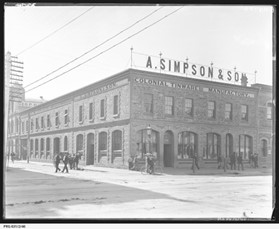
A Simpson & Son, Gawler Place, corner of Grenfell Street, 1899. SLSA: PRG 631/2/46.
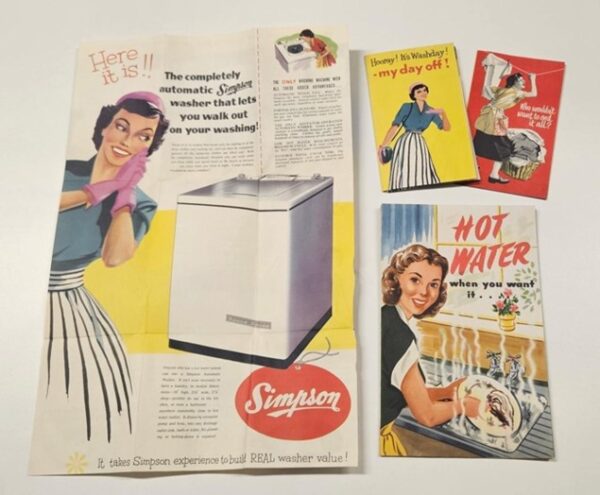
Collection of product catalogues, brochures, and pamphlets, featured in SLSA: BRG 9/27. , Picture
The 1889 photograph is an albumen print, a popular photographic technique of the late 19th century. This process involved coating thin paper with egg white (albumen) and salt, sensitising it with a silver nitrate solution, and printing it under a negative exposed to daylight. Albumen prints were typically mounted on card stock to support the delicate paper base and were widely used for both portraiture and commercial purposes.
Upon examination, the photograph exhibited several common types of deterioration:
- Yellowing of highlights – a characteristic aging effect of albumen prints
- Cracking of the albumen layer – leading to surface instability
- Silver mirroring – a metallic sheen in darker areas due to silver degradation
- Adhesive residue – remnants from a previous window mat attachment
- Surface dirt and accretion.
However, the most significant concern was structural instability, including:
- Losses in both the paper support and image layer
- Cracks and detached media
- Surface abrasions and scratches.
The primary objective of the treatment was to stabilise the media, retain the structural integrity, and house the treated work in an archival environment to slow down the deterioration rate. The print was carefully cleaned with a soft brush and scalpel to remove surface accretions. Old adhesive residues were successfully removed using 5% w/v methyl cellulose in deionised water, with a controlled contact time of 2–3 minutes. Water exposure was minimised throughout the treatment process.
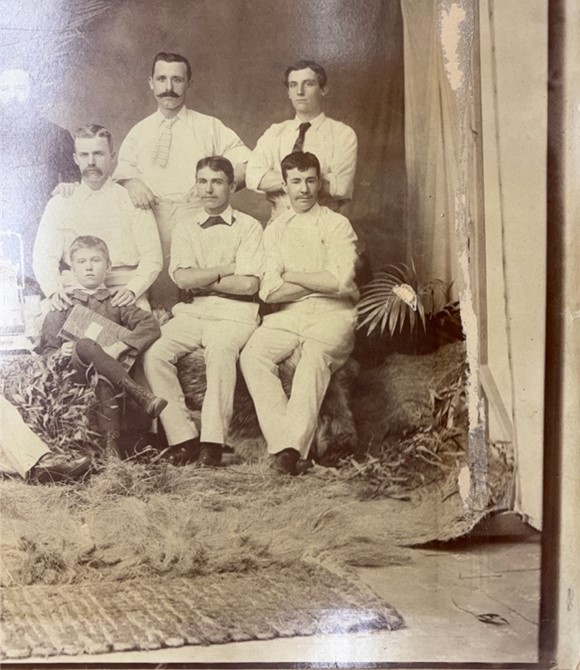
Old adhesive residues from original window mat can be seen along the edges.
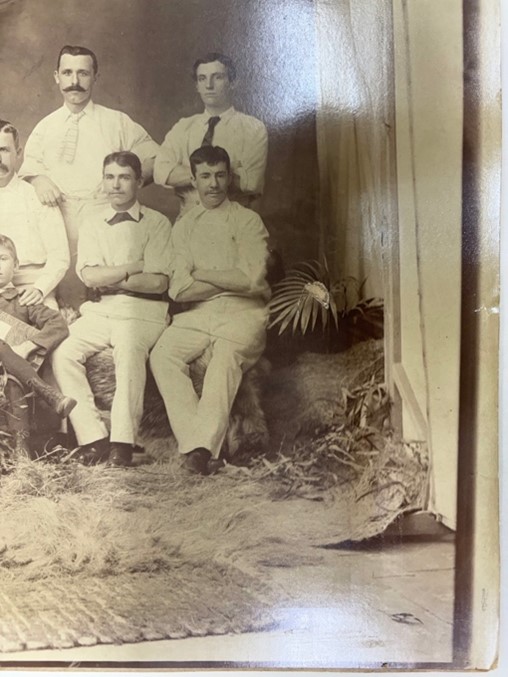
5% w/v methyl cellulose removed the residue while still maintaining the sheen.
To address cracks and detached areas, the backing layer was partially removed in a controlled manner until the albumen print paper layer was reached. Once exposed, the cracks and detached piece were gently realigned and secured using a fairly dry paste. The mended areas were then reinforced with dry paste and repair paper on the verso. To ensure structural stability, the partially removed sections were infilled with repair paper until a level surface was achieved.
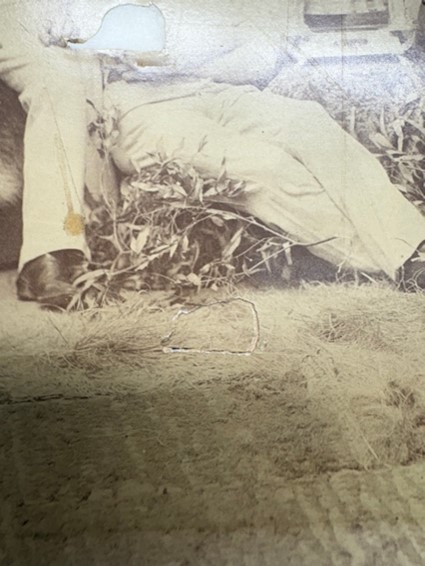
A piece of media detached from the photograph.
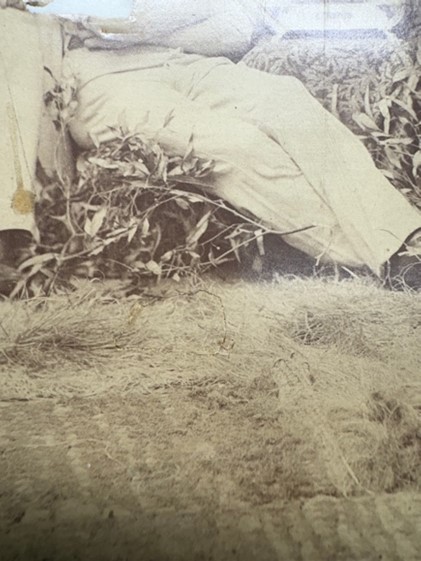
Damaged area after mending.
The most challenging and time-consuming aspect of the process was the infilling and colour-matching. This photograph has a smooth semi-glossy surface, which makes coloured repair paper highly visible due to its differing texture. Various materials were tested to adjust the surface sheen, including 4% w/v methyl cellulose and 3% w/v gelatine in deionised water, applied over the repair. However, the gloss often diminished upon application. Japanese Gampi paper was also explored for its inherent sheen, but the moisture from the paste dulled its reflective quality. Low-water-content adhesives such as Evacon-R and Lascaux 498HV were considered but ultimately rejected, as they require ethanol for removal in the future if the repair is not desirable.
A successful solution was found by coating the coloured repair paper with a 1% w/v gelatine solution. The process involves the following steps:
- Prepare a piece of Mylar, a solution of 1% w/v gelatine in deionised water, and coloured Japanese repair paper.
- Use a pipette to distribute the gelatine solution evenly over the Mylar.
- Smooth the gelatine layer with a glass rod to ensure uniform application.
- Place the repair paper onto the gelatine, using a brush if necessary to ensure proper adhesion.
- Allow the repair paper to air dry while still attached to the Mylar, as this is crucial for forming a glossy finish.
Dry paste was later used to infill the damaged area with gelatine coated repair paper. This method managed to replicate the original surface sheen of the photograph to a desirable degree.
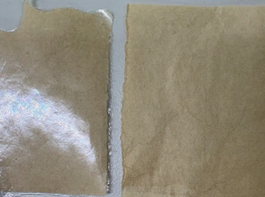
Same repair paper with one coated with gelatine.
Upon completion of the treatment, all three components – the media, top window mat and bottom window mat with inscription – were hinged with Japanese paper and wheat starch paste, and mounted in a sink mat format using archival-grade matboard. This approach ensures the preservation of all relevant information while providing a stable archival housing suitable for long-term storage and future display.
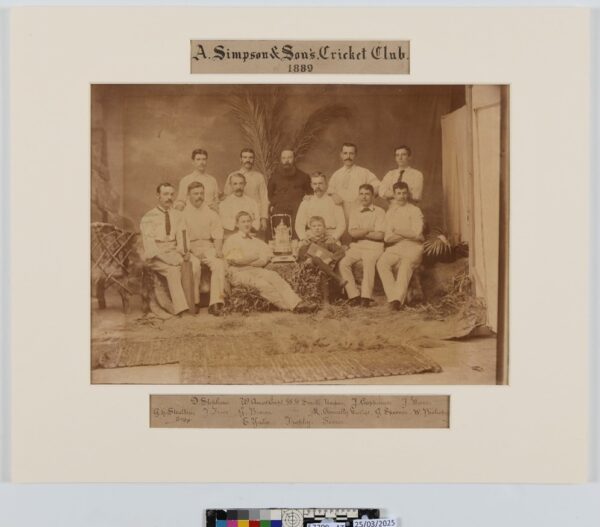
1889 albumen print after treatment.
Conserving this 1889 albumen print has been an incredibly meaningful journey, safeguarding an important piece of Adelaide’s manufacturing history. This has been one of the most challenging projects I’ve ever undertaken, as it is the most damaged photo I have treated. I am deeply grateful for the unwavering support from the paper conservation team and the invaluable guidance of Corinne Ball, senior curator from the History Trust. Their expertise and kindness have made this experience truly rewarding. Exploring South Australian history through these remarkable collections has been a valuable experience, and I feel privileged to play a part in preserving them.