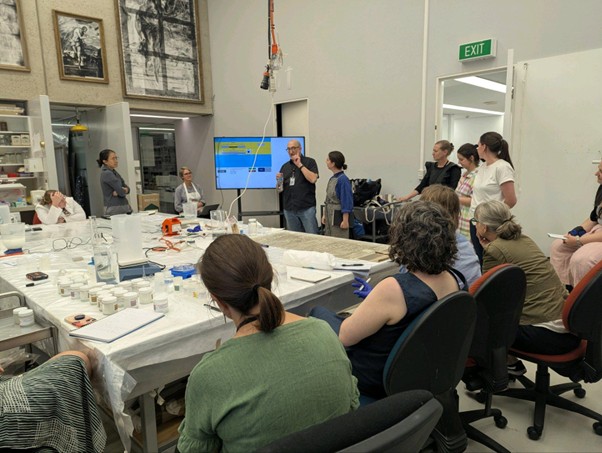
The Paintings Special Interest Group, a part of the Australian Institute for the Conservation of Cultural Material (AICCM), held a successful Modular Cleaning Program (MCP) workshop led by Chris Stravoudis. This took place from 17 to 21 March and was generously hosted by the Queensland Art Gallery | Gallery of Modern Art (QAGOMA) in Brisbane.
The workshop brought together 22 in-person participants from a range of conservation specialisations, alongside more than 20 additional participants who joined online for the theory-based components.
The workshop consisted of five days of hands-on learning where participants gained a solid foundation in the theory and practical application of aqueous cleaning solutions, solvent gels, silicone solvents, gelling agents and microemulsions. A key component of the course was training in the use of the MCP software, which allows users to tailor cleaning solutions to suit the specific needs of a given artwork or material.
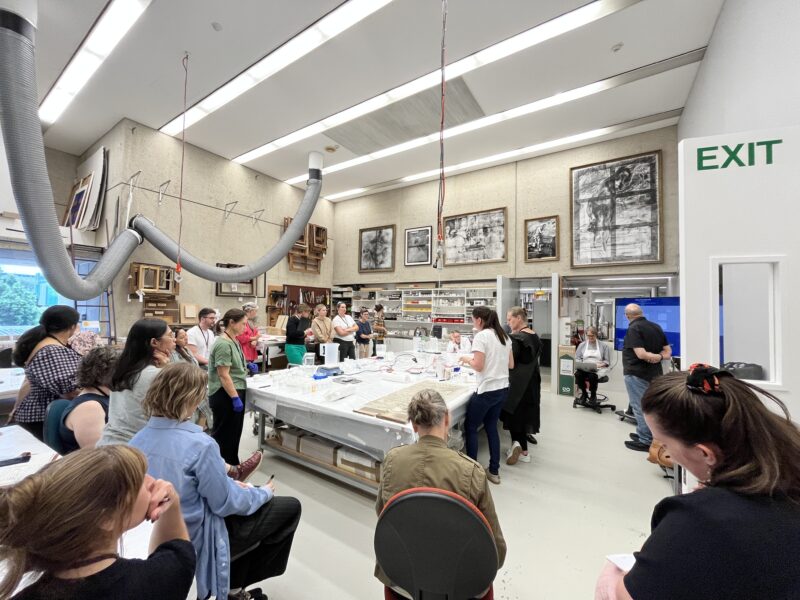
A significant focus of the MCP is its emphasis on safe, sustainable cleaning practices. By reducing reliance on traditional solvents and promoting the use of carefully formulated aqueous systems, the MCP supports environmentally responsible conservation while delivering effective treatment outcomes. Participants were introduced to a variety of formulations that operate across a wide pH range, enabling greater versatility and control in their treatment approaches.
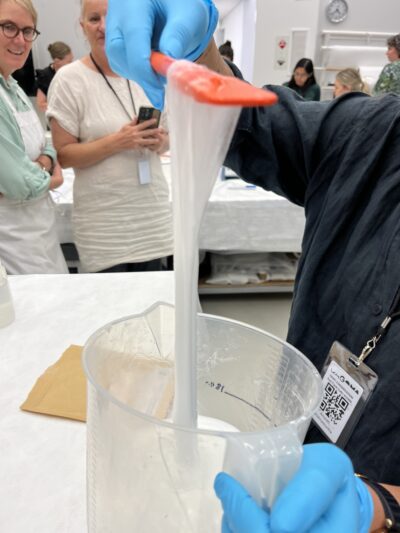
All in-person attendees received a comprehensive MCP concentrate kit, allowing them to immediately begin testing and incorporating the techniques into their lab settings. The optional sixth day provided an open-format session for further experimentation, collaboration and troubleshooting, which many found invaluable.
One of the highlights of the workshop was the opportunity for conservators from different disciplines – paintings, objects, textiles, paper, furniture and more – to connect and exchange ideas. Participants noted that learning how others approached complex cleaning challenges broadened their understanding of treatment possibilities and sparked new ways of thinking about their work.
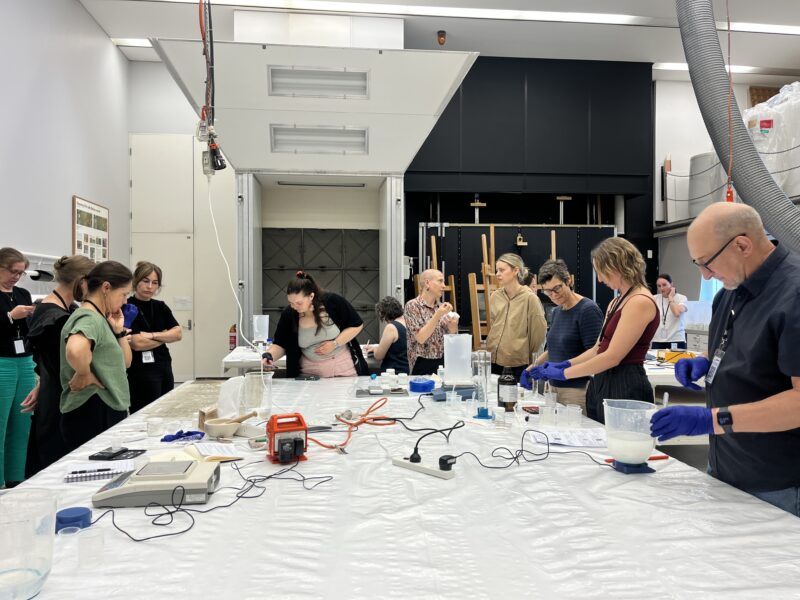
Feedback from attendees has been overwhelmingly positive. Since returning to their respective studios and labs, many have reported that they’ve already begun applying MCP systems to tackle particularly difficult treatments with more confidence and success. Beyond just improving the quality of outcomes, several participants shared that the training has empowered them to adopt more measured, analytical approaches when dealing with uncertain or high-risk treatments.
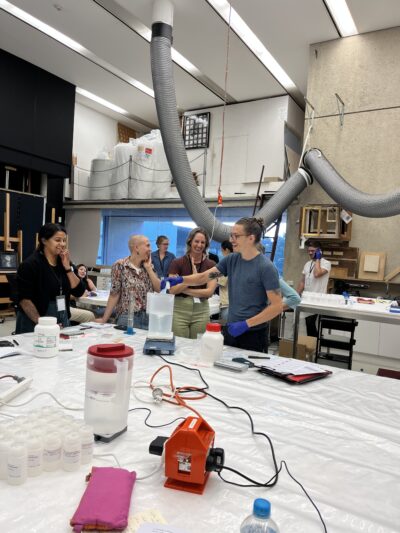
With its strong theoretical foundation, practical relevance and commitment to sustainability, the MCP workshop has proven to be a valuable and enriching experience for conservators at all stages of their careers.
AICCM extends its sincere thanks to Chris Stavroudis for sharing his expertise, to QAGOMA for its generous hosting, and to all the participants, online and in-person, for their enthusiasm and engagement. As interest in modular cleaning methods continues to grow, AICCM looks forward to supporting more opportunities for conservators to access this important training in the future.