Over Chinese New Year, the Year of the Horse, I supported the See Yup Temple’s celebrations from 17 February for seven days as part of my ongoing work assisting the See Yup Society after a devastating fire in February 2024, which destroyed the main hall of the temple where Kwan Tai has been worshipped since 1866. My job that week was to help count temple visitation but I was also able to assist with Lunar New Year operations as part of this. Throughout that week, many people came through the temple gate to worship, make offerings to the gods, burn incense, honour their ancestors, meet relatives, and celebrate the New Year in a shared community space. They included regular worshippers, parents with children, families of three or four generations, old friends arriving side by side, members of the wider public drawn by an interest in Chinese New Year and Chinese Australian heritage, and some recent arrivals from overseas who appeared to be visiting the temple for the first time. Younger people often stopped at the entrance, looked around, and took everything in slowly, while senior visitors walked straight in with ease and familiarity. The air smelled of incense. Outside, the city carried on as usual. Inside, it felt like a different kind of time.
A new exhibition, See Yup Temple: Next 170 Years, opened on 21 February 2026 and documents recovery works after the fire. The exhibition marks an important stage in the temple’s recovery. For the Chinese and Asian Australian community, it offers a way to reconnect with the site and remain connected to a place of ongoing spiritual and communal meaning. For the See Yup Temple Recovery Project, it makes visible the post-fire recovery and restoration work, and what this means to the community. My research, collection recovery and conservation work on the fire-damaged items and their inscriptions are featured in the exhibition. As a Chinese international student living and studying in Australia, I felt a strong cultural connection to the temple during Chinese New Year, which made the experience meaningful to me in both professional and personal ways. The exhibition was launched by Nina Taylor MP, Member for Albert Park, on behalf of the Minister for Multicultural Affairs Ingrid Stitt, and was attended by temple community members, worshippers, important stakeholders, visitors, supporters, and staff and students from the Robert Cripps Institute for Cultural Conservation.
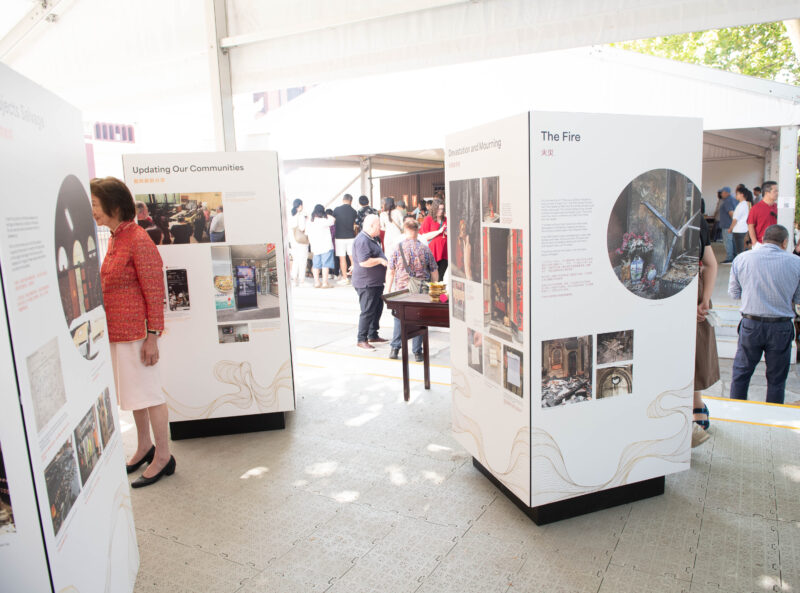
Visitors reading the outdoor exhibition panels. Image credit: Anthony Leong, 2026.
The Cripps Institute display is located in the 1901 building next to the ancestor hall of spirit tablets. It shows the conservation work done after the 2024 fire, and the work of students and staff. Through panels, photographs, and selected fire-damaged objects, including items that had been partly cleaned or stabilised, it shows conservation processes and the material impact of the fire. The goal was to open up a conversation, and the display did just that. People would stop and read the panels, then come and ask us questions. What happened to this object after the fire? How do you clean it without causing damage? Has the temple fully reopened? When will everything be restored? People were curious and scanned the QR codes that explained more and encouraged visitors to share their thoughts and consider donating to the temple restoration fund. Others, when buying incense or oil, told us to keep the change. These small gestures stayed with me, especially at a time when funding for the restoration is limited, and insurance discussions continue. These forms of public support are important. This effort was also strengthened by grants secured by Mollie Liu, a Masters of Cultural Materials Conservation student at the Robert Cripps Institute for Cultural Conservation, and included the Willem Snoek Award, which provided 400 hours of student volunteer support to help make the items safe and build the website, and the Hansen Little Public Humanities Award, which supported a multilingual fundraising campaign.
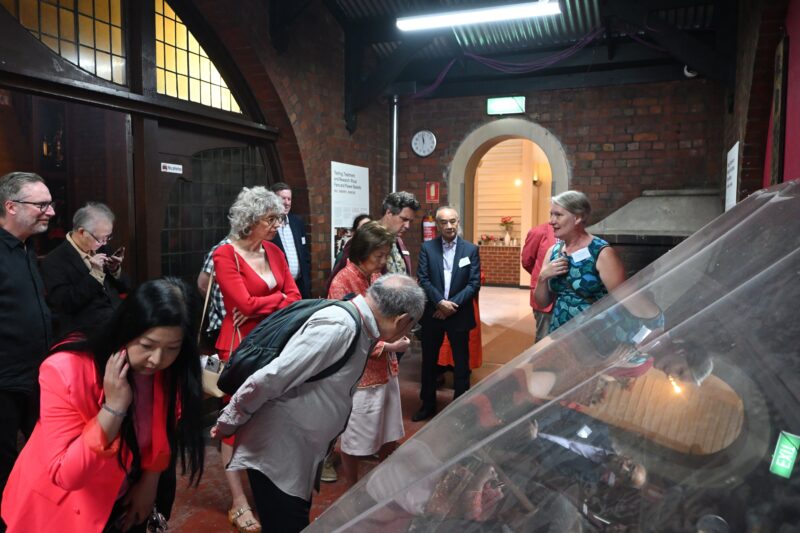
Visitors viewing the Cripps Institute display. Image credit: Danni Lin, 2026.
The conversations I remember most were with the elders of the community. Some had been coming to this temple for ten, twenty, thirty years or more. For them, the 2024 fire and the See Yup Temple’s recovery were not just about heritage but were strongly personal. One man told me he had brought his children here when they were small. This temple was built by the early Chinese immigrants. They came from Guangdong, often alone and with very little. They faced hardship and were not always welcomed. But together they built this place, as an act of faith and of looking out for one another. Here they found a sense of home. The See Yup Temple has been there through all the joys and sorrows that followed – the reunions and the farewells, the celebrations and the losses. All of those lives in its walls and its objects. Throughout the week I had been photographing and filming inside the temple, making a record of the opening days. Some of the elders asked me if they could have copies of the photos and videos, as something to keep. I realised then that this recording is also a way of caring.
The See Yup community that maintains the temple is getting older. People talked about this honestly, but you could feel the worry behind it. Who will keep this place going? Who will remember the rituals, know the names, keep the incense burning? But that same week, I watched children stop in front of the exhibition panels and read. Some asked their parents questions. Some stood quietly and looked at photos of objects damaged in the fire and then restored. Young people stayed longer than I expected. The exhibition seemed to give them a way into the temple’s history and continuing life.
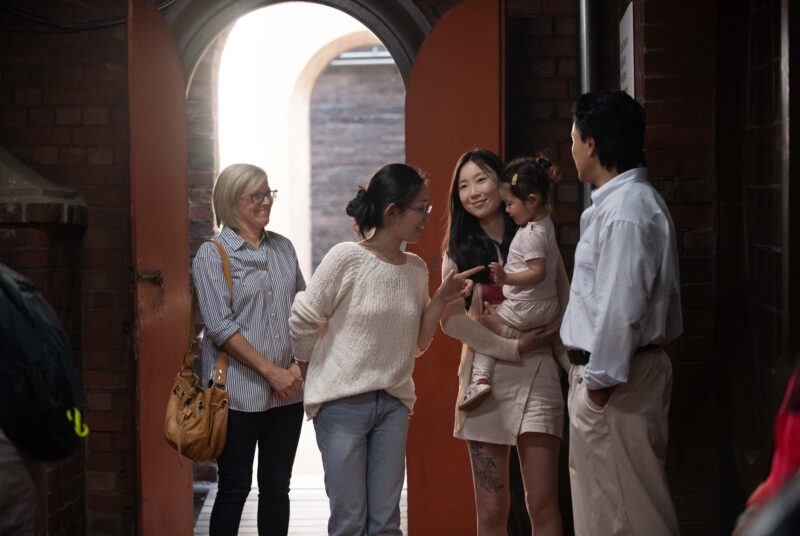
Students from the Robert Cripps Institute for Cultural Conservation. Image credit: Anthony Leong, 2026.
Some of my work on the exhibition involved translating materials for the indoor displays, as well as working through inscriptions, and records of the temple. Many are in classical Chinese and not easy to read. The work is slow. But one afternoon during Chinese New Year, I watched an elderly visitor stop in front of an inscription on the wall and read it quietly to herself. In that moment I remembered why conservation matters. Conservation is not only about keeping objects in good condition, so they can still be interpreted, it is also about keeping the connection alive between people and what those objects mean. For the Australian Chinese community, the See Yup Temple is an entry point to a history that is still alive. Sometimes, language is the key.
I have now started a PhD on post-fire heritage and cultural memory in Chinese diaspora temples, and I am fortunate that my connection to the See Yup Temple continues. The questions raised over Chinese New Year resonated and are open for me to reflect on. The title of the exhibition – Next 170 Years – is in many ways the question I want to keep working on. Not the temple as a museum, but as a living place. Still growing, still welcoming people, still asking what kind of care and support will be needed to help it last. I am grateful to the See Yup Society and See Yup Temple Recovery Project for their trust and openness. I am grateful to Associate Professor Nicole Tse and Dr Sophie Couchman for their guidance. And I am grateful to everyone who stopped to talk with me during Chinese New Year. All reminded me of what conservation is about and how it can support meaning and identity.
Exhibition details
See Yup Temple: Next 170 Years
See Yup Temple, 76 Raglan Street, South Melbourne VIC 3205
Saturdays and Sundays, 9am–4pm
For more information: https://seeyuptemple.org.au
Acknowledgements
I would like to thank the See Yup Society and the See Yup Temple Recovery Project, especially Michael Lam, for their trust and support. I am also grateful for the support of the Melbourne Research Scholarship, which has made my current PhD research possible. Support has been provided by Heritage Victoria, the Victorian State Government, and the Federal Government Department of Multicultural Affairs.